

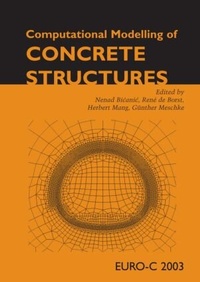
Computational Modelling of Concrete Structures
Proceedings of the EURO-C Conference 2003, St. Johann im Pongau, Austria, 17 - 20 March 2003
1st Edition
Will be published approx. on 1. January 2003
Book
Hardback
932 pages
978-90-5809-536-7 (ISBN)
Description
A collection of 100 conference papers divided into five sections: computational advances and multiscale modelling; constitutive modelling; modelling in multiphysics phenomena and time effects; modelling of structural performance; and modelling of seismic and cyclic response.
More details
Language
English
Place of publication
Rotterdam
Netherlands
Target group
College/higher education
Professional and scholarly
Dimensions
Height: 246 mm
Width: 174 mm
Weight
1970 gr
ISBN-13
978-90-5809-536-7 (9789058095367)
Copyright in bibliographic data and cover images is held by Nielsen Book Services Limited or by the publishers or by their respective licensors: all rights reserved.
Schweitzer Classification
Other editions
Additional editions
N. Bicanic | R. de Borst | H. Mang
Computational Modelling of Concrete Structures
E-Book
03/2026
1st Edition
Taylor & Francis
€48.49
Available for download
N. Bicanic | R. de Borst | H. Mang
Computational Modelling of Concrete Structures
E-Book
03/2026
1st Edition
Taylor & Francis
€48.49
Available for download
Persons
N. Bicanic, University of Glasgow, UK. R. de Borst, Delft University of Technology, The Netherlands. H. Mang, Vienna University of Technology, Austria. G. Meschke, Ruhr-University Bochum, Germany.
Content
Foreword; Computational advances and multiscale modelling; Keynote paper: Discrete vs smeared crack models for concrete fracture: bridging the gap ; Keynote paper: Models and algorithms for localized failure; A new approach to strong embedded discontinuities; A dynamically consistent gradient model derived from a discrete microstructure: higher-order stiffness and higher-order inertia; A micromechanical approach to the strength criterion of composite materials; Computational strategies for time-dependent behaviour of ECC; Multiscale modelling of granular materials; Investigations on crack propagation in reinforced concrete structures; Analysis of concrete fracture using a heterogeneous continuum model; Strong discontinuity modeling of cracking in concrete; A computational approach for three-dimensional probabilistic discrete cracking in concrete; Adaptive simulation of quasibrittle failure; Description of thermo-mechanical behaviour of reinforced concrete; Combined damage-plasticity models for discontinuous fracture; Combined continuous/discontinuous failure of cementitious composites; Ductility assessment of HP2C structures: from material modeling to model-based structural simulation; Modeling of static multi-cracking fracture processes in concrete; Constitutive modelling; Modelling of multiphysics phenomena and time effects; Modelling of structural performance; Modelling of seismic and cyclic behaviour; Author Index.