

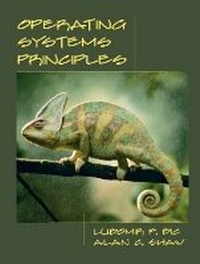
Operating Systems Principles
United States Edition
Published on 10. December 2002
Book
Paperback/Softback
560 pages
978-0-13-026611-8 (ISBN)
Description
For one-semester, junior/senior-level courses in Introduction to Operating Systems and Principles of Operating Systems in the departments of Computer Science and Engineering and Information and Computer Science.
Responding to a major paradigm shift from single-processor to distributed and parallel computer systems, this succinct text is the first of its kind to integrate those fundamental ideas, principles, and concepts in both centralized and distributed computing that remain constant even as new, more advanced systems are introduced. In addition, it presents many examples from commercial and research operating systems as a way to immediately illustrate the relevance of particular concepts.
Responding to a major paradigm shift from single-processor to distributed and parallel computer systems, this succinct text is the first of its kind to integrate those fundamental ideas, principles, and concepts in both centralized and distributed computing that remain constant even as new, more advanced systems are introduced. In addition, it presents many examples from commercial and research operating systems as a way to immediately illustrate the relevance of particular concepts.
More details
Language
English
Place of publication
United States
Publishing group
Pearson Education (US)
Target group
College/higher education
Dimensions
Height: 241 mm
Width: 184 mm
Thickness: 26 mm
Weight
970 gr
ISBN-13
978-0-13-026611-8 (9780130266118)
Copyright in bibliographic data and cover images is held by Nielsen Book Services Limited or by the publishers or by their respective licensors: all rights reserved.
Schweitzer Classification
Other editions
New editions
Lubomir Bic | Alan C. Shaw
Operating Systems Principles
Book
12/2003
Prentice-Hall
€56.94
Article is exhausted; no reprint
Persons
Lubomir F. Bic is Professor of Information and Computer Science at the University of California, Irvine, where he received his Ph.D. His primary research has been in parallel and distributed computing. Dr. Bic has been widely published in areas of professional interest. He served as the General Chair of the 20th International Symposium on Computer Architecture and as one of the editors of the IEEE Transactions on Knowledge and Data Engineering.
Alan C. Shaw is Professor Emeritus of Computer Science and Engineering at the University of Washington. His has a Ph.D. in Computer Science froth Stanford. Dr. Shaw also served on the Computer Science faculty at Cornell University. He has been Visiting Professor at TELECOM Paris and Visiting Professor and Fulbright Research Scholar at the University of Paris. In addition to publishing many research papers and a number of computer science texts, Dr. Shaw has served as an editor of several professional journals, and as a member of the ACM Editorial committee and Fulbright awards committee. He is a fellow of the ACM.
Alan C. Shaw is Professor Emeritus of Computer Science and Engineering at the University of Washington. His has a Ph.D. in Computer Science froth Stanford. Dr. Shaw also served on the Computer Science faculty at Cornell University. He has been Visiting Professor at TELECOM Paris and Visiting Professor and Fulbright Research Scholar at the University of Paris. In addition to publishing many research papers and a number of computer science texts, Dr. Shaw has served as an editor of several professional journals, and as a member of the ACM Editorial committee and Fulbright awards committee. He is a fellow of the ACM.
Content
1. Introduction.
I. PROCESS MANAGEMENT AND COORDINATION.
2. Basic Concepts: Processes and Interactions.
3. Higher-Level Synchronization Schemes.
4. The Operating System Kernel: Implementing Processes and Threads.
5. Process and Thread Scheduling.
6. Deadlocks.
II. MEMORY MANAGEMENT.
7. Physical Memory.
8. Virtual Memory.
9. Sharing of Data and Code in Main Memory.
III. FILE SYSTEMS AND INPUT/OUTPUT.
10. File Systems.
11. Input/Output Systems.
IV. PROTECTION AND SECURITY.
12. The Protection and Security Interface.
13. Internal Protection Mechanisms.
Programming Projects.
I. PROCESS MANAGEMENT AND COORDINATION.
2. Basic Concepts: Processes and Interactions.
3. Higher-Level Synchronization Schemes.
4. The Operating System Kernel: Implementing Processes and Threads.
5. Process and Thread Scheduling.
6. Deadlocks.
II. MEMORY MANAGEMENT.
7. Physical Memory.
8. Virtual Memory.
9. Sharing of Data and Code in Main Memory.
III. FILE SYSTEMS AND INPUT/OUTPUT.
10. File Systems.
11. Input/Output Systems.
IV. PROTECTION AND SECURITY.
12. The Protection and Security Interface.
13. Internal Protection Mechanisms.
Programming Projects.