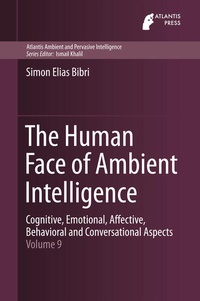
As a socially disruptive technology, Ambient Intelligence is ultimately directed towards humans and targeted at the mundane life made of an infinite richness of circumstances that cannot fully be considered and easily be anticipated. Most books, however, focus their analysis on, or deal largely with, the advancement of the technology and its potential only. This book offers a fresh, up-to-date, and holistic approach to Ambient Intelligence. As such, it addresses the interdisciplinary and
transdisciplinary aspects of the rapidly evolving field of Ambient Intelligence by seamlessly integrating and fusing it with artificial intelligence, cognitive science and psychology, social sciences, and
humanities. It is divided into two main parts: Part 1 is about different permutations of enabling technologies as well as core computational capabilities, namely context awareness, implicit and natural interaction, and intelligent behavior. It details the existing and upcoming prerequisite technologies, and elucidates the application and convergence of major current and future computing trends. Part 2 is an accessible review and synthesis of the latest research in the human-directed sciences and computing and how these are intricately interrelated in the realm of Ambient
Intelligence. It deals with the state-of-the-art human-inspired applications which show human-like understanding and exhibit intelligent behavior in relation to a variety of aspects of human functioning - states and processes. It describes and elaborates on the rich potential of Ambient Intelligence from a variety of interrelated perspectives and the plethora of challenges and bottlenecks involved in making Ambient Intelligence a reality, and also discusses the established knowledge and recent discoveries
in the human-directed sciences and their application and convergence in the ambit of Ambient Intelligence computing. This seminal reference work isthe most comprehensive of its kind, and will prove invaluable to students, researchers, and professionals across both computing and the human-directed sciences.
Series
Edition
Language
Place of publication
Target group
Professional and scholarly
Research
Illustrations
22 s/w Abbildungen, 9 farbige Abbildungen
XXXII, 523 p. 31 illus., 9 illus. in color.
Dimensions
Height: 241 mm
Width: 160 mm
Thickness: 36 mm
Weight
ISBN-13
978-94-6239-129-1 (9789462391291)
DOI
10.2991/978-94-6239-130-7
Schweitzer Classification
Simon E. Bibri is a PhD Candidate at the Norwegian University of Science and Technology (NTNU), Trondheim, Norway. He has a true passion for academic and lifelong learning and a natural thirst for knowledge. Having above all been intrigued by the relationship between scientific knowledge, technological systems, and society, he has wittingly and voluntarily chosen to pursue an unusual academic journey by embarking on studying a diverse range of subject areas - at the interaction of Science, Technology, and Society. His intellectual pursuits and endeavors have resulted, hitherto, in an educational background encompassing knowledge from, and meta-knowledge about, different academic disciplines. He holds a Bachelor of Science in computer engineering with a major in ICT strategy, a research-based Master of Science in computer science with a focus on Ambient Intelligence and ICT for sustainability, a Master of Science in computer science with a major in informatics, a Master of Sciencein entrepreneurship and innovation with a focus on new venture creation, a Master of Science in strategic leadership towards sustainability, a Master of Science in sustainable urban planning and development, a Master of Social Science with a major in business administration (MBA), a Master of Arts in communication and media for social change and a postgraduate degree in management and economics. In addition, he has a number of certificates, including innovation science, economics of innovation, teaching for sustainability, corporate entrepreneurship, project management, and policy in the European Union. He has received his Master's degrees and certificates from different universities in Sweden, namely Lund University, West University, Blekinge Institute of Technology, Malmö University, and Halmstad University.
Before starting his Master studies' endeavor, Bibri worked as an ICT strategist. In 2004, he founded a small business and consulting firm where heserved as a sustainability and green ICT strategist and consultant. Over the last few years, he has been involved in a number of research and consulting projects pertaining to the IoT, green ICT strategy, strategic sustainability innovations, circular business model innovation, clean and energy efficiency technology, sustainable urban planning, and sustainable urban models (eco-city, smart city, and compact city). Since his graduation in June 2014, he has been working as a freelance consultant in his areas of expertise and a research associate, giving lectures on specialized topics, and writing his second book.
Bibri has a genuine interest in interdisciplinary and transdisciplinary research. In light of his varied academic background, his research interests include AmI, the IoT, social shaping of science-based technology, philosophy and sociology of scientific knowledge, sustainability transitions and innovations, urban sustainability, eco-city and smartcity, governance of sociotechnical changes in technological innovation systems, green and knowledge-intensive innovation, clean and energy efficiency technology, green and circular economy, and S&T and innovation policy.
Introduction.- Ambient Intelligence: A New Computing Paradigm and a Vision of a Next Wave in ICT.- Context and Context Awareness of Humans and AmI Systems: Characteristics and Differences and Technological Challenges and Limitations.- Context Recognition in AmI Environments: Sensor and MMES Technology, Recognition Approaches, and Pattern Recognition Methods.- Context Modelling, Representation, and Reasoning: An Ontological and Hybrid Approach.- Implicit and Natural HCI in AmI: Ambient and Multimodal User Interfaces, Intelligent Agents, Intelligent Behavior, and Mental and Physical Invisibility.- Towards AmI Systems Capable of Engaging in 'Intelligent Dialogue' and 'Mingling Socially with Humans'.- Affective Behavioral Features of AmI: Affective Context Aware, Emotion-Aware, Context-Aware Affective, and Emotionally Intelligent Systems.- The Cognitively Supporting Behavior of AmI Systems: Context Awareness, Explicit Natural (Touchless) Interaction, Affective Factors and Aesthetics, and Presence.- Concluding Remarks, Practical and Research Implications, and Reflections.