

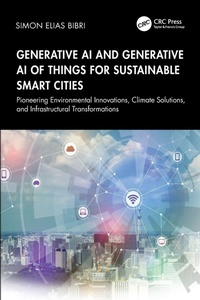
Generative AI and Generative AI of Things for Sustainable Smart Cities
Pioneering Environmental Innovations, Climate Solutions, and Infrastructural Transformations
1st Edition
Published on 8. December 2025
Book
Paperback/Softback
564 pages
978-1-041-13982-9 (ISBN)
Description
This pioneering book invites readers on a compelling journey into Generative Artificial Intelligence (GAI) and its groundbreaking convergence with AI of Things (AIoT), introducing GAIoT as a transformative frontier in urban computing and intelligence. GAIoT signals a paradigm shift towards more intelligent, self-learning, self-evolving, and context-aware systems-capable of generating adaptive, forward-looking solutions to the complex infrastructural and environmental challenges confronting sustainable smart cities.
With its combination of theoretical depth, applied innovation, and interdisciplinary scope, the book offers a comprehensive examination of deep generative models-namely Generative Adversarial Networks, Variational Autoencoders, Diffusion Models, Transformers, and hybrid architectures-and their applications in environmental sustainability, climate resilience, infrastructure optimization, dynamic decision-making, and data-driven urban management and planning. From synthetic data generation, data augmentation, and data imputation to predictive modeling and scenario simulation, GAIoT is driving the next wave of climate-responsive, environmentally conscious smart city innovation.
What sets this book apart is its first-of-its-kind focus on GAIoT as a pathbreaking force in shaping the future of sustainable urban development. It delivers actionable insights, conceptual and operational frameworks, case studies, and policy guidance-equipping diverse stakeholders with the tools to build cities that not only respond to change but also anticipate and shape it. Targeting a broad and cross-disciplinary audience, the book shares state-of-the-art research, presents innovative solutions, and forecasts future trends in urban transformation. As both a seminal reference and a practical resource for researchers, technologists, practitioners, professionals, and policymakers, it provides essential guidance for those engaged in advancing the next frontier in urban computing and intelligence.
With its combination of theoretical depth, applied innovation, and interdisciplinary scope, the book offers a comprehensive examination of deep generative models-namely Generative Adversarial Networks, Variational Autoencoders, Diffusion Models, Transformers, and hybrid architectures-and their applications in environmental sustainability, climate resilience, infrastructure optimization, dynamic decision-making, and data-driven urban management and planning. From synthetic data generation, data augmentation, and data imputation to predictive modeling and scenario simulation, GAIoT is driving the next wave of climate-responsive, environmentally conscious smart city innovation.
What sets this book apart is its first-of-its-kind focus on GAIoT as a pathbreaking force in shaping the future of sustainable urban development. It delivers actionable insights, conceptual and operational frameworks, case studies, and policy guidance-equipping diverse stakeholders with the tools to build cities that not only respond to change but also anticipate and shape it. Targeting a broad and cross-disciplinary audience, the book shares state-of-the-art research, presents innovative solutions, and forecasts future trends in urban transformation. As both a seminal reference and a practical resource for researchers, technologists, practitioners, professionals, and policymakers, it provides essential guidance for those engaged in advancing the next frontier in urban computing and intelligence.
More details
Language
English
Place of publication
London
United Kingdom
Publishing group
Taylor & Francis Ltd
Target group
College/higher education
Professional and scholarly
Postgraduate, Professional Practice & Development, and Professional Reference
Illustrations
24 s/w Tabellen, 29 s/w Abbildungen, 29 s/w Zeichnungen
24 Tables, black and white; 29 Line drawings, black and white; 29 Illustrations, black and white
Dimensions
Height: 234 mm
Width: 156 mm
Thickness: 31 mm
Weight
869 gr
ISBN-13
978-1-041-13982-9 (9781041139829)
Copyright in bibliographic data and cover images is held by Nielsen Book Services Limited or by the publishers or by their respective licensors: all rights reserved.
Schweitzer Classification
Other editions
Additional editions
Simon Elias Bibri
Generative AI and Generative AI of Things for Sustainable Smart Cities
Pioneering Environmental Innovations, Climate Solutions, and Infrastructural Transformations
E-Book
12/2025
CRC Press
€82.99
Available for download
Simon Elias Bibri
Generative AI and Generative AI of Things for Sustainable Smart Cities
Pioneering Environmental Innovations, Climate Solutions, and Infrastructural Transformations
E-Book
12/2025
CRC Press
€82.99
Available for download
Simon Elias Bibri
Generative AI and Generative AI of Things for Sustainable Smart Cities
Pioneering Environmental Innovations, Climate Solutions, and Infrastructural Transformations
Book
12/2025
1st Edition
CRC Press
€276.30
Shipment within 15-20 days
Person
Simon Elias Bibri is a Senior Researcher, Project Coordinator, Editor-in-Chief, International Expert, and prolific scholar--with 8 authored books, 3 edited, and 11co-edited works, and an h-index of 53. Recognized by Stanford University and Elsevier, he has been ranked among the top 1% of scientists worldwide for five consecutive years.
Content
Introduction: The Next Frontier in Urban Computing and Intelligence: Redefining Sustainable Smart Cities through Generative AI and Generative AI of Things
1. The Rise of Generative AI and Generative AI of Things for Sustainable Smart City Development: Innovations, Opportunities, Data Solutions, Applications, and Prospects
2. Deep Generative Models for Cognitive Augmentation of AI of Things in Sustainable Smart Cities: A Comparative Analysis of GANs, VAEs, Diffusion Models, Transformers, and Hybrid Models
3. Generative AI of Things for Sustainable Smart Cities: Recent Advancements in Environmental Efficiency, Infrastructural Optimization, and Climate Resilience
4. Generative AI at the Intersection of Smart Cities, Environmental Sustainability, and Climate Change: Conceptual, Analytical, Methodological, Technical, and Practical Foundations
5. Harnessing the Transformative Potential of Generative AI for Advancing Sustainable Smart City Development Goals: Leading-Edge Solutions for Environmental and Climate Challenges
6. Generative AI of Things-Powered Sustainable Smart City Brain and Digital Twin Systems: Synergizing Real-Time Operational Management and Strategic Predictive Planning
7. A Pioneering Generative AI of Things Framework for Sustainable Smart City Brain and Digital Twin Integration: Tackling Data Challenges to Advance Environmental Management and Planning
1. The Rise of Generative AI and Generative AI of Things for Sustainable Smart City Development: Innovations, Opportunities, Data Solutions, Applications, and Prospects
2. Deep Generative Models for Cognitive Augmentation of AI of Things in Sustainable Smart Cities: A Comparative Analysis of GANs, VAEs, Diffusion Models, Transformers, and Hybrid Models
3. Generative AI of Things for Sustainable Smart Cities: Recent Advancements in Environmental Efficiency, Infrastructural Optimization, and Climate Resilience
4. Generative AI at the Intersection of Smart Cities, Environmental Sustainability, and Climate Change: Conceptual, Analytical, Methodological, Technical, and Practical Foundations
5. Harnessing the Transformative Potential of Generative AI for Advancing Sustainable Smart City Development Goals: Leading-Edge Solutions for Environmental and Climate Challenges
6. Generative AI of Things-Powered Sustainable Smart City Brain and Digital Twin Systems: Synergizing Real-Time Operational Management and Strategic Predictive Planning
7. A Pioneering Generative AI of Things Framework for Sustainable Smart City Brain and Digital Twin Integration: Tackling Data Challenges to Advance Environmental Management and Planning