

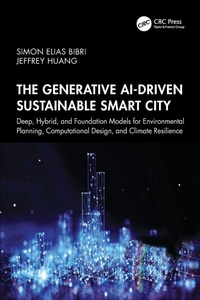
The Generative AI-Driven Sustainable Smart City
Deep, Hybrid, and Foundation Models for Environmental Planning, Computational Design, and Climate Resilience
1st Edition
Published on 27. April 2026
Book
Paperback/Softback
506 pages
978-1-041-08723-6 (ISBN)
Description
The rapid rise of generative artificial intelligence (GenAI) is reshaping urban computing and intelligence, marking the next frontier of sustainable smart cities. This book explores the transformative potential of deep generative models (DGMs), hybrid architectures, and foundation models (FMs) in redefining the urban landscape. These technologies enhance environmental sustainability, climate resilience, infrastructure performance, operational efficiency, spatial organization, and livability through innovative approaches to urban planning, design, and management-often via digital twins and other emerging technologies.
DGMs enable synthetic data generation, data augmentation, data imputation, scenario simulation, and predictive modeling, offering deeper insights into complex urban and environmental systems. Hybrid architectures integrate generative and conventional models to improve robustness, scalability, adaptability, and flexibility across diverse urban operational and planning tasks. FMs extend these capabilities by enabling multi-modal knowledge generalization, cross-domain integration, large-scale simulation, advanced reasoning, and adaptive decision-making under uncertainty. Strengthened by integrative frameworks and cross-disciplinary insights, these technologies offer powerful tools for developing sophisticated urban and environmental solutions. They advance how urban ecosystems are environmentally and strategically planned, efficiently and dynamically managed, aesthetically and functionally designed, and spatially and contextually organized.
Rich in conceptual frameworks, theoretical insights, operational models, applied innovations, practical case studies, and policy guidance, this book equips researchers, planners, designers, technologists, and policymakers to harness generative intelligence in shaping adaptive, context-aware, and continuously refined urban environments that are ecologically responsible, climate-resilient, and future-ready. Essential for anyone exploring the frontier of GenAI-driven sustainable urban development, it offers actionable insights to guide the next generation of sustainable smart cities.
DGMs enable synthetic data generation, data augmentation, data imputation, scenario simulation, and predictive modeling, offering deeper insights into complex urban and environmental systems. Hybrid architectures integrate generative and conventional models to improve robustness, scalability, adaptability, and flexibility across diverse urban operational and planning tasks. FMs extend these capabilities by enabling multi-modal knowledge generalization, cross-domain integration, large-scale simulation, advanced reasoning, and adaptive decision-making under uncertainty. Strengthened by integrative frameworks and cross-disciplinary insights, these technologies offer powerful tools for developing sophisticated urban and environmental solutions. They advance how urban ecosystems are environmentally and strategically planned, efficiently and dynamically managed, aesthetically and functionally designed, and spatially and contextually organized.
Rich in conceptual frameworks, theoretical insights, operational models, applied innovations, practical case studies, and policy guidance, this book equips researchers, planners, designers, technologists, and policymakers to harness generative intelligence in shaping adaptive, context-aware, and continuously refined urban environments that are ecologically responsible, climate-resilient, and future-ready. Essential for anyone exploring the frontier of GenAI-driven sustainable urban development, it offers actionable insights to guide the next generation of sustainable smart cities.
More details
Language
English
Place of publication
London
United Kingdom
Publishing group
Taylor & Francis Ltd
Target group
Professional and scholarly
College/higher education
Professional Practice & Development, Professional Reference, and Undergraduate Advanced
Product notice
Paperback (trade)
Unsewn / adhesive bound
Illustrations
31 s/w Abbildungen, 31 s/w Zeichnungen, 38 s/w Tabellen
38 Tables, black and white; 31 Line drawings, black and white; 31 Illustrations, black and white
Dimensions
Height: 234 mm
Width: 156 mm
Thickness: 27 mm
Weight
730 gr
ISBN-13
978-1-041-08723-6 (9781041087236)
Copyright in bibliographic data and cover images is held by Nielsen Book Services Limited or by the publishers or by their respective licensors: all rights reserved.
Schweitzer Classification
Other editions
Additional editions
Simon Elias Bibri | Jeffrey Huang
The Generative AI-Driven Sustainable Smart City
Deep, Hybrid, and Foundation Models for Environmental Planning, Computational Design, and Climate Resilience
E-Book
04/2026
1st Edition
CRC Press
€93.49
Available for download
Simon Elias Bibri | Jeffrey Huang
The Generative AI-Driven Sustainable Smart City
Deep, Hybrid, and Foundation Models for Environmental Planning, Computational Design, and Climate Resilience
E-Book
04/2026
1st Edition
CRC Press
€93.49
Available for download
Simon Elias Bibri | Jeffrey Huang
The Generative AI-Driven Sustainable Smart City
Deep, Hybrid, and Foundation Models for Environmental Planning, Computational Design, and Climate Resilience
Book
04/2026
1st Edition
CRC Press
€255.50
Shipment within 15-20 days
Persons
Simon Elias Bibri, PhD, is a globally recognized scholar and expert in sustainable smart cities and smarter eco-cities, focusing on the integration and application of advanced technologies, particularly urban digital twins (UDTs), artificial intelligence (AI), artificial intelligence of things (AIoT), and generative artificial intelligence (GenAI), to foster innovative solutions in urban transformation and environmental sustainability. Currently, he serves as a Senior Researcher and Scientific Coordinator at the Swiss Federal Institute of Technology Lausanne (EPFL), Institute of Computer and Communication Sciences (IINFCOM), School of Architecture, Civil and Environmental Engineering (ENAC), Media and Design Laboratory (LDM). He has a diverse professional background, having served as head of the computer department, software and IT business engineer, IT project manager, green ICT and environmental sustainability strategist, research associate, assistant professor, and international expert. He was also a visiting scholar at Lund University and a visiting senior researcher at Royal Institute of Technology (KTH) in Sweden. He served as an international expert in Artificial Intelligence and Applied Machine Learning for Climate Action for UNFCCC and an international expert in Sustainable Cities for UNIDO. He currently serves as an expert for Focus Group for Smart Sustainable Cities, Environmental Sustainability, and Digital Twins for ITU. He also holds the position of the Editor-in-Chief of the International Journal of Environmental Studies at Taylor & Francis Group and the Associate Editor of the Journal of Sustainable Cities and Society.
Dr. Bibri's academic journey exemplifies both interdisciplinarity and transdisciplinarity. His intellectual background encompasses computer science, computer engineering, systems science, innovation science, environmental science, social sciences, and humanities. He holds a bachelor's degree in computer engineering and a postgraduate degree in management science. Notably, he earned multiple master's degrees from esteemed Swedish universities, namely Lund University, West University, Blekinge Institute of Technology, Stockholm University, Malmoe University, and Mid-Sweden University. He received his PhD in computer science and information technology from the Norwegian University of Science and Technology (NTNU), specializing in computational technology and urban informatics, with a focus on data-driven smart sustainable cities. Dr. Bibri is a prolific scholar with numerous highly cited journal articles, 9 authored books, 3 edited works, and 13 co-edited volumes to his credit. His work has been cited over 15,250 times, resulting in an h-index of 55. His impact has been recognized by Stanford University and Elsevier as among the top 1% of scientists worldwide, a distinction he has held for six consecutive years. He has also been listed by ScholarGPS as the #1 highly ranked scholar in sustainable cities, #2 in urbanism, and #8 in environmental sustainability in the world.
Dr. Bibri's research interests and expertise cover a broad spectrum of areas, including sustainable cities, smarter eco-cities, sustainable smart cities, urban artificial intelligence, urban artificial intelligence of things, urban generative artificial intelligence, urban generative artificial intelligence of things, urban digital twin, smart urban metabolism, urban circularity, cyber-physical systems of systems, urban planning and design, environmental governance, environmental sustainability, climate change mitigation and adaptation, smart sustainable energy, smart sustainable transportation, smart sustainable waste management, sustainability transitions, and technological innovation systems.
Jeffrey Huang, PhD, is the Director of the Institute of Architecture and the City at the Swiss Federal Institute of Technology Lausanne (EPFL), Switzerland. He is also the Head of the Media and Design Laboratory (LDM) and a Full Professor in Architecture and Computer Science at EPFL. He holds a DiplArch from ETH Zurich, and master's and doctoral degrees from Harvard University, where he was awarded the Gerald McCue Medal for academic excellence. Prior to EPFL, he was a Researcher at MIT's Sloan School of Management, and an Associate Professor at Harvard University's Graduate School of Design. He was also a Visiting Professor at Tsinghua University, a Visiting Fellow at Stanford University's d.school, an Honorary Visiting Professor at the University of Sheffield, and a Berkman Fellow and Faculty Associate at Harvard. In collaboration with Muriel Waldvogel, he founded and co-heads Convergeo, an award-winning, international strategic design firm.
Dr. Bibri's academic journey exemplifies both interdisciplinarity and transdisciplinarity. His intellectual background encompasses computer science, computer engineering, systems science, innovation science, environmental science, social sciences, and humanities. He holds a bachelor's degree in computer engineering and a postgraduate degree in management science. Notably, he earned multiple master's degrees from esteemed Swedish universities, namely Lund University, West University, Blekinge Institute of Technology, Stockholm University, Malmoe University, and Mid-Sweden University. He received his PhD in computer science and information technology from the Norwegian University of Science and Technology (NTNU), specializing in computational technology and urban informatics, with a focus on data-driven smart sustainable cities. Dr. Bibri is a prolific scholar with numerous highly cited journal articles, 9 authored books, 3 edited works, and 13 co-edited volumes to his credit. His work has been cited over 15,250 times, resulting in an h-index of 55. His impact has been recognized by Stanford University and Elsevier as among the top 1% of scientists worldwide, a distinction he has held for six consecutive years. He has also been listed by ScholarGPS as the #1 highly ranked scholar in sustainable cities, #2 in urbanism, and #8 in environmental sustainability in the world.
Dr. Bibri's research interests and expertise cover a broad spectrum of areas, including sustainable cities, smarter eco-cities, sustainable smart cities, urban artificial intelligence, urban artificial intelligence of things, urban generative artificial intelligence, urban generative artificial intelligence of things, urban digital twin, smart urban metabolism, urban circularity, cyber-physical systems of systems, urban planning and design, environmental governance, environmental sustainability, climate change mitigation and adaptation, smart sustainable energy, smart sustainable transportation, smart sustainable waste management, sustainability transitions, and technological innovation systems.
Jeffrey Huang, PhD, is the Director of the Institute of Architecture and the City at the Swiss Federal Institute of Technology Lausanne (EPFL), Switzerland. He is also the Head of the Media and Design Laboratory (LDM) and a Full Professor in Architecture and Computer Science at EPFL. He holds a DiplArch from ETH Zurich, and master's and doctoral degrees from Harvard University, where he was awarded the Gerald McCue Medal for academic excellence. Prior to EPFL, he was a Researcher at MIT's Sloan School of Management, and an Associate Professor at Harvard University's Graduate School of Design. He was also a Visiting Professor at Tsinghua University, a Visiting Fellow at Stanford University's d.school, an Honorary Visiting Professor at the University of Sheffield, and a Berkman Fellow and Faculty Associate at Harvard. In collaboration with Muriel Waldvogel, he founded and co-heads Convergeo, an award-winning, international strategic design firm.
Content
1. The Rise of Deep Generative, Hybrid, and Foundation Models for Sustainable Smart City Intelligence: Theoretical Frameworks, Transformative Innovations, and Advanced Applications. 2. Empowering Sustainable Smart City Digital Twins with Deep Generative and Foundation Models: A Pioneering Framework for Environmental Planning and Computational Design. 3. Deep Generative and Hybrid Models for Advancing Environmental Sustainability in Smart Cities: Emerging Solutions for Climate Change Mitigation and Adaptation Challenges. 4. Deep Generative and Hybrid Models for Sustainable Smart Cities: Infrastructure Management, Strategic Planning, and Climate Resilience. 5. Deep Generative and Foundation Models for Sustainable Smart City Digital Twins: Operational, Infrastructural, and Practical Advancements for Environmental Planning. 6. Augmenting Computational Urban and Architectural Design with Deep Generative, Hybrid, and Multimodal Models: Innovative Applications and a Cross-Scalar Disciplinary Framework for Sustainable Smart Cities. 7. The Next Frontier in Sustainable Smart City Development: Urban, Flow, Environmental, Climate, and Geospatial Foundation Models for Multimodal Intelligence and Systemic Innovation.