

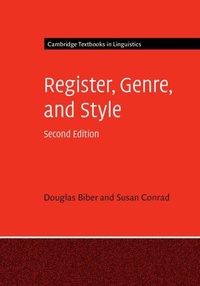
Register, Genre, and Style
2nd Edition
Published on 18. April 2019
Book
Hardback
420 pages
978-1-108-42652-7 (ISBN)
Description
A fully updated and expanded second edition of this flagship work, which introduces methodological techniques to carry out analyses of text varieties, and provides descriptions of the most important text varieties in English. Part I introduces an analytical framework for studying registers, genre conventions, and styles, while Part II provides more detailed corpus-based descriptions of text varieties in English, including spoken interpersonal varieties, general and professional written varieties and emerging electronic varieties. Part III introduces more advanced analytical approaches and deals with larger theoretical concerns, such as the relationship between register studies and other sub-disciplines of linguistics, and practical applications of register analysis. A new chapter on EAP and ESP has been added, with new sections on the important differences between academic writing in the humanities and sciences, and a case study on engineering reports as an ESP register and genre. Coverage of new electronic registers has been updated, and a new analysis of hybrid registers has been added.
Reviews / Votes
'This book is an excellent discourse analysis resource for both students and professionals from all research orientations. It includes very detailed frameworks for situational, linguistic, and functional analyses of variation.' Viviana Cortes, Georgia State UniversityMore details
Series
Edition
2nd Revised edition
Language
English
Place of publication
Cambridge
United Kingdom
Target group
Professional and scholarly
College/higher education
Edition type
Revised edition
Illustrations
Worked examples or Exercises; 29 Tables, black and white; 49 Line drawings, black and white
Dimensions
Height: 250 mm
Width: 175 mm
Thickness: 27 mm
Weight
907 gr
ISBN-13
978-1-108-42652-7 (9781108426527)
Copyright in bibliographic data and cover images is held by Nielsen Book Services Limited or by the publishers or by their respective licensors: all rights reserved.
Schweitzer Classification
Other editions
Additional editions
Douglas Biber
Register, Genre, and Style
E-Book
05/2019
Cambridge University Press
€26.99
Available for download
Douglas Biber | Susan Conrad
Register, Genre, and Style
E-Book
05/2019
2nd Edition
Cambridge University Press
€28.99
Available for download
Previous edition
Douglas Biber | Susan Conrad
Register, Genre, and Style
Book
10/2009
Cambridge University Press
€108.94
Article exhausted; check for reprint
Persons
Douglas Biber is Regents' Professor of English (Applied Linguistics) at Northern Arizona University. His research efforts have focused on corpus linguistics, English grammar, and register variation. He has published over 220 research articles and 24 books including Variation across Speech and Writing (Cambridge, 1988), Longman Grammar of Spoken and Written English (1999), and The Cambridge Handbook of English Corpus Linguistics (Cambridge, 2015). Susan Conrad is Professor of Applied Linguistics at Portland State University. Her research investigates how people vary their grammar, vocabulary, and organization to fulfil different purposes. Her work has appeared in diverse journals, from the Journal of Engineering Education to Register Studies. Her previous books include Real Grammar: A Corpus-Based Approach to English (2009) and Longman Grammar of Spoken and Written English (1999) among others.
Content
1. Registers, genres, and styles: fundamental varieties of language; Part I. Analytical Framework: 2. Describing the situational characteristics of registers and genres; 3. Analysing linguistic features and their functions; Part II. Detailed Descriptions of Registers, Genres, and Styles: 4. Interpersonal spoken registers; 5. Written registers, genres, and styles; 6. Academic and professional written registers; 7. Registers and genres in interpersonal electronic communication; 8. Historical evolution of registers, genres, and styles; Part III. Larger Theoretical Issues: 9. Multidimensional patterns of register variation; 10. Register studies in context.