

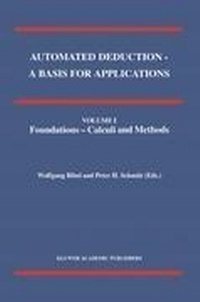
Automated Deduction - A Basis for Applications Volume I Foundations - Calculi and Methods Volume II Systems and Implementation Techniques Volume III Applications
Published on 9. December 2010
Book
Paperback/Softback
XX, 481 pages
978-90-481-5050-2 (ISBN)
Description
The nationwide research project `Deduktion', funded by the `Deutsche Forschungsgemeinschaft (DFG)' for a period of six years, brought together almost all research groups within Germany engaged in the field of automated reasoning. Intensive cooperation and exchange of ideas led to considerable progress both in the theoretical foundations and in the application of deductive knowledge. This three-volume book covers these original contributions moulded into the state of the art of automated deduction.
The three volumes are intended to document and advance a development in the field of automated deduction that can now be observed all over the world. Rather than restricting the interest to purely academic research, the focus now is on the investigation of problems derived from realistic applications. In fact industrial applications are already pursued on a trial basis. In consequence the emphasis of the volumes is not on the presentation of the theoretical foundations of logical deduction as such, as in a handbook; rather the books present the concepts and methods now available in automated deduction in a form which can be easily accessed by scientists working in applications outside of the field of deduction. This reflects the strong conviction that automated deduction is on the verge of being fully included in the evolution of technology.
Volume I focuses on basic research in deduction and on the knowledge on which modern deductive systems are based. Volume II presents techniques of implementation and details about system building. Volume III deals with applications of deductive techniques mainly, but not exclusively, to mathematics and the verification of software.
Each chapter was read by two referees, one an international expert from abroad and the other a knowledgeable participant in the national project. It has been accepted for inclusion on the basis of these review reports.
Audience: Researchers and developers in software engineering, formal methods, certification, verification, validation, specification of complex systems and software, expert systems, natural language processing.
The three volumes are intended to document and advance a development in the field of automated deduction that can now be observed all over the world. Rather than restricting the interest to purely academic research, the focus now is on the investigation of problems derived from realistic applications. In fact industrial applications are already pursued on a trial basis. In consequence the emphasis of the volumes is not on the presentation of the theoretical foundations of logical deduction as such, as in a handbook; rather the books present the concepts and methods now available in automated deduction in a form which can be easily accessed by scientists working in applications outside of the field of deduction. This reflects the strong conviction that automated deduction is on the verge of being fully included in the evolution of technology.
Volume I focuses on basic research in deduction and on the knowledge on which modern deductive systems are based. Volume II presents techniques of implementation and details about system building. Volume III deals with applications of deductive techniques mainly, but not exclusively, to mathematics and the verification of software.
Each chapter was read by two referees, one an international expert from abroad and the other a knowledgeable participant in the national project. It has been accepted for inclusion on the basis of these review reports.
Audience: Researchers and developers in software engineering, formal methods, certification, verification, validation, specification of complex systems and software, expert systems, natural language processing.
More details
Series
Edition
1st ed. Softcover of orig. ed. 1998
Language
English
Place of publication
Dordrecht
Netherlands
Target group
Professional and scholarly
Research
Product notice
Paperback (trade)
Unsewn / adhesive bound
Illustrations
XX, 481 p.
Dimensions
Height: 235 mm
Width: 155 mm
Thickness: 28 mm
Weight
756 gr
ISBN-13
978-90-481-5050-2 (9789048150502)
Schweitzer Classification
Other editions
Additional editions
Wolfgang Bibel | P.H. Schmitt
Automated Deduction - A Basis for Applications Volume I Foundations - Calculi and Methods Volume II Systems and Implementation Techniques Volume III Applications
Book
06/1998
Kluwer Academic Publishers
€213.99
Shipment within 15-20 days
Content
Volume I: Foundations. Calculi and Methods. Preface; W. Bibel, P.H. Schmitt. Part One: Tableau and Connection Calculi. Introduction; U. Furbach. 1. Analytic Tableaux; B. Beckert, R. Hahnle. 2. Clausal Tableaux; R. Letz. 3. Variants of Clausal Tableaux; P. Baumgartner, U. Furbach. 4. Cuts in Tableaux; U. Egly. 5. Compressions and Extensions; W. Bibel, et al. Part Two: Special Calculi and Refinements. Introduction; U. Petermann. 6. Theory Reasoning; P. Baumgartner, U. Petermann. 7. Unification Theory; F. Baader, K.U. Schulz. 8. Rigid E-Unification; B. Beckert. 9. Sorted Unification and Tree Automata; C. Weidenbach. 10. Dimensions of Types in Logic Programming; G. Meyer, C. Beierle. 11. Equational Reasoning in Saturation-Based Theorem Proving; L. Bachmair, H. Ganzinger. 12. Higher-Order Rewriting and Equational Reasoning; T. Nipkow, C. Prehofer. 13. Higher-Order Automated Theorem Proving; M. Kohlhase. Index. Volume II: Systems and Implementation Techniques. Introduction; T. Nipkow, W. Reif. 1. Structured Specifications and Interactive Proofs with KIV; W. Reif, et al. 2. Proof Theory at Work: Program Development in the Minlog System; H. Benl, et al. 3. Interactive and Automated Proof Construction in Type Theory; M. Strecker, et al. 4. Integrating Automated and Interactive Theorem Proving; W. Ahrendt, et al. Part Two: Representation and Optimization Techniques. Introduction; J. Siekmann, D. Fehrer. 5. Term Indexing; P. Graf, D. Fehrer. 6. Developing Deduction Systems: The Toolbox Style; D. Fehrer. 7. Specifications of Inference Rules: Extensions of the PTTP Technique; G. Neugebauer, U. Petermann. 8. Proof Analysis, Generalization and Reuse; T. Kolbe, C. Walther. Part Three: Parallel Inference Systems. Introduction; W. Kuchlin. 9. Parallel Term Rewriting with PaReDuX; R. Bundgen, et al. 10. Parallel Theorem Provers Based on SETHEO; J. Schumann, et al. 11. Massively Parallel Reasoning; S.-E. Bornscheuer, et al. Part Four: Comparison and Cooperation of Theorem Provers. Introduction; J. Avenhaus. 12. Extension Methods in Automated Deduction; M. Baaz, et al. 13. A Comparison of Equality Reasoning Heuristics; J. Denzinger, M. Fuchs. 14. Cooperating Theorem Provers; J. Denzinger, I. Dahn. Index. Volume III: Applications. Part One: Automated Theorem Proving in Mathematics. Introduction; M. Kohlhase. 1. Lattice-Ordered Groups in Deduction; I. Dahn. 2. Superposition Theorem Proving for Commutative Rings; J. Stuber. 3. How to Augment a Formal System with a Boolean Algebra Component; H.J. Ohlbach, J. Kuhler. 4. Proof Planning: A practical Approach to Mechanized Reasoning in Mathematics; M. Kerber. Part Two: Automated Deduction in Software Engineering and hardware Design. Introduction; J. Schumann. 5. Program Synthesis; C. Kreitz. 6. Termination Analysis for Functional Programs; J. Giesl, et al. 7. The WAM Case Study: Verifying Compiler Correctness for Prolog with KIV; G. Schellhorn, W. Ahrendt. 8. Using Automated Theorem Provers in Verification of Protocols; I. Dahn, J. Schumann. 9. Theorem Proving in Large Theories; W. Reif, G. Schellhorn. 10. Analyzing Rule Sets for the Calculation of Banking Fees by a Theorem Prover with Constraints; F. Stolzenburg, B. Thomas. 11. Deduction-Based Software Component Retrieval; B. Fischer, et al. 12. Rewrite Based hardware Verification with ReDuX; R. Bundgen. Index.