

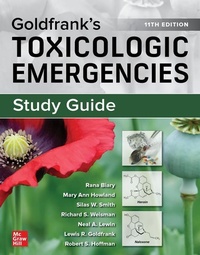
Study Guide for Goldfrank's Toxicologic Emergencies
11th Edition
Published on 30. September 2022
Book
Paperback/Softback
464 pages
978-1-260-47502-9 (ISBN)
Description
The hands-on study companion for the most respected, rigorous medical toxicology text available
Goldfrank's Toxicologic Emergencies has long been the go-to guide for accurately diagnosing and effectively treating poisoned and overdosed patients. Now, this practical companion provides everything you need to get even more out of Goldfrank's.
Study Guide for Goldfrank's Toxicologic Emergencies provides 1,400 questions with answers for testing your knowledge-a process that increases information retention and serves as invaluable practice for board exams. Each chapter has its own question set using both general factual and case-based questions. The guide is ideal for students, nurses, pharmacists, and physicians.
Study Guide for Goldfrank's Toxicologic Emergencies covers:
General approaches to the poisoned patient
Principles of medical toxicology
Clinical basis of medical toxicology
Poison prevention and education
Research principles
Legal and forensic considerations
Goldfrank's Toxicologic Emergencies has long been the go-to guide for accurately diagnosing and effectively treating poisoned and overdosed patients. Now, this practical companion provides everything you need to get even more out of Goldfrank's.
Study Guide for Goldfrank's Toxicologic Emergencies provides 1,400 questions with answers for testing your knowledge-a process that increases information retention and serves as invaluable practice for board exams. Each chapter has its own question set using both general factual and case-based questions. The guide is ideal for students, nurses, pharmacists, and physicians.
Study Guide for Goldfrank's Toxicologic Emergencies covers:
General approaches to the poisoned patient
Principles of medical toxicology
Clinical basis of medical toxicology
Poison prevention and education
Research principles
Legal and forensic considerations
More details
Edition
11th edition
Language
English
Place of publication
OH
United States
Product notice
Paperback (trade)
Unsewn / adhesive bound
Illustrations
50 Illustrations
Dimensions
Height: 272 mm
Width: 215 mm
Thickness: 19 mm
Weight
942 gr
ISBN-13
978-1-260-47502-9 (9781260475029)
Copyright in bibliographic data and cover images is held by Nielsen Book Services Limited or by the publishers or by their respective licensors: all rights reserved.
Schweitzer Classification
Persons
McGraw-Hill authors represent the leading experts in their fields and are dedicated to improving the lives, careers, and interests of readers worldwide
McGraw-Hill authors represent the leading experts in their fields and are dedicated to improving the lives, careers, and interests of readers worldwide
McGraw-Hill authors represent the leading experts in their fields and are dedicated to improving the lives, careers, and interests of readers worldwide
Lewis R. Goldfrank, MD, FACEP, FAAEM, FAACT, FACMT, FACP Professor and Chair, Department of Emergency Medicine, New York University School of Medicine; Director, Emergency Medicine, Bellevue Hospital Center and New York University Medical Center; Medical Director, New York City Poison Center, New York, New York.
McGraw-Hill authors represent the leading experts in their fields and are dedicated to improving the lives, careers, and interests of readers worldwide
McGraw-Hill authors represent the leading experts in their fields and are dedicated to improving the lives, careers, and interests of readers worldwide
McGraw-Hill authors represent the leading experts in their fields and are dedicated to improving the lives, careers, and interests of readers worldwide
Lewis R. Goldfrank, MD, FACEP, FAAEM, FAACT, FACMT, FACP Professor and Chair, Department of Emergency Medicine, New York University School of Medicine; Director, Emergency Medicine, Bellevue Hospital Center and New York University Medical Center; Medical Director, New York City Poison Center, New York, New York.
McGraw-Hill authors represent the leading experts in their fields and are dedicated to improving the lives, careers, and interests of readers worldwide
Content
Historical Principles and Perspectives
Toxicologic Misfortunes and Catastrophes in History
PART A
THE GENERAL APPROACH TO THE PATIENT
Initial Evaluation of the Patient: Vital Signs and Toxic Syndromes
Principles of Managing the Acutely Poisoned or Overdosed Patient
SC1. Principles of Antidote Stocking
Decontamination Principles: Prevention of Gastrointestinal Absorption
SC2. Decontamination Principles: Prevention of Dermal, ophthalmic and inhalational Absorption
A1. Activated Charcoal
A2. Whole-Bowel Irrigation and Other Intestinal Evacuants
Principles and Techniques Applied to Enhance Elimination
Toxicologic Misfortunes and Catastrophes in History
PART A
THE GENERAL APPROACH TO THE PATIENT
Initial Evaluation of the Patient: Vital Signs and Toxic Syndromes
Principles of Managing the Acutely Poisoned or Overdosed Patient
SC1. Principles of Antidote Stocking
Decontamination Principles: Prevention of Gastrointestinal Absorption
SC2. Decontamination Principles: Prevention of Dermal, ophthalmic and inhalational Absorption
A1. Activated Charcoal
A2. Whole-Bowel Irrigation and Other Intestinal Evacuants
Principles and Techniques Applied to Enhance Elimination