

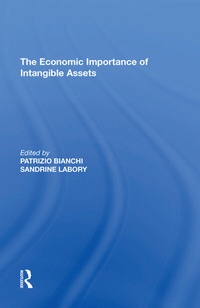
The Economic Importance of Intangible Assets
1st Edition
Published on 18. September 2018
Book
Paperback/Softback
214 pages
978-1-138-62093-3 (ISBN)
Description
This book is the result of a two-year interdisciplinary research programme named PRISM (Policy making, Reporting and measuring, Intangibles, Skills development and Management), financed by the European Commission and aimed both at understanding better how these assets are created and developed and what the policy implications of their growing importance in economies are. The book focuses on the policy issues raised by the increasing importance of intangible assets in a country's growth and competitiveness. The main idea is that the value of intangible assets, which is imperfectly captured by current economic indicators and imperfectly formalized in economic theory, lies in their being the cumulative elements that keep the economy together - the glue of the system. This argument leads to the focus on networks and social capital as drivers of the development of intangible assets and is illustrated by the case of EU innovation and knowledge diffusion policy.
More details
Language
English
Place of publication
London
United Kingdom
Publishing group
Taylor & Francis Ltd
Target group
College/higher education
Dimensions
Height: 235 mm
Width: 152 mm
Weight
453 gr
ISBN-13
978-1-138-62093-3 (9781138620933)
Copyright in bibliographic data and cover images is held by Nielsen Book Services Limited or by the publishers or by their respective licensors: all rights reserved.
Schweitzer Classification
Other editions
Additional editions
Patrizio Bianchi
The Economic Importance of Intangible Assets
E-Book
11/2017
Routledge
€58.99
Available for download
Patrizio Bianchi
The Economic Importance of Intangible Assets
E-Book
11/2017
Routledge
€59.49
Available for download
Patrizio Bianchi
The Economic Importance of Intangible Assets
Book
11/2017
1st Edition
Routledge
€215.41
Shipment within 15-20 days
Person
Patrizio Bianchi
Content
Contents: The intangible economy: overview of PRISM research findings, Clark Eustace; The political economy of intangible assets, Patrizio Bianchi and Sandrine Labory; EU policies for innovation and knowledge diffusion, Sandrine Labory; Clustering of intangibles, Marco R. Di Tommaso, Daniele Paci and Stuart O. Schweitzer; Why is social capital a 'capital'? Public goods, co-operative efforts and the accumulation of intangible assets, Francesco Galassi and Susanna Mancinelli; Public intervention to increase collaboration between innovative agents, Roberto Iorio; Dynamic networks in innovation - intensive industries, Alberto Cottica and Giovanni Ponti; Intangibles and intellectual capital: an overview of the reporting issues and some measurement models, Stefano Zambon; Towards a more effective investment analysis of intangibles sensitive companies, Mike Hall and Richard Youngman; Index.