

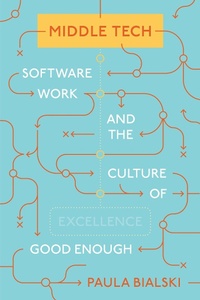
Middle Tech
Software Work and the Culture of Good Enough
Published on 21. May 2024
Book
Paperback/Softback
224 pages
978-0-691-25716-7 (ISBN)
Description
Why software isn't perfect, as seen through the stories of software developers at a run-of-the-mill tech company
Contrary to much of the popular discourse, not all technology is seamless and awesome; some of it is simply "good enough." In Middle Tech, Paula Bialski offers an ethnographic study of software developers at a non-flashy, non-start-up corporate tech company. Their stories reveal why software isn't perfect and how developers communicate, care, and compromise to make software work-or at least work until the next update. Exploring the culture of good enoughness at a technology firm she calls "MiddleTech," Bialski shows how doing good-enough work is a collectively negotiated resistance to the organizational ideology found in corporate software settings.
The truth, Bialski reminds us, is that technology breaks due to human-related issues: staff cutbacks cause media platforms to crash, in-car GPS systems cause catastrophic incidents, and chatbots can be weird. Developers must often labor to patch and repair legacy systems rather than dream up killer apps. Bialski presents a less sensationalist, more empirical portrait of technology work than the frequently told Silicon Valley narratives of disruption and innovation. She finds that software engineers at MiddleTech regard technology as an ephemeral object that only needs to be good enough to function until its next iteration. As a result, they don't feel much pressure to make it perfect. Through the deeply personal stories of people and their practices at MiddleTech, Bialski traces the ways that workers create and sustain a complex culture of good enoughness.
Contrary to much of the popular discourse, not all technology is seamless and awesome; some of it is simply "good enough." In Middle Tech, Paula Bialski offers an ethnographic study of software developers at a non-flashy, non-start-up corporate tech company. Their stories reveal why software isn't perfect and how developers communicate, care, and compromise to make software work-or at least work until the next update. Exploring the culture of good enoughness at a technology firm she calls "MiddleTech," Bialski shows how doing good-enough work is a collectively negotiated resistance to the organizational ideology found in corporate software settings.
The truth, Bialski reminds us, is that technology breaks due to human-related issues: staff cutbacks cause media platforms to crash, in-car GPS systems cause catastrophic incidents, and chatbots can be weird. Developers must often labor to patch and repair legacy systems rather than dream up killer apps. Bialski presents a less sensationalist, more empirical portrait of technology work than the frequently told Silicon Valley narratives of disruption and innovation. She finds that software engineers at MiddleTech regard technology as an ephemeral object that only needs to be good enough to function until its next iteration. As a result, they don't feel much pressure to make it perfect. Through the deeply personal stories of people and their practices at MiddleTech, Bialski traces the ways that workers create and sustain a complex culture of good enoughness.
Reviews / Votes
"[Middle Tech] proves indispensable for demonstrating how the mundane but nevertheless consequential choices inside AI companies, indeed in all software companies, are made by engineers as they navigate the material and ethical stakes of what is 'good enough' and who it is good enough for in their daily work."---Emanuel Moss, Public Books "A most welcome addition to the sociology of work, organizations, and occupations and an important contribution to readers' understanding ofthe creation, change, and maintenance of workplace culture." * Choice *More details
Series
Language
English
Place of publication
New Jersey
United States
Target group
College/higher education
Professional and scholarly
Product notice
Paperback (trade)
Illustrations
8 b/w illus.
Dimensions
Height: 232 mm
Width: 152 mm
Thickness: 14 mm
Weight
368 gr
ISBN-13
978-0-691-25716-7 (9780691257167)
Copyright in bibliographic data and cover images is held by Nielsen Book Services Limited or by the publishers or by their respective licensors: all rights reserved.
Schweitzer Classification
Other editions
Additional editions
E-Book
05/2024
1st Edition
Princeton University Press
€27.99
Available for download
Person
Paula Bialski is associate professor of digital sociology at the University of St. Gallen in St. Gallen, Switzerland. She is the author of Becoming Intimately Mobile and a coauthor of Communication.