

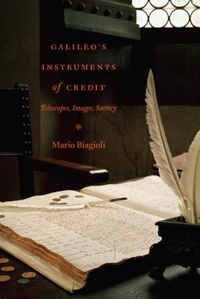
Galileo's Instruments of Credit
Telescopes, Images, Secrecy
Will be published approx. on 14. April 2006
Book
Hardback
316 pages
978-0-226-04561-0 (ISBN)
Description
In six short years, Galileo Galilei went from being a somewhat obscure mathematics professor running a student boarding house in Padua to a star in the court of Florence to the recipient of dangerous attention from the Inquisition for his support of Copernicanism. In that brief period, Galileo made a series of astronomical discoveries that reshaped the debate over the physical nature of the heavens: he deeply modified the practices and status of astronomy with the introduction of the telescope and pictorial evidence, proposed a radical reconfiguration of the relationship between theology and astronomy, and transformed himself from university mathematician into court philosopher. "Galileo's Instruments of Credit" proposes radical new interpretations of several key episodes of Galileo's career, including his early telescopic discoveries of 1610, the dispute over sunspots, and the conflict with the Holy Office over the relationship between Copernicanism and Scripture.
Galileo's tactics during this time shifted as rapidly as his circumstances, argues Mario Biagioli, and the pace of these changes forced him to respond swiftly to the opportunities and risks posed by unforeseen inventions, further discoveries, and the interventions of his opponents. Focusing on the aspects of Galileo's scientific life that extend beyond the framework of court culture and patronage, Biagioli offers a revisionist account of the different systems of exchanges, communication, and credibility at work in various phases of Galileo's career. "Galileo's Instruments of Credit" will find grateful readers among scholars of science studies, historical epistemology, visual studies, Galilean science, and late Renaissance astronomy.
Galileo's tactics during this time shifted as rapidly as his circumstances, argues Mario Biagioli, and the pace of these changes forced him to respond swiftly to the opportunities and risks posed by unforeseen inventions, further discoveries, and the interventions of his opponents. Focusing on the aspects of Galileo's scientific life that extend beyond the framework of court culture and patronage, Biagioli offers a revisionist account of the different systems of exchanges, communication, and credibility at work in various phases of Galileo's career. "Galileo's Instruments of Credit" will find grateful readers among scholars of science studies, historical epistemology, visual studies, Galilean science, and late Renaissance astronomy.
Reviews / Votes
"In the history of science there have traditionally been those who study the social setting of scientists and those who study the science itself.... Biagioli's book takes the analysis one step further.... Galileo, Courtier is the most important book on Galileo to appear in half a century." - Albert Van Helden, Rice University "One of the most challenging commentaries I've read on Galileo's life and world.... Indeed, Biagioli's command of primary and secondary documentation is spectacular and his readings of both texts and events are extremely deft and elegant." - Anthony Grafton, Princeton University"More details
Language
English
Place of publication
Chicago
United States
Publishing group
The University of Chicago Press
Target group
Professional and scholarly
Dimensions
Height: 24 mm
Width: 17 mm
Thickness: 2 mm
Weight
624 gr
ISBN-13
978-0-226-04561-0 (9780226045610)
Copyright in bibliographic data and cover images is held by Nielsen Book Services Limited or by the publishers or by their respective licensors: all rights reserved.
Schweitzer Classification
Other editions
Additional editions
E-Book
05/2024
1st Edition
University of Chicago Press
from
€40.49
Available for download
Person
Mario Biagioli is professor of history of science at Harvard University and the author of Galileo, Courtier: The Practice of Science in the Culture of Absolutism, also published by the University of Chicago Press.