

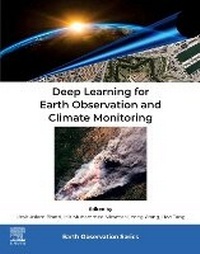
Deep Learning for Earth Observation and Climate Monitoring
Published on 9. June 2025
Book
Paperback/Softback
314 pages
978-0-443-24712-5 (ISBN)
Description
Deep Learning for Earth Observation and Climate Monitoring bridges the gap between deep learning and the Earth sciences, offering cutting-edge techniques and applications that are transforming our understanding of the environment. With a focus on practical scenarios, this book introduces readers to the fundamental concepts of deep learning, from classification and image segmentation to anomaly detection and domain adaptability. The book includes practical discussion on regression, parameter retrieval, forecasting, and interpolation, among other topics. With a solid foundational theory, real-world examples, and example codes, it provides a full understanding of how intelligent systems can be applied to enhance Earth observation and especially climate monitoring.
This book allows readers to apply learning representations, unsupervised deep learning, and physics-aware models to Earth observation data, enabling them to leverage the power of deep learning to fully utilize the wealth of environmental data from satellite technologies.
This book allows readers to apply learning representations, unsupervised deep learning, and physics-aware models to Earth observation data, enabling them to leverage the power of deep learning to fully utilize the wealth of environmental data from satellite technologies.
More details
Language
English
Place of publication
Philadelphia
United States
Target group
Professional and scholarly
College/higher education
Dimensions
Height: 276 mm
Width: 216 mm
Weight
1000 gr
ISBN-13
978-0-443-24712-5 (9780443247125)
Copyright in bibliographic data and cover images is held by Nielsen Book Services Limited or by the publishers or by their respective licensors: all rights reserved.
Schweitzer Classification
Other editions
Additional editions
Uzair Aslam Bhatti | Mir Muhammad Nizamani | Yong Wang
Deep Learning for Earth Observation and Climate Monitoring
E-Book
03/2025
Elsevier
€164.99
Available for download
Persons
Uzair Aslam Bhatti is a researcher focused on applying machine learning to medical and signal processing problems, with additional interest in broader artificial intelligence applications. He completed his PhD at Hainan University, where he received two Best Research Paper Awards and a Chinese Government Scholarship. After his PhD, he worked as a Postdoctoral Researcher at Nanjing Normal University (School of Geography), in the Remote Sensing and Signal Processing area. During this period, he contributed as first author to multiple publications in SCI-indexed journals and conferences, including work in IEEE Transactions on Geoscience and Remote Sensing and Chemosphere. His work also contributed to recognition as an Excellent Postdoctoral Candidate by Nanjing Normal University. He has participated in research projects supported by the National Natural Science Foundation of China, the National Key R&D Program, and the Hainan Provincial Major Science and Technology Program.
Mir Muhammad Nizamani's research focuses on deep understanding of fundamental ecological principles and methods as well as their applications to current human and urban issues. He has published nearly 60 academic papers and won a Chinese Government Scholarship to pursue a doctorate during his Ph.D. studies at Hainan University. He has participated in many external projects, such as the National Natural Science Foundation of China and the National Science Foundation of Hainan Province.
Yong Wang is a professor at Guizhou University, specializing in ecology and mycology. His research interests encompass a broad range of topics within these fields. As an ecologist, he investigates the relationships between organisms and their environment, studying how living organisms interact with each other and their surrounding ecosystems. With his expertise in ecology and mycology, Professor Yong Wang has contributed to the understanding of the ecological dynamics and functions of fungi, their role in nutrient cycling, symbiotic relationships with other organisms, or the effects of environmental factors on fungal communities. His research findings can help inform conservation efforts, promote sustainable practices, and contribute to the broader scientific knowledge in these fields.
Hao Tang is a Lecturer with the School of Information and Communication Engineering, Hainan University after receiving his Ph.D. degree in mechanical engineering from South China University of Technology, Guangzhou City, Guangdong Province, China, in 2021. His research interests include intelligent manufacturing, industrial big data, scheduling and embedded systems.
Mir Muhammad Nizamani's research focuses on deep understanding of fundamental ecological principles and methods as well as their applications to current human and urban issues. He has published nearly 60 academic papers and won a Chinese Government Scholarship to pursue a doctorate during his Ph.D. studies at Hainan University. He has participated in many external projects, such as the National Natural Science Foundation of China and the National Science Foundation of Hainan Province.
Yong Wang is a professor at Guizhou University, specializing in ecology and mycology. His research interests encompass a broad range of topics within these fields. As an ecologist, he investigates the relationships between organisms and their environment, studying how living organisms interact with each other and their surrounding ecosystems. With his expertise in ecology and mycology, Professor Yong Wang has contributed to the understanding of the ecological dynamics and functions of fungi, their role in nutrient cycling, symbiotic relationships with other organisms, or the effects of environmental factors on fungal communities. His research findings can help inform conservation efforts, promote sustainable practices, and contribute to the broader scientific knowledge in these fields.
Hao Tang is a Lecturer with the School of Information and Communication Engineering, Hainan University after receiving his Ph.D. degree in mechanical engineering from South China University of Technology, Guangzhou City, Guangdong Province, China, in 2021. His research interests include intelligent manufacturing, industrial big data, scheduling and embedded systems.
Content
1. Introduction: Advancing Ecological Protection Through Integrated GIS-Enabled Environmental Monitoring: A Holistic Approach to Addressing Environmental Pollution
Section I: Deep Learning For Climate Change
2. Secure Data Storage and Processing Architectures for Climate IoT Systems
3. Artificial Intelligence for Remote Sensing and Climate Monitoring
4. Carbon emission pattern analysis and its relationship with climate change
Section II: Deep Learning For Ecological Patterns
5. Application of GIS and remote sensing technology in ecosystem services and biodiversity conservation
6. Unlocking Environmental Secrets with Deep Learning: Pioneering Progress and Uses in India's Earth Surveillance and Climate Tracking
7. Application of machine learning to urban ecology
Section III: Deep Learning For GIS
8. An integrated deep learning-based approach for traffic maintenance prediction with GIS data
9. Enriching the metadata of map images: a deep learning approach with GIS-based data augmentation
Section IV: Deep Learning For Lulc
10. Enhancing Geospatial Insights: A Data-Driven Approach to Multi-Source Remote Sensing Fusion
11. Climate change air quality monitoring using Sentimental 2 dataset
12. Latest trends in LULC monitoring using Deep Learning
Section V: Deep Learning For Oceans
13. Oceanic Biometric Recognition Algorithm Based on Generalized Zero-Shot Learning
14. Remote Sensing lmage Fusion Based on Deep Learning and Convolutional Neural Network Technique
15. Oil Spills and the Ripple Effect: Exploring Climate and Environmental Impacts Through a Deep Learning Lens
Section I: Deep Learning For Climate Change
2. Secure Data Storage and Processing Architectures for Climate IoT Systems
3. Artificial Intelligence for Remote Sensing and Climate Monitoring
4. Carbon emission pattern analysis and its relationship with climate change
Section II: Deep Learning For Ecological Patterns
5. Application of GIS and remote sensing technology in ecosystem services and biodiversity conservation
6. Unlocking Environmental Secrets with Deep Learning: Pioneering Progress and Uses in India's Earth Surveillance and Climate Tracking
7. Application of machine learning to urban ecology
Section III: Deep Learning For GIS
8. An integrated deep learning-based approach for traffic maintenance prediction with GIS data
9. Enriching the metadata of map images: a deep learning approach with GIS-based data augmentation
Section IV: Deep Learning For Lulc
10. Enhancing Geospatial Insights: A Data-Driven Approach to Multi-Source Remote Sensing Fusion
11. Climate change air quality monitoring using Sentimental 2 dataset
12. Latest trends in LULC monitoring using Deep Learning
Section V: Deep Learning For Oceans
13. Oceanic Biometric Recognition Algorithm Based on Generalized Zero-Shot Learning
14. Remote Sensing lmage Fusion Based on Deep Learning and Convolutional Neural Network Technique
15. Oil Spills and the Ripple Effect: Exploring Climate and Environmental Impacts Through a Deep Learning Lens