

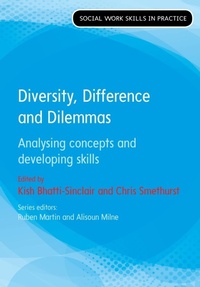
Diversity and Difference
Published on 16. October 2017
Book
Paperback/Softback
200 pages
978-0-335-26182-6 (ISBN)
Description
Social Work is increasingly delivered in complex situations. Key to professional practice is developing a sensitive understanding of the issues of diversity and oppression.
The book will introduce you to social differences in relation to class, race, disability, gender and sexual orientation. It will offer guidance, tools and methods to promote attitudes and behaviours which enable us to live well together whilst respecting cultural, religious and ethnic differences. It also explains the essential skills expected in the professional standards such as the PCF.
Instead of providing a reductive 'how-to' guide to diversity issues, this book invites practitioners to develop a considered and analytical approach to diversity issues that are often complex, multi-faceted and contested - and to reflect on the issues involved.
The book features:
Explanations of key terms such as anti-oppressive or anti-discriminatory practice
An understanding of class assumptions and prejudice
A look at attitudes to Roma people and religious fundamentalism and the challenges these pose to social work practice
Coverage of minority groups such as the deafblind
Discussion of issues of race in social work and avoiding stereotypes
Summaries of core knowledge and skills for the social worker in each chapter
Case studies featuring contemporary issues to provide lessons for social work
This is an essential book for all those interested in providing excellence in practice, whether students, newly qualified social workers or established professionals in social care.
The book will introduce you to social differences in relation to class, race, disability, gender and sexual orientation. It will offer guidance, tools and methods to promote attitudes and behaviours which enable us to live well together whilst respecting cultural, religious and ethnic differences. It also explains the essential skills expected in the professional standards such as the PCF.
Instead of providing a reductive 'how-to' guide to diversity issues, this book invites practitioners to develop a considered and analytical approach to diversity issues that are often complex, multi-faceted and contested - and to reflect on the issues involved.
The book features:
Explanations of key terms such as anti-oppressive or anti-discriminatory practice
An understanding of class assumptions and prejudice
A look at attitudes to Roma people and religious fundamentalism and the challenges these pose to social work practice
Coverage of minority groups such as the deafblind
Discussion of issues of race in social work and avoiding stereotypes
Summaries of core knowledge and skills for the social worker in each chapter
Case studies featuring contemporary issues to provide lessons for social work
This is an essential book for all those interested in providing excellence in practice, whether students, newly qualified social workers or established professionals in social care.
More details
Persons
Kish Bhatti-Sinclair is Reader in Social Policy and Social Work and Head of Social Work Programmes at the University of Chichester, UK. Kish is known for her work on social work, race and racism, including researching border controls and IT in the countries of the EU, globalisation in relation to social work values, troubled families, black and minority ethnic children in care, and inter-professional working in a culturally appropriate way.
Chris Smethurst is Head of the Department of Childhood, Social Work and Social Care at the University of Chichester, UK. Prior to a career in Higher Education, Chris worked in a range of social work and social care settings: in community work, youth work, residential child care, day services and in learning disability and community mental health teams. This experience informed a particular interest in the impact of social attitudes on social policy and on the day-to-day work of practitioners and organisations.
Chris Smethurst is Head of the Department of Childhood, Social Work and Social Care at the University of Chichester, UK. Prior to a career in Higher Education, Chris worked in a range of social work and social care settings: in community work, youth work, residential child care, day services and in learning disability and community mental health teams. This experience informed a particular interest in the impact of social attitudes on social policy and on the day-to-day work of practitioners and organisations.
Content
PART 1 Theories and Contexts 1. Diversity and difference in challenging times: The social and political context
2. Cultural competence: Towards a reflexive approach to working inclusively
3. Being White - feeling guilty?
4. Social work identities: You're different too!
PART 2 Themes from contemporary practice 5. Class, inequality and social work: 'We're all in this together'?
6. Islam - a 'dangerous' religion?
7. Roma people: Are discriminatory attitudes natural?
8. Reclaiming and embracing spirituality as a legitimate facet of social work
9. The realities of meaningful service user involvement in social work education: avoiding the spectre of tokenism
10. Deafblind law and policy
11. Concluding chapter
2. Cultural competence: Towards a reflexive approach to working inclusively
3. Being White - feeling guilty?
4. Social work identities: You're different too!
PART 2 Themes from contemporary practice 5. Class, inequality and social work: 'We're all in this together'?
6. Islam - a 'dangerous' religion?
7. Roma people: Are discriminatory attitudes natural?
8. Reclaiming and embracing spirituality as a legitimate facet of social work
9. The realities of meaningful service user involvement in social work education: avoiding the spectre of tokenism
10. Deafblind law and policy
11. Concluding chapter