

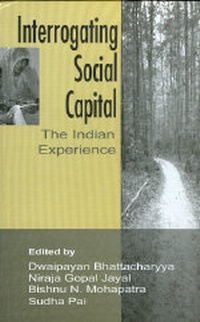
Interrogating Social Capital
The Indian Experience
1st Edition
Published on 8. November 2004
Book
Hardback
335 pages
978-0-7619-3286-4 (ISBN)
Description
Recent years have seen the concept of social capital gain increasing currency, besides courting controversy, both in academic social science writing and in the development discourse of multilateral donor agencies. It has been viewed as an explanation for both the flourishing of democracy and economic development, and therefore as the potential key to successful development practices in the developing world.
Presenting varied experiences of the interaction between social capital and the democratic functioning of a variety of institutions in India, the essays in this volume subject the notion of social capital to close and thorough scrutiny. The critique of social capital that this volume provides is strongly anchored in empirical case studies of three kinds:
- field-based micro-studies in rural areas
- sectoral studies in the areas of joint forest management, environment and education
- macro-studies which relate indicators of human development to dimensions of social capital
The contributors explore central issues concerning the inter-relationship between social capital and democracy. Additionally, they address important questions such as: Does social capital inhere in some communities and associations and not in others? Can it be `constructed` and, if so, which are the agencies best suited to do so?
Presenting varied experiences of the interaction between social capital and the democratic functioning of a variety of institutions in India, the essays in this volume subject the notion of social capital to close and thorough scrutiny. The critique of social capital that this volume provides is strongly anchored in empirical case studies of three kinds:
- field-based micro-studies in rural areas
- sectoral studies in the areas of joint forest management, environment and education
- macro-studies which relate indicators of human development to dimensions of social capital
The contributors explore central issues concerning the inter-relationship between social capital and democracy. Additionally, they address important questions such as: Does social capital inhere in some communities and associations and not in others? Can it be `constructed` and, if so, which are the agencies best suited to do so?
Reviews / Votes
The lucid language in which the essays are written and the supporting tables and figures make the book interesting to read. There is a free and continuous flow of issues and thoughts in the book. The field-based critique of the theory of social capital in an Indian (non-Western) setting is the most appealing feature of the book....The book deals with a subject that is so relevant to development, and looks at an attribute that may contribute to the greater effectiveness of development programmes and anti-poverty efforts. -- Journal of Social and Economic DevelopmentMore details
Edition
First Edition
Language
English
Place of publication
Thousand Oaks
United States
Target group
College/higher education
Professional and scholarly
Product notice
Cloth over boards
Dimensions
Height: 216 mm
Width: 140 mm
Weight
492 gr
ISBN-13
978-0-7619-3286-4 (9780761932864)
Copyright in bibliographic data and cover images is held by Nielsen Book Services Limited or by the publishers or by their respective licensors: all rights reserved.
Schweitzer Classification
Persons
Dwaipayan Bhattacharyya is Fellow at the Centre for Studies in Social Sciences, Calcutta. He did his doctoral research on the agrarian politics of the Left at the University of Cambridge, UK, and taught at the Centre for Political Studies, Jawaharlal Nehru University (JNU), New Delhi, for close to a decade. His main interests are related to democracy, decentralization, civic community and political mobilization in recent times.
Niraja Gopal Jayal is Professor at the Centre for the Study of Law and Governance, JNU, and is also Director of the Ford Foundation project 'Dialogue on Democracy and Pluralism in South Asia'. Her current research interests include gender and governance, ethnic inequality and the governance of public institutions, and environmental political theory. Among her previous publications are Democracy and the State: Welfare, Secularism and Development in Contemporary India (1999); Drought, Policy and Politics in India (1993, co-authored); Democracy in India (2001, edited); and Democratic Governance in India: Challenges of Poverty, Development, and Identity (2001, co-edited with Sudha Pai).
Bishnu N Mohapatra is Associate Professor at the Centre for Political Studies, JNU, where he has been since 1994. He studied in Orissa, Delhi and Oxford. Besides social and cultural history, his recent interests cover areas like democracy, civil society and governance, social exclusion and indignity. He is also Programme Officer for Local-Global Governance at the Ford Foundation's South Asia office at New Delhi.
Sudha Pai is Professor at the Centre for Political Studies, JNU. Apart from articles in reputed journals on electoral politics and the party system in India, her recent publications are Dalit Assertion and the Unfinished Democratic Revolution: The Bahujan Samaj Party in Uttar Pradesh (2002) and Democratic Governance in India: Challenges of Poverty, Development, and Identity (2001, co-edited with Niraja Gopal Jayal). Her current interests include issues of governance and globalization in India.
Niraja Gopal Jayal is Professor at the Centre for the Study of Law and Governance, JNU, and is also Director of the Ford Foundation project 'Dialogue on Democracy and Pluralism in South Asia'. Her current research interests include gender and governance, ethnic inequality and the governance of public institutions, and environmental political theory. Among her previous publications are Democracy and the State: Welfare, Secularism and Development in Contemporary India (1999); Drought, Policy and Politics in India (1993, co-authored); Democracy in India (2001, edited); and Democratic Governance in India: Challenges of Poverty, Development, and Identity (2001, co-edited with Sudha Pai).
Bishnu N Mohapatra is Associate Professor at the Centre for Political Studies, JNU, where he has been since 1994. He studied in Orissa, Delhi and Oxford. Besides social and cultural history, his recent interests cover areas like democracy, civil society and governance, social exclusion and indignity. He is also Programme Officer for Local-Global Governance at the Ford Foundation's South Asia office at New Delhi.
Sudha Pai is Professor at the Centre for Political Studies, JNU. Apart from articles in reputed journals on electoral politics and the party system in India, her recent publications are Dalit Assertion and the Unfinished Democratic Revolution: The Bahujan Samaj Party in Uttar Pradesh (2002) and Democratic Governance in India: Challenges of Poverty, Development, and Identity (2001, co-edited with Niraja Gopal Jayal). Her current interests include issues of governance and globalization in India.
Content
Introduction - Dwaipayan Bhattacharyya et al
Social Capital, Panchayats and Grass Roots Democracy - Sudha Pai
The Politics of Dalit Assertion in Two Districts of Uttar Pradesh
Democracy and Social Capital in the Central Himalayas - Niraja Gopal Jayal
A Tale of Two Villages
Social Connectedness and the Fragility of Social Capital - Bishnu N Mohapatra
A View from a Village in Orissa
Is Civil Society the Answer? - Susanne Hoeber Rudolph
Civic Community and Its Margins - Dwaipayan Bhattacharyya
Schoolteachers in Rural West Bengal
Classes for the Masses? Social Capital, Social Distance and the Quality of the Government School System - Manabi Majumdar
Devolution, Joint Forest Management and the Transformation of `Social Capital' - Nandini Sundar
Making Democracy Perform - Peter Mayer
Human Development and Civic Community in India
`Putman in India' - Renata Serra
Is Social Capital a Meaningful and Measurable Concept at the Indian State Level?
Social Network and Protest Movements - Ashok Swain
The Case of Kerala
Index
Social Capital, Panchayats and Grass Roots Democracy - Sudha Pai
The Politics of Dalit Assertion in Two Districts of Uttar Pradesh
Democracy and Social Capital in the Central Himalayas - Niraja Gopal Jayal
A Tale of Two Villages
Social Connectedness and the Fragility of Social Capital - Bishnu N Mohapatra
A View from a Village in Orissa
Is Civil Society the Answer? - Susanne Hoeber Rudolph
Civic Community and Its Margins - Dwaipayan Bhattacharyya
Schoolteachers in Rural West Bengal
Classes for the Masses? Social Capital, Social Distance and the Quality of the Government School System - Manabi Majumdar
Devolution, Joint Forest Management and the Transformation of `Social Capital' - Nandini Sundar
Making Democracy Perform - Peter Mayer
Human Development and Civic Community in India
`Putman in India' - Renata Serra
Is Social Capital a Meaningful and Measurable Concept at the Indian State Level?
Social Network and Protest Movements - Ashok Swain
The Case of Kerala
Index