

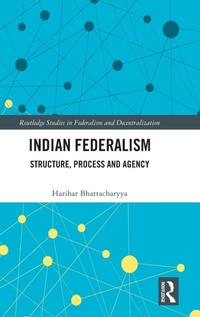
Indian Federalism
Structure, Process and Agency
1st Edition
Will be published approx. on 24. February 2026
Book
Hardback
240 pages
978-1-032-45549-5 (ISBN)
Description
Indian Federalism: Structure, Process and Agency takes a comprehensive look at Indian Federalism, offering a jargon free and accessible critical analysis of its origin and development, innovative structural elements, federal functioning and effectiveness, and its resilience in the face of many challenges.
Federalism in India is a relative success story as a model of governance of a complex multi-ethnic country. This book provides a detailed examination of the structures of Indian federalism with particular focus on the core structures such as tiers of government, constitutional distribution of powers, parliamentary second chamber, Supreme Court, Finance Commission (fiscal federalism and, federal asymmetry), and Inter-State Council. Each discussion is preceded by the constitutional designs, and functions. The issues covered in this book are territorial accommodation of ethnic identity; power-sharing; centripetalism and state autonomy; changing political economy from a command economy to a market driven one; special significance of the major transformation in the party systems for federalism; and the new meaning of centre-state relations in the shifting patty systems and the political economy.
This book will be of interest to advanced undergraduates and postgraduates as a core text on Indian federalism, and a necessary reference for the students and researchers of comparative federalism, and Indian politics, globally speaking.
Federalism in India is a relative success story as a model of governance of a complex multi-ethnic country. This book provides a detailed examination of the structures of Indian federalism with particular focus on the core structures such as tiers of government, constitutional distribution of powers, parliamentary second chamber, Supreme Court, Finance Commission (fiscal federalism and, federal asymmetry), and Inter-State Council. Each discussion is preceded by the constitutional designs, and functions. The issues covered in this book are territorial accommodation of ethnic identity; power-sharing; centripetalism and state autonomy; changing political economy from a command economy to a market driven one; special significance of the major transformation in the party systems for federalism; and the new meaning of centre-state relations in the shifting patty systems and the political economy.
This book will be of interest to advanced undergraduates and postgraduates as a core text on Indian federalism, and a necessary reference for the students and researchers of comparative federalism, and Indian politics, globally speaking.
Reviews / Votes
"This majestic work shows how India's federalism conflates territoriality and ethnicity with self-rule and shared rule. This compact, comprehensive and accessible volume should be on every reading list on federalism".Subrata Mitra, Heidelberg University
"This book is an essential guide to the evolution, development and the contemporary challenges of Indian federalism that is sure to become a reference source. Erudite and accessible, it provides a masterful synopsis of the subject that is a must for scholars, students and the general reader."
Professor. Gurharpal Singh, King's College, London.
"This wide-ranging textbook covers key institutions making federalism in India work. Its nuanced interpretation of the politics of federalism in India deserves to be widely read".
Professor Katharine Adeney, University of Nottingham
More details
Series
Language
English
Place of publication
London
United Kingdom
Publishing group
Taylor & Francis Ltd
Target group
College/higher education
Professional and scholarly
Academic, Postgraduate, and Undergraduate Advanced
Illustrations
10 s/w Tabellen, 1 s/w Abbildung, 1 s/w Photographie bzw. Rasterbild
10 Tables, black and white; 1 Halftones, black and white; 1 Illustrations, black and white
Dimensions
Height: 240 mm
Width: 161 mm
Thickness: 18 mm
Weight
540 gr
ISBN-13
978-1-032-45549-5 (9781032455495)
Copyright in bibliographic data and cover images is held by Nielsen Book Services Limited or by the publishers or by their respective licensors: all rights reserved.
Schweitzer Classification
Other editions
Additional editions
E-Book
02/2026
Routledge
€60.99
Available for download
E-Book
02/2026
Routledge
€60.99
Available for download
Person
Harihar Bhattacharyya formerly a Professor of Political Science at the University of Burdwan, West Bengal, India. Previously he taught at Delhi University, the Heidelberg University (South Asia Institute), Hull University (UK), and the Institute of Federalism, Fribourg where he was a Visiting Research Professor (1998-99) for one year to draft a book on a comparative study of Indian and Swiss federalism. Widely globally travelled, Bhattacharyya also takes part in ethnic conflict resolution and constitution making for transitional states. Recent publications include Asymmetric Federalism in India: Ethnicity, Development and Governance (2022); Federalism in Asia: India, Pakistan, Malaysia, Nepal and Myanmar, 2nd ed. (2021); and Radical Political and Governance in India's North East: The Case of Tripura (2018). He is also a recipient of the Publius Distinguished Scholar Award (2025).
Content
Introduction
1. Conceptual issues in federalism
2. Origin and development of Indian federalism
3. Structural dimensions of Indian federalism
4. Centre-state relations in Indian federalism
5. Fiscal federalism in India
6. Role of the judiciary in Indian federalism
7. Indian federalism and democracy
8. Federalism, centralization and decentralization in India
9. Statehood and sub-statehood: institutional effectiveness
10 Party systems changes in India and their effects of Indian federalism
11. Contentious issues of Indian federalism
Conclusion
1. Conceptual issues in federalism
2. Origin and development of Indian federalism
3. Structural dimensions of Indian federalism
4. Centre-state relations in Indian federalism
5. Fiscal federalism in India
6. Role of the judiciary in Indian federalism
7. Indian federalism and democracy
8. Federalism, centralization and decentralization in India
9. Statehood and sub-statehood: institutional effectiveness
10 Party systems changes in India and their effects of Indian federalism
11. Contentious issues of Indian federalism
Conclusion