

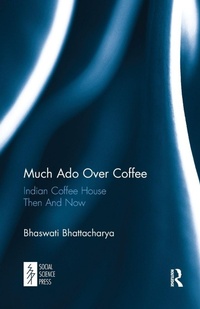
Much Ado Over Coffee
Indian Coffee House Then And Now
1st Edition
Published on 25. June 2024
Book
Paperback/Softback
432 pages
978-1-032-65277-1 (ISBN)
Description
Based on oral history, fiction, fascinating intellectual gossip, and records of the Coffee Board of India, this study is a multi-sited ethnography of the Indian Coffee House, possibly the world's first coffee house chain. It offers a critical analysis of adda (informal meetings) of the educated middle class in Allahabad, Calcutta and Delhi. The coffee house became the new socio-intellectual nerve centre, replacing the neigbourhood tea shops, and creating an entirely different social space. This book will have line drawings and cartoons as well as archival photographs.
More details
Language
English
Place of publication
London
United Kingdom
Publishing group
Taylor & Francis Ltd
Target group
College/higher education
Postgraduate
Product notice
Paperback (trade)
Unsewn / adhesive bound
Dimensions
Height: 216 mm
Width: 140 mm
Thickness: 22 mm
Weight
499 gr
ISBN-13
978-1-032-65277-1 (9781032652771)
Copyright in bibliographic data and cover images is held by Nielsen Book Services Limited or by the publishers or by their respective licensors: all rights reserved.
Schweitzer Classification
Other editions
Additional editions
E-Book
08/2017
Routledge
€59.49
Available for download
E-Book
08/2017
Routledge
€59.49
Available for download

Book
07/2017
1st Edition
Routledge
€208.40
Shipment within 10-20 days
Person
Bhaswati Bhattacharya is a historian affiliated with the Centre for Modern Indian Studies in Goettingen. Her publications include Bhattacharya et al The diary and photographs of Jan Kornelis De Cock during his trip to India 1909-10, Leiden: Roelof Barkhuis, 2014.
Content
1. Adda and Public Spaces of Sociability before the ICH 2. India Coffee House: A New Space in the City 3. The Workers and the Coffee House: From 'India' to 'Indian' 4. The Indian Coffee House and the World of Literature 5. Brewing Discontent Instead of Coffee? 6. How Public is the Public Space of the Indian Coffee House? 7. The Middle Class and Coffee Houses: Old and New