

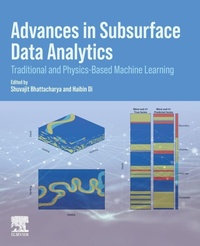
Advances in Subsurface Data Analytics
Traditional and Physics-Based Machine Learning
Published on 20. May 2022
Book
Paperback/Softback
376 pages
978-0-12-822295-9 (ISBN)
Description
Advances in Subsurface Data Analytics: Traditional and Physics-Based Approaches brings together the fundamentals of popular and emerging machine learning (ML) algorithms with their applications in subsurface analysis, including geology, geophysics, petrophysics, and reservoir engineering. The book is divided into four parts: traditional ML, deep learning, physics-based ML, and new directions, with an increasing level of diversity and complexity of topics. Each chapter focuses on one ML algorithm with a detailed workflow for a specific application in geosciences. Some chapters also compare the results from an algorithm with others to better equip the readers with different strategies to implement automated workflows for subsurface analysis.
Advances in Subsurface Data Analytics: Traditional and Physics-Based Approaches will help researchers in academia and professional geoscientists working on the subsurface-related problems (oil and gas, geothermal, carbon sequestration, and seismology) at different scales to understand and appreciate current trends in ML approaches, their applications, advances and limitations, and future potential in geosciences by bringing together several contributions in a single volume.
Advances in Subsurface Data Analytics: Traditional and Physics-Based Approaches will help researchers in academia and professional geoscientists working on the subsurface-related problems (oil and gas, geothermal, carbon sequestration, and seismology) at different scales to understand and appreciate current trends in ML approaches, their applications, advances and limitations, and future potential in geosciences by bringing together several contributions in a single volume.
More details
Language
English
Place of publication
United States
Target group
Professional and scholarly
Product notice
Paperback (trade)
Dimensions
Height: 235 mm
Width: 191 mm
Thickness: 20 mm
Weight
647 gr
ISBN-13
978-0-12-822295-9 (9780128222959)
Copyright in bibliographic data and cover images is held by Nielsen Book Services Limited or by the publishers or by their respective licensors: all rights reserved.
Schweitzer Classification
Other editions
Additional editions
Shuvajit Bhattacharya | Haibin Di
Advances in Subsurface Data Analytics
E-Book
05/2022
Elsevier
€131.00
Available for download
Persons
Dr. Shuvajit Bhattacharya is a research associate at the Bureau of Economic Geology, the University of Texas at Austin. He is an applied geophysicist/petrophysicist specializing in seismic interpretation, petrophysical modeling, machine learning, and integrated subsurface characterization. Prior to joining the Bureau of Economic Geology, Dr. Bhattacharya worked as an Assistant Professor at the University of Alaska Anchorage. He has completed several projects in the USA, Netherlands, Australia, South Africa, and India. He has published and presented more than 70 technical articles in journals, books, and conferences. His current research focuses on energy resources exploration, development, and subsurface storage of carbon and hydrogen. He completed his Ph.D. at West Virginia University in 2016. Dr. Haibin Di is a Senior Data Scientist in the Digital Subsurface Intelligence team at Schlumberger. His research interest is in implementing machine learning algorithms, particularly deep neural networks, into multiple seismic applications, including stratigraphy interpretation, property estimation, denoising, and seismic-well tie. He has published more than 70 papers in seismic interpretation and holds seven patents on machine learning-assisted subsurface data analysis. Dr. Di received his Ph.D. in Geology from West Virginia University in 2016, worked as a postdoctoral researcher at Georgia Institute of Technology in 2016-2018, and joined Schlumberger in 2018.
Content
Part 1: Traditional Machine Learning Approaches
1. User Vs. Machine Seismic Attribute Selection for Unsupervised Machine Learning Techniques: Does Human Insight Provide Better Results Than Statistically Chosen Attributes?
2. Relative Performance of Support Vector Machine, Decision Trees, and Random Forest Classifiers for Predicting Production Success in US unconventional Shale Plays
Part 2: Deep Learning Approaches
3. Recurrent Neural Network: application in facies classification
4. Recurrent Neural Network for Seismic Reservoir Characterization
5. Application of Convolutional Neural Networks for the Classification of Siliciclastic Core Photographs
6. Convolutional Neural Networks for Fault Interpretation - Case Study Examples around the World
Part 3: Physics-based Machine Learning Approaches
7. Scientific Machine Learning for Improved Seismic Simulation and Inversion
8. Prediction of Acoustic Velocities using Machine Learning
9. Regularized Elastic Full Waveform Inversion using Deep Learning
10. A Holistic Approach to Computing First-arrival Traveltimes using Neural Networks
Part 4: New Directions
11. Application of Artificial Intelligence to Computational Fluid Dynamics
1. User Vs. Machine Seismic Attribute Selection for Unsupervised Machine Learning Techniques: Does Human Insight Provide Better Results Than Statistically Chosen Attributes?
2. Relative Performance of Support Vector Machine, Decision Trees, and Random Forest Classifiers for Predicting Production Success in US unconventional Shale Plays
Part 2: Deep Learning Approaches
3. Recurrent Neural Network: application in facies classification
4. Recurrent Neural Network for Seismic Reservoir Characterization
5. Application of Convolutional Neural Networks for the Classification of Siliciclastic Core Photographs
6. Convolutional Neural Networks for Fault Interpretation - Case Study Examples around the World
Part 3: Physics-based Machine Learning Approaches
7. Scientific Machine Learning for Improved Seismic Simulation and Inversion
8. Prediction of Acoustic Velocities using Machine Learning
9. Regularized Elastic Full Waveform Inversion using Deep Learning
10. A Holistic Approach to Computing First-arrival Traveltimes using Neural Networks
Part 4: New Directions
11. Application of Artificial Intelligence to Computational Fluid Dynamics