

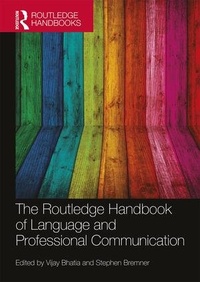
The Routledge Handbook of Language and Professional Communication
1st Edition
Published on 26. October 2016
Book
Paperback/Softback
584 pages
978-1-138-28178-3 (ISBN)
Description
The Routledge Handbook of Language and Professional Communication provides a broad coverage of the key areas where language and professional communication intersect and gives a comprehensive account of the field.
The four main sections of the Handbook cover:
Approaches to Professional Communication
Practice
Acquisition of Professional Competence
Views from the Professions
This invaluable reference book incorporates not only an historical view of the field, but also looks to possible future developments. Contributions from international scholars and practitioners, focusing on specific issues, explore the major approaches to professional communication and bring into focus recent research.
This is the first handbook of language and professional communication to account for both pedagogic and practitioner perspectives and as such is an essential reference for postgraduate students and those researching and working in the areas of applied linguistics and professional communication.
The four main sections of the Handbook cover:
Approaches to Professional Communication
Practice
Acquisition of Professional Competence
Views from the Professions
This invaluable reference book incorporates not only an historical view of the field, but also looks to possible future developments. Contributions from international scholars and practitioners, focusing on specific issues, explore the major approaches to professional communication and bring into focus recent research.
This is the first handbook of language and professional communication to account for both pedagogic and practitioner perspectives and as such is an essential reference for postgraduate students and those researching and working in the areas of applied linguistics and professional communication.
Reviews / Votes
'A handbook like this is long overdue. Professional communication, especially from the workplace vantage point, has long been overshadowed by interest in exclusively academic communication. Bhatia and Bremner have brought together a host of specialists in English for specific purposes, genre analysis, business communication and other related areas, as well as representatives of such fields as banking and law, all of whom contribute to what becomes, in effect, a compelling argument for learning more about written, spoken, and multimodal communication in professional communities.'Diane Belcher, Georgia State University, USA
More details
Series
Language
English
Place of publication
London
United Kingdom
Publishing group
Taylor & Francis Ltd
Target group
College/higher education
Illustrations
17 s/w Tabellen
17 Tables, black and white
Dimensions
Height: 246 mm
Width: 174 mm
Weight
1000 gr
ISBN-13
978-1-138-28178-3 (9781138281783)
Copyright in bibliographic data and cover images is held by Nielsen Book Services Limited or by the publishers or by their respective licensors: all rights reserved.
Schweitzer Classification
Other editions
Additional editions
E-Book
02/2014
Routledge
€92.49
Available for download
E-Book
02/2014
Routledge
€92.49
Available for download
Book
02/2014
1st Edition
Routledge
€341.69
Shipment within 15-20 days
Person
Vijay Bhatia is an Adjunct Professor in Macquarie University and University of Malaya. He is author of Analysing Genre: Language Use in Professional Settings (1993) and Worlds of Written Discourse: A Genre-based View (2004).
Stephen Bremner is an Associate Professor in the Department of English at City University of Hong Kong. His main research interests are workplace writing, and the ways in which students make the transition from the academy to the workplace.
Stephen Bremner is an Associate Professor in the Department of English at City University of Hong Kong. His main research interests are workplace writing, and the ways in which students make the transition from the academy to the workplace.
Content
1. PROFESSIONAL COMMUNICATION TODAY 2. THEORETICAL FRAMEWORKS AVAILABLE,CONTRIBUTING THEORETICAL FRAMEWORKS,
General theory of communication (One Chapter) , Language Description: Discourse and genre Analysis (Two Chapters) , Corpus driven analyses of professional discourse (One Chapter) ,
,BROAD DISCIPLINARY FRAMEWORKS,
Business Communication (Two Chapters) Technical Communication (Two Chapters) Workplace Communication (One Chapter) Intercultural and Cross-Cultural Communication (One Chapter) SPECIFIC (SUB) DISCIPLINARY FRAMEWORKS,
Management Communication (Two Chapters) Organization Communication (Two Chapters) ,
Institutional Communication (Two Chapters) ,
?3. PRACTICE4. ACQUISITION OF PROFESSIONAL COMPETENCE5. PRACTITIONERS' PERSPECTIVES6. RELEVANT AREAS FOR FUTURE DEVELOPMENT
General theory of communication (One Chapter) , Language Description: Discourse and genre Analysis (Two Chapters) , Corpus driven analyses of professional discourse (One Chapter) ,
,BROAD DISCIPLINARY FRAMEWORKS,
Business Communication (Two Chapters) Technical Communication (Two Chapters) Workplace Communication (One Chapter) Intercultural and Cross-Cultural Communication (One Chapter) SPECIFIC (SUB) DISCIPLINARY FRAMEWORKS,
Management Communication (Two Chapters) Organization Communication (Two Chapters) ,
Institutional Communication (Two Chapters) ,
?3. PRACTICE4. ACQUISITION OF PROFESSIONAL COMPETENCE5. PRACTITIONERS' PERSPECTIVES6. RELEVANT AREAS FOR FUTURE DEVELOPMENT