

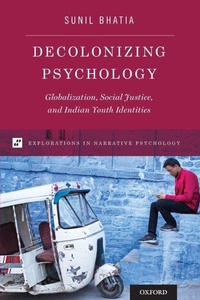
Decolonizing Psychology
Globalization, Social Justice, and Indian Youth Identities
Published on 26. October 2017
Book
Paperback/Softback
360 pages
978-0-19-996472-7 (ISBN)
Description
In recent years, the news media has directed a significant amount of attention to the effect of globalization on the second most populous nation in the world: India. With the emergence of new economic opportunities and the influx of foreign popular culture and commodities, India has experienced an enormous sea of change in the last few decades. In Decolonizing Psychology: Globalization, Social Justice, and Indian Youth Identities, author Sunil Bhatia focuses on the psychological tensions that these changes have brought upon Indian youth today.
Drawing on dozens of interviews, Bhatia offers readers a compelling glimpse and analysis of how these youth populations are engaging with the emerging presence of globalization in their day-to-day lives. As Bhatia explains, young Indians use the term 'world class selves' as a way to identify and describe the ways in which globalization has strengthened their standing in the world. By frequenting urban cafes and bars, watching American television and cinema, traveling abroad, and regularly consuming foreign commodities, Indian youth absorb the westernized culture and view themselves as peers to their western counterparts. At the same time, however, these young Indians proudly hold onto their homeland's traditions governing family and religious values.
With remarkable clarity and nuance, Bhatia sheds an important light on the universalizing power and the colonizing dimensions of Euro-American psychology. By integrating insights from postcolonial, narrative, and cultural psychologies to explore how Euro-American scientific psychology became the standard approach, Bhatia reminds readers of whose stories are not being told, what knowledge is not being considered, and whose lives are not included in the central understanding of psychology today.
Drawing on dozens of interviews, Bhatia offers readers a compelling glimpse and analysis of how these youth populations are engaging with the emerging presence of globalization in their day-to-day lives. As Bhatia explains, young Indians use the term 'world class selves' as a way to identify and describe the ways in which globalization has strengthened their standing in the world. By frequenting urban cafes and bars, watching American television and cinema, traveling abroad, and regularly consuming foreign commodities, Indian youth absorb the westernized culture and view themselves as peers to their western counterparts. At the same time, however, these young Indians proudly hold onto their homeland's traditions governing family and religious values.
With remarkable clarity and nuance, Bhatia sheds an important light on the universalizing power and the colonizing dimensions of Euro-American psychology. By integrating insights from postcolonial, narrative, and cultural psychologies to explore how Euro-American scientific psychology became the standard approach, Bhatia reminds readers of whose stories are not being told, what knowledge is not being considered, and whose lives are not included in the central understanding of psychology today.
More details
Series
Language
English
Place of publication
New York
United States
Target group
Professional and scholarly
Dimensions
Height: 234 mm
Width: 156 mm
Thickness: 22 mm
Weight
613 gr
ISBN-13
978-0-19-996472-7 (9780199964727)
Copyright in bibliographic data and cover images is held by Nielsen Book Services Limited or by the publishers or by their respective licensors: all rights reserved.
Schweitzer Classification
Other editions
Additional editions

E-Book
09/2017
OUP eBook
€55.49
Available for download

E-Book
09/2017
OUP eBook
€55.49
Available for download
Person
Sunil Bhatia is a professor of human development at Connecticut College. His research focuses on the development of self and identity within the postcolonial contexts of migration, globalization, neo-liberalization, and the formation of transnational diasporas. In 2014, he was elected a Fellow to the American Psychological Association for his outstanding local, national, and international contributions to the field of psychology. In December 2014, he was selected by the American Psychological Association for the prestigious APA 2015 Humanitarian of the Year award.
Content
Introduction: Decolonizing Psychology: Transnational Cultures, Social Justice, and Indian Youth Identities
Chapter 1: Decolonizing Moves: Beyond Eurocentric Culture, Narrative, and Identity
Chapter 2: The Cultural Psychology of Globalization: Constructing Desirable Identities and Spaces
Chapter 3: Psychology and the Neoliberal Self: Global Culture and The "New Colonial" Subjects
Chapter 4: Stories and Theories: Globalization, Narrative and Meaning-Making
Chapter 5: Travelling Transnational Identities: Imagining Stories of "Ultimate" Indianness
Chapter 6: Outsourcing the Self: Work, Love, and Money in the Call Center Culture
Chapter 7: Identities Left Behind: Globalization, Social Inequality and the Search for Dignity
Chapter 8: Towards a Transnational Cultural Psychology: Narrative and Social Justice in the Age of Unequal Globalization
Chapter 9: Studying Globalization at Home: Reflections on Method, Self-Reflexivity and Narrative Inquiry
Chapter 1: Decolonizing Moves: Beyond Eurocentric Culture, Narrative, and Identity
Chapter 2: The Cultural Psychology of Globalization: Constructing Desirable Identities and Spaces
Chapter 3: Psychology and the Neoliberal Self: Global Culture and The "New Colonial" Subjects
Chapter 4: Stories and Theories: Globalization, Narrative and Meaning-Making
Chapter 5: Travelling Transnational Identities: Imagining Stories of "Ultimate" Indianness
Chapter 6: Outsourcing the Self: Work, Love, and Money in the Call Center Culture
Chapter 7: Identities Left Behind: Globalization, Social Inequality and the Search for Dignity
Chapter 8: Towards a Transnational Cultural Psychology: Narrative and Social Justice in the Age of Unequal Globalization
Chapter 9: Studying Globalization at Home: Reflections on Method, Self-Reflexivity and Narrative Inquiry