

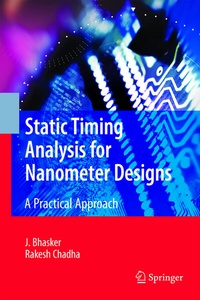
Static Timing Analysis for Nanometer Designs
A Practical Approach
Published on 17. April 2009
Book
Hardback
XX, 572 pages
978-0-387-93819-6 (ISBN)
Description
iming, timing, timing! That is the main concern of a digital designer charged with designing a semiconductor chip. What is it, how is it T described, and how does one verify it? The design team of a large digital design may spend months architecting and iterating the design to achieve the required timing target. Besides functional verification, the t- ing closure is the major milestone which dictates when a chip can be - leased to the semiconductor foundry for fabrication. This book addresses the timing verification using static timing analysis for nanometer designs. The book has originated from many years of our working in the area of timing verification for complex nanometer designs. We have come across many design engineers trying to learn the background and various aspects of static timing analysis. Unfortunately, there is no book currently ava- able that can be used by a working engineer to get acquainted with the - tails of static timing analysis. The chip designers lack a central reference for information on timing, that covers the basics to the advanced timing veri- cation procedures and techniques.
More details
Edition
2009 ed.
Language
English
Place of publication
New York
United States
Target group
Professional and scholarly
Professional/practitioner
Product notice
Unsewn / adhesive bound
Paper over boards
Illustrations
225 s/w Abbildungen
XX, 572 p. 225 illus.
Dimensions
Height: 241 mm
Width: 161 mm
Thickness: 40 mm
Weight
1056 gr
ISBN-13
978-0-387-93819-6 (9780387938196)
DOI
10.1007/978-0-387-93820-2
Schweitzer Classification
Other editions
Additional editions
Book
09/2011
Springer
€213.99
Shipment within 15-20 days
E-Book
04/2009
1st Edition
Springer
€203.29
Available for download
Content
STA Concepts.- Standard Cell Library.- Interconnect Parasitics.- Delay Calculation.- Crosstalk and Noise.- Configuring the STA Environment.- Timing Verification.- Interface Analysis.- Robust Verification.