

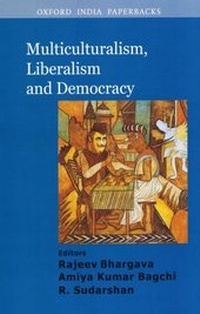
Multiculturalism, Liberalism and Democracy
Published in December 2007
Book
Paperback/Softback
448 pages
978-0-19-569298-3 (ISBN)
Description
The last few decades have witnessed a shift towards a more balanced view in political theory and social science, one that acknowledges the cultural dimension of politics an the political dimension of culture. The essays in this volume reflect this shift by bringing together a number if interrelated themes of the multicultural perspective, such as the need for a stable identity; the link between identity, recognition and cultural community; the importance of belonging and cultural particularity. Significant questions are raised and discussed: What does it mean to recognize cultural communities? Does recognition entail subsidies from the state? Should every culture be publicly recognized? How can multiculturalism be prevented from being hierarchical and authoritarian? Can it be made liberal and democratic? Can the presence of different cultures within one political order be trouble free or will it always be conflict ridden?
More details
Language
English
Place of publication
New Delhi
India
Target group
College/higher education
Professional and scholarly
Dimensions
Height: 217 mm
Width: 140 mm
Thickness: 25 mm
Weight
483 gr
ISBN-13
978-0-19-569298-3 (9780195692983)
Copyright in bibliographic data and cover images is held by Nielsen Book Services Limited or by the publishers or by their respective licensors: all rights reserved.
Schweitzer Classification
Persons
Rajeev Bhargava is Senior Fellow, Centre for the Study of Developing Societies, Delhi; Amiya Kumar Bagchi is Professor of Economics and Director, Institute of Development Studies, Kolkata; R. Sudarshan is Governance Adviser, Regional Centre, United Nations Development Programme (UNDP), Bangkok.
Content
LIST OF CONTRIBUTORS;; 1. INTRODUCING MULTICULTURALISM (RAJEEV BHARGAVA); 2. IDENTITY AND INTEGRITY (ALAN MONTEFIORE);; 3. EXPENSIVE TASTES AND MULTICULTURALISM (G.A. COHEN);; 4. GOVERNANCE OF MULTICULTURAL POLITIES: LIMITS OF THE RULE OF LAW (R. SUDARSHAN);; 5. FRENCH REPUBLICANISM AND THICK MULTICULTURALISM (CATHERINE AUDARD);; 6. DEMOCRATIC EXCLUSION (AND ITS REMEDIES?) (CHARLES TAYLOR);; 7. SECULAR LIBERALISM AND THE MORAL PSYCHOLOGY OF IDENTITY (AKEEL BILGRAMI);; 8. THE MORAL PSYCHOLOGY OF IDENTITY BY AKEEL BILGRAMI: A COMMENTARY (ALAN MONTEFIORE);; 9. MULTICULTURALISM, GOVERNANCE AND THE INDIAN BOURGEOISIE (AMIYA KUMAR BAGCHI);; 10. MAKING A DIFFERENCE: HINDI, 1880-1930 (ALOK RAI);; 11. THE CONTEST OVER SPACE AND THE FORMATION OF COMMUNAL COLLECTIVITIES: BURIAL OF A FAKIR, CALCUTTA, 1924 (P.K. DATTA);; 12. NATION FROM ITS MARGINS: NOTES ON E.V. RAMASWAMYS IMPOSSIBLE NATION (M.S.S. PANDIAN);; 13. GENERIC SENTENCES, SOCIAL KINDS, AND STEREOTYPES (TISTA BAGCHI);; 14. PUBLIC SPHERE AND DEMOCRATIC GOVERNANCE IN CONTEMPORARY INDIA (JAVEED ALAM); CIVIL SOCIETY AND COMMUNITY: REFLECTIONS ON THE AFRICAN EXPERIENCE (MAHMOOD MAMDANI);; 15. CULTURES, COMMUNITIES AND THE HISTORY OF POLITICS IN SOUTHERN AFRICA (PREBEN KAARSHOLM);; 16. RECOGNIZING WHOM? MULTICULTURALISM, MUSLIM MINORITY IDENTITY AND THE MERS (SHAIL MAYARAM);; 17. POLITICS AND HISTORY AFTER SOVEREIGNTY (VIVEK DHARESHWAR);; INDEX