

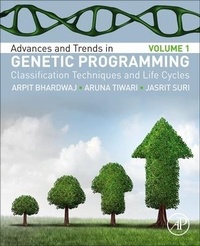
Advances and Trends in Genetic Programming
Volume 1: Classification Techniques and Life Cycles
Will be published approx. on 1. January 2029
Book
Paperback/Softback
220 pages
978-0-12-818020-4 (ISBN)
Description
Advances and Trends in Genetic Programming, Volume One: Classification Techniques and Life Cycles presents the reader with complete coverage of the most current developments in Genetic Programming for Artificial Intelligence. The book provides a thorough look at classification as a systematic way of predicting class membership for a set of examples or instances using the properties of those examples. Classification arises in a wide variety of real life situations, such as detecting faces from large database, finding vehicles, matching fingerprints and diagnosing medical conditions.
A classification algorithm requires huge amount of accuracy and reliability that is very difficult for human programmers. Therefore, there is a need to develop an automated computer-based classification system that can classify the required objects.
A classification algorithm requires huge amount of accuracy and reliability that is very difficult for human programmers. Therefore, there is a need to develop an automated computer-based classification system that can classify the required objects.
More details
Language
English
Place of publication
San Diego
United States
Publishing group
Elsevier Science Publishing Co Inc
Target group
Professional and scholarly
Students and researchers in neural engineering and computer science who are interested in genetic programming solutions for a wide variety of applications.
Product notice
Paperback (trade)
Unsewn / adhesive bound
Dimensions
Height: 235 mm
Width: 191 mm
ISBN-13
978-0-12-818020-4 (9780128180204)
Copyright in bibliographic data and cover images is held by Nielsen Book Services Limited or by the publishers or by their respective licensors: all rights reserved.
Schweitzer Classification
Persons
Harshit Bhardwaj did his M.Tech from Medicaps Institute of Science and Technology Indore, India in 2016. Currently, he is working as an Assistant Professor in Dronacharya Group of Institutions, Greater Noida, India. His research interests focus on Evolutionary Hybrid Algorithms. The motive behind this integration is to overcome individual limitations and achieve synergetic effects; more specifically these include Genetic Programming and Artificial Neural Networks and their applications in multi-class classification problems. In addition, he is also interested in Computer Vision. He has publications in Expert Systems with Application Elsevier Journal. Dr. Aruna Tiwari is an Associate Professor in Computer Science and Engineering at Indian Institute of Technology Indore (IIT Indore). She did her PhD in Computer Science & Engineering from RGPV Bhopal (MP). She did her M.E. and B.E. in Computer Engineering from Shri Govindaram Seksaria Institute Of Technology & Science, Indore (MP). Her research interests are around the Soft computing, Machine learning frameworks which can perform learning by handling real life ambiguous situations. Specifically, with artificial neural networks, fuzzy clustering, genetic programming and their applications to bioinformatics, medical diagnosis. The growing births of new intelligent system architectures are often due to the multi strategy learning and adaptation of advanced soft computing techniques in various fields such as pattern recognition, and data mining, particularly to address the issues of Big data for classification, clustering and feature selection. Big data computing needs advanced technologies or methods to solve the issues of computational time to extract valuable information, in a realistic and practical time frame, without compromising the model's quality. Therefore, the need for developing intelligent scalable algorithms has been felt, which will be able to perform classification, clustering and feature selection in optimal sense after adjusting their parameters in an adaptive way to accomplish faster solutions to address Big data. Collaboration is enable with Soyabean Research Centre, Indore for testing real life big data. She has more than 50 publications in various transactions and journals. She is a life time member of Computer Society of India, IEEE Computational Intelligence Society, and Soft Computing Research Society, India. Dr. Jasjit Suri, PhD, MBA, is a renowned innovator and scientist. He received the Director General's Gold Medal in 1980 and is a Fellow of several prestigious organizations, including the American Institute of Medical and Biological Engineering and the Institute of Electrical and Electronics Engineers. Dr. Suri has been honored with lifetime achievement awards from Marcus, NJ, USA, and Graphics Era University, India. He has published nearly 300 peer-reviewed AI articles, 100 books, and holds 100 innovations/trademarks, achieving an H-index of nearly 100 with about 43,000 citations. Dr. Suri has served as chairman of AtheroPoint, IEEE Denver section, and as an advisory board member to various healthcare industries and universities globally.
Content
Section 1: Overview on Machine Learning
1. Introduction on Machine Learning, Genetic programming life cycles, and classification in multi class problems
2. Inter-comparison of different types of machine learning algorithm for classification
3. Two class versus multi-class classification for numeric data
4. Types of genetic programming and their applications
Section 2: Tree-Based Genetic Programming
5. Tree-based Genetic programming for Classification
6. Diversity in initial population of Genetic programming
7. Intron in Genetic programming
8. The problem of Bloat in Genetic Programming: Effects of bloat on the Classifier evolvement
Section 3: Crossover and Mutation Operators in Genetic Programming
9. Dynamic Fitness Evaluation: It's effects on training paradigm
10. Crossover and Mutation Operators: How they Work in Parallel to Improve the Genetic Programming Life Cycle11. An Integrated model-based Genetic Programming Algorithm for the Multi-class Classification
1. Introduction on Machine Learning, Genetic programming life cycles, and classification in multi class problems
2. Inter-comparison of different types of machine learning algorithm for classification
3. Two class versus multi-class classification for numeric data
4. Types of genetic programming and their applications
Section 2: Tree-Based Genetic Programming
5. Tree-based Genetic programming for Classification
6. Diversity in initial population of Genetic programming
7. Intron in Genetic programming
8. The problem of Bloat in Genetic Programming: Effects of bloat on the Classifier evolvement
Section 3: Crossover and Mutation Operators in Genetic Programming
9. Dynamic Fitness Evaluation: It's effects on training paradigm
10. Crossover and Mutation Operators: How they Work in Parallel to Improve the Genetic Programming Life Cycle11. An Integrated model-based Genetic Programming Algorithm for the Multi-class Classification