

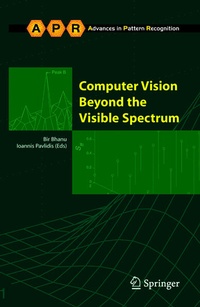
Computer Vision Beyond the Visible Spectrum
Published on 4. January 2005
Book
Hardback
X, 320 pages
978-1-85233-604-2 (ISBN)
Description
Recently, there has been a dramatic increase in the use of sensors in the non-visible bands. As a result, there is a need for existing computer vision methods and algorithms to be adapted for use with non-visible sensors, or for the development of completely new methods and systems.
Computer Vision Beyond the Visible Spectrum
is the first book to bring together state-of-the-art work in this area. It presents new & pioneering research across the electromagnetic spectrum in the military, commercial, and medical domains. By providing a detailed examination of each of these areas, it focuses on the development of state-of-the-art algorithms and looks at how they can be used to solve existing & new challenges within computer vision. Essential reading for academics & industrial researchers working in the area of computer vision, image processing, and medical imaging, it will also be useful background reading for advanced undergraduate & postgraduate students.
More details
Series
Edition
2005 ed.
Language
English
Place of publication
London
United Kingdom
Target group
College/higher education
Professional and scholarly
Research
Illustrations
151 s/w Abbildungen, 5 farbige Abbildungen
X, 320 p. 156 illus., 5 illus. in color.
Dimensions
Height: 241 mm
Width: 160 mm
Thickness: 26 mm
Weight
732 gr
ISBN-13
978-1-85233-604-2 (9781852336042)
DOI
10.1007/b138155
Schweitzer Classification
Other editions
Additional editions
Bir Bhanu | Ioannis Pavlidis
Computer Vision Beyond the Visible Spectrum
Book
10/2010
Springer
€160.49
Shipment within 15-20 days
Bir Bhanu | Ioannis Pavlidis
Computer Vision Beyond the Visible Spectrum
E-Book
03/2006
1st Edition
Springer
€149.79
Available for download
Content
A Theoretical Framework for Predicting Performance of Object Recognition.- Methods for Improving the Performance of an SAR Recognition System.- Three-Dimensional Laser Radar Recognition Approaches.- Target Classification Using Adaptive Feature Extraction and Subspace Projection for Hyperspectral Imagery.- Moving Object Detection and Compression in IR Sequences.- Face Recognition in the Thermal Infrared.- Cardiovascular MR Image Analysis.- Visualization and Segmentation Techniques in 3D Ultrasound Images.- Time-Frequency Analysis in Terahertz-Pulsed Imaging.