

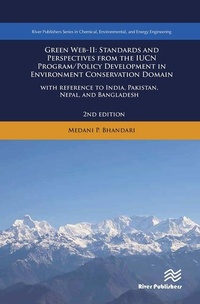
Green Web-II
Standards and Perspectives from the IUCN Program / Policy Development in Environment Conservation Domain - with reference to India, Pakistan, Nepal, and Bangladesh
2nd Edition
Published on 21. October 2024
Book
Paperback/Softback
364 pages
978-87-7004-332-8 (ISBN)
Description
This second edition of the book, "Green Web-II: Standards and Perspectives from the IUCN Program / Policy Development in Environment Conservation Domain- with reference to India, Pakistan, Nepal, and Bangladesh" investigates the IUCN's role in global biodiversity conservation policy as well as in national program development in India, Pakistan, Nepal and Bangladesh. It explores how nature protection priorities and approaches are promoted or addressed by IUCN, and how environment conservation policies are created and maintained in states of South Asia with different capacities. It also evaluates IUCN's competency in biodiversity, climate change, nature conservation and environmental policy formulation at the global, regional and country levels.
This book adds to our knowledge firstly by contributing to a small but growing body of work on the sociology of international organizations. International Governmental Organizations (IGOs), have previously been mainly the subject of political science. Secondly, it critically explores one of the largest and most active nature conservation organizations in the world. Thirdly, it also explores how IUCN actually goes about building protectoral programs with individual member nations. Finally, the research also shows the historical development of global institutions and IUCN's activities with member nations in helping to define or redefine the concept of global governance. The outcomes of this research will also be beneficial for global collaboration, networking, and for the identification of common concerns among the many environmental and conservational organizations at the international and national level. In this broader sense, the research outcomes might be beneficial to constituencies of the global North as well as global South because of the nature and coverage of IUCN and its role in conservation policy formation. This effort may serve as a model for additional research on international organizations.
Technical topics discussed in the book include:? The Motivation for Environmental Conservation- How personal efforts make a difference? The Role of International Environment Conservation Organizations? The Political Economy of Organizations, Network theory, Institutional theory, Stakeholder theory, Governance theory? Governance performance and Competitiveness ? Popularity indices? Knowledge creation and diffusion? Conservation commons
This book adds to our knowledge firstly by contributing to a small but growing body of work on the sociology of international organizations. International Governmental Organizations (IGOs), have previously been mainly the subject of political science. Secondly, it critically explores one of the largest and most active nature conservation organizations in the world. Thirdly, it also explores how IUCN actually goes about building protectoral programs with individual member nations. Finally, the research also shows the historical development of global institutions and IUCN's activities with member nations in helping to define or redefine the concept of global governance. The outcomes of this research will also be beneficial for global collaboration, networking, and for the identification of common concerns among the many environmental and conservational organizations at the international and national level. In this broader sense, the research outcomes might be beneficial to constituencies of the global North as well as global South because of the nature and coverage of IUCN and its role in conservation policy formation. This effort may serve as a model for additional research on international organizations.
Technical topics discussed in the book include:? The Motivation for Environmental Conservation- How personal efforts make a difference? The Role of International Environment Conservation Organizations? The Political Economy of Organizations, Network theory, Institutional theory, Stakeholder theory, Governance theory? Governance performance and Competitiveness ? Popularity indices? Knowledge creation and diffusion? Conservation commons
More details
Edition
2nd edition
Language
English
Place of publication
Gistrup
Denmark
Target group
Professional and scholarly
Academic
Product notice
Paperback (trade)
Unsewn / adhesive bound
Dimensions
Height: 234 mm
Width: 156 mm
Weight
620 gr
ISBN-13
978-87-7004-332-8 (9788770043328)
Copyright in bibliographic data and cover images is held by Nielsen Book Services Limited or by the publishers or by their respective licensors: all rights reserved.
Schweitzer Classification
Other editions
Additional editions
Medani P. Bhandari
Green Web-II
Standards and Perspectives from the IUCN Program / Policy Development in Environment Conservation Domain - with reference to India, Pakistan, Nepal, and Bangladesh
E-Book
09/2022
2nd Edition
Taylor & Francis
€56.49
Available for download
Medani P. Bhandari
Green Web-II
Standards and Perspectives from the IUCN Program / Policy Development in Environment Conservation Domain - with reference to India, Pakistan, Nepal, and Bangladesh
E-Book
09/2022
2nd Edition
Taylor & Francis
€56.49
Available for download
Medani P. Bhandari
Green Web-II
Standards and Perspectives from the IUCN Program / Policy Development in Environment Conservation Domain - with reference to India, Pakistan, Nepal, and Bangladesh
Book
05/2020
2nd Edition
River Publishers
€164.60
Article not available for order
Content
1 Introduction 2 Literature on the Topic 3 Methodology 4 The IUCN - An International Organization for Environment Conservation 5 Exploring IUCN's Failings - Members Perspective 6 The Strengths and Weaknesses of the IUCN 7 Comparative Chapter: Case Studies of Bangladesh, India, Nepal, and Pakistan 8 IUCN's Role for Conservation of Nature in Bangladesh, India, Nepal, and Pakistan 9 Discussion of Theory, Knowledge Creation, and Diffusion at IUCN: National and International Programs 10 Conclusion