

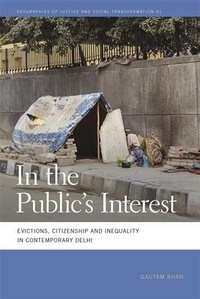
In the Public's Interest
Evictions, Citizenship, and Inequality in Contemporary Delhi
Published on 15. November 2016
Book
Paperback/Softback
308 pages
978-0-8203-5010-3 (ISBN)
Description
This book studies the recent legacy of basti "evictions" in Delhi-mass clearings of some of the city's poorest neighborhoods-as a way to understand how the urban poor are disenfranchised in the name of "public interest" and, in the case of Delhi, by the very courts meant to empower and protect them. Studying bastes, says Gautam Bhan, provokes six clear lines of inquiry applicable to studies of urbanism across the global south.
The first is the long-standing debate over urban informality and illegality: the debate's impact on conceptions and practices of urban planning, the production of space, and the regulation of value. The second is a set of debates on "good governance," read through their intersections with ideas of "planned development" within rapidly transforming cities. The third is the political field of urban citizenship and the possibilities of substantive rights and belonging in the city. The fourth is resistance and the ability of a city's subaltern residents to struggle against exclusion. The two remaining inquiries both cut across and unify the first four. One of these is the role of the judiciary and the relationships between law and urbanism in cities of the global south. The other is the relationship between democracy and inequality in the city.
What emerges about Delhi in particular are a set of new modes for the reproduction of inequality. When rights are lost, citizenship is unequal and differentiated, the promise of development is refused, and poverty and inequality are reproduced and deepened. The task at hand, says Bhan, is not just to explain evictions but also to listen to what they are telling us about "the city that is as well as the city that can be."
The first is the long-standing debate over urban informality and illegality: the debate's impact on conceptions and practices of urban planning, the production of space, and the regulation of value. The second is a set of debates on "good governance," read through their intersections with ideas of "planned development" within rapidly transforming cities. The third is the political field of urban citizenship and the possibilities of substantive rights and belonging in the city. The fourth is resistance and the ability of a city's subaltern residents to struggle against exclusion. The two remaining inquiries both cut across and unify the first four. One of these is the role of the judiciary and the relationships between law and urbanism in cities of the global south. The other is the relationship between democracy and inequality in the city.
What emerges about Delhi in particular are a set of new modes for the reproduction of inequality. When rights are lost, citizenship is unequal and differentiated, the promise of development is refused, and poverty and inequality are reproduced and deepened. The task at hand, says Bhan, is not just to explain evictions but also to listen to what they are telling us about "the city that is as well as the city that can be."
Reviews / Votes
This masterful book by Bhan not only opens up a range of new questions for critical urban theorists, it also offers a method of inquiry which begins with a case, embedded in a context, in 'place', and uses this as a lens to suggest perspectives on cities elsewhere...This will be a book of considerable value to urban and planning researchers, academics and students and particularly those interested in global South cities and critical urban theory. -- Vanessa Watson * Urban Studies *More details
Series
Language
English
Place of publication
Georgia
United States
Target group
College/higher education
Professional and scholarly
Product notice
Paperback (trade)
Dimensions
Height: 226 mm
Width: 154 mm
Thickness: 25 mm
Weight
310 gr
ISBN-13
978-0-8203-5010-3 (9780820350103)
Copyright in bibliographic data and cover images is held by Nielsen Book Services Limited or by the publishers or by their respective licensors: all rights reserved.
Schweitzer Classification
Person
GAUTAM BHAN is a senior consultant for academics and research at the Indian Institute for Human Settlements. He is the coeditor of the forthcoming Routledge Companion to Planning in the Global South; coauthor (with Kalyani Menon-Sen) of Swept off the Map: Surviving Eviction and Resettlement in Delhi; and coeditor (with Arvind Narrain) of Because I Have a Voice: Queer Politics in India.