

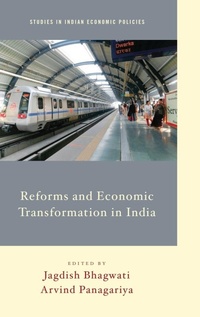
Reforms and Economic Transformation in India
Published on 13. February 2014
Book
Hardback
312 pages
978-0-19-991520-0 (ISBN)
Description
Reforms and Economic Transformation in India is the second volume in the series Studies in Indian Economic Policies. The first volume, India's Reforms: How They Produced Inclusive Growth (OUP, 2012), systematically demonstrated that reforms-led growth in India led to reduced poverty among all social groups. They also led to shifts in attitudes whereby citizens overwhelmingly acknowledge the benefits that accelerated growth has brought them and as voters, they now reward the governments that deliver superior economic outcomes and punish those that fail to do so.
This latest volume takes as its starting point the fact that while reforms have undoubtedly delivered in terms of poverty reduction and associated social objectives, the impact has not been as substantial as seen in other reform-oriented economies such as South Korea and Taiwan in the 1960s and 1970s, and more recently, in China. The overarching hypothesis of the volume is that the smaller reduction in poverty has been the result of slower transformation of the economy from a primarily agrarian to a modern, industrial one. Even as the GDP share of agriculture has seen rapid decline, its employment share has declined very gradually. More than half of the workforce in India still remains in agriculture. In addition, non-farm workers are overwhelmingly in the informal sector. Against this background, the nine original essays by eminent economists pursue three broad themes using firm level data in both industry and services.
The papers in part I ask why the transformation in India has been slow in terms of the movement of workers out of agriculture, into industry and services, and from informal to formal employment. They address what India needs to do to speed up this transformation. They specifically show that severe labor-market distortions and policy bias against large firms has been a key factor behind the slow transformation. The papers in part II analyze the transformation that reforms have brought about within and across enterprises. For example, they investigate the impact of privatization on enterprise profitability. Part III addresses the manner in which the reforms have helped promote social transformation. Here the papers analyze the impact the reforms have had on the fortunes of the socially disadvantaged groups in terms of wage and education outcomes and as entrepreneurs.
This latest volume takes as its starting point the fact that while reforms have undoubtedly delivered in terms of poverty reduction and associated social objectives, the impact has not been as substantial as seen in other reform-oriented economies such as South Korea and Taiwan in the 1960s and 1970s, and more recently, in China. The overarching hypothesis of the volume is that the smaller reduction in poverty has been the result of slower transformation of the economy from a primarily agrarian to a modern, industrial one. Even as the GDP share of agriculture has seen rapid decline, its employment share has declined very gradually. More than half of the workforce in India still remains in agriculture. In addition, non-farm workers are overwhelmingly in the informal sector. Against this background, the nine original essays by eminent economists pursue three broad themes using firm level data in both industry and services.
The papers in part I ask why the transformation in India has been slow in terms of the movement of workers out of agriculture, into industry and services, and from informal to formal employment. They address what India needs to do to speed up this transformation. They specifically show that severe labor-market distortions and policy bias against large firms has been a key factor behind the slow transformation. The papers in part II analyze the transformation that reforms have brought about within and across enterprises. For example, they investigate the impact of privatization on enterprise profitability. Part III addresses the manner in which the reforms have helped promote social transformation. Here the papers analyze the impact the reforms have had on the fortunes of the socially disadvantaged groups in terms of wage and education outcomes and as entrepreneurs.
More details
Series
Language
English
Place of publication
New York
United States
Target group
Professional and scholarly
Illustrations
42 illustrations
Dimensions
Height: 240 mm
Width: 161 mm
Thickness: 23 mm
Weight
688 gr
ISBN-13
978-0-19-991520-0 (9780199915200)
Copyright in bibliographic data and cover images is held by Nielsen Book Services Limited or by the publishers or by their respective licensors: all rights reserved.
Schweitzer Classification
Other editions
Additional editions
Jagdish Bhagwati | Arvind Panagariya
Reforms and Economic Transformation in India
E-Book
10/2012
1st Edition
OUP eBook
€36.99
Available for download
Jagdish Bhagwati | Arvind Panagariya
Reforms and Economic Transformation in India
E-Book
10/2012
1st Edition
OUP eBook
€36.99
Available for download
Persons
Jagdish Bhagwati, University Professor at Columbia University and Senior Fellow in International Economics at the Council on Foreign Relations, is a prominent economist.
Arvind Panagariya is Professor of Economics & Jagdish Bhagwati Professor of Indian Political Economy at Columbia University and a Non-resident Senior Fellow at the Brookings Institution.
Arvind Panagariya is Professor of Economics & Jagdish Bhagwati Professor of Indian Political Economy at Columbia University and a Non-resident Senior Fellow at the Brookings Institution.
Content
1. INTRODUCTION; JAGDISH BHAGWATI AND ARVIND PANAGARIYA; PART I: REFORMS AND THE TRANSFORMATION WITHIN MANUFACTURING AND SERVICES; 2. LABOR LAWS AND THE FIRM SIZE DISTRIBUTION IN INDIAN MANUFACTURING; RANA HASAN AND KARL ROBERT L. JANDOC; 3. COMPLEMENTARITY BETWEEN ORGANIZED AND UNORGANIZED MANUFACTURING IN INDIA: THE ROLE OF POLICIES AND INSTITUTIONS; ASHA SUNDARAM, RESHAD N. AHSAN AND DEVASHISH MITRA; 4. SERVICES GROWTH IN INDIA: A LOOK INSIDE THE BLACK BOX; RAJIV DEHEJIA AND ARVIND PANAGARIYA; 5. ORGANIZED RETAILING IN INDIA: ISSUES AND OUTLOOK; RAJIV KOHLI AND JAGDISH BHAGWATI; PART II: REFORMS AND THE TRANSFORMATION WITHIN AND ACROSS ENTERPRISES; 6. SELLING THE FAMILY SILVER TO PAY THE GROCER'S BILL? THE CASE OF PRIVATIZATION IN INDIA; NANDINI GUPTA; 7. VARIETY IN, VARIETY OUT: IMPORTED INPUT AND PRODUCT SCOPE EXPANSION IN INDIA; PINELOPI GOLDBERG, AMIT KHANDELWAL AND NINA PAVCNIK; 8. REFORMS AND THE COMPETITION ENVIRONMENT; LAURA ALFARO AND ANUSHA CHARI; PART III: REFORMS AND SOCIAL TRANSFORMATION; 9. THE POST-REFORM NARROWING OF INEQUALITY ACROSS CASTES: EVIDENCE FROM THE STATES; VIKTORIA HNATKOVSKA AND AMARTYA LAHIRI; 10. ENTREPRENEURSHIP IN SERVICES AND SOCIALLY DISADVANTAGED IN INDIA; RAJEEV DEHEJIA AND ARVIND PANAGARIYA