

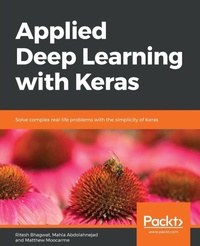
Applied Deep Learning with Keras
Solve complex real-life problems with the simplicity of Keras
Published on 24. April 2019
Book
Paperback/Softback
412 pages
978-1-83855-507-8 (ISBN)
Description
Take your neural networks to a whole new level with the simplicity and modularity of Keras, the most commonly used high-level neural networks API.
Key Features
Solve complex machine learning problems with precision
Evaluate, tweak, and improve your deep learning models and solutions
Use different types of neural networks to solve real-world problems
Book DescriptionThough designing neural networks is a sought-after skill, it is not easy to master. With Keras, you can apply complex machine learning algorithms with minimum code.
Applied Deep Learning with Keras starts by taking you through the basics of machine learning and Python all the way to gaining an in-depth understanding of applying Keras to develop efficient deep learning solutions. To help you grasp the difference between machine and deep learning, the book guides you on how to build a logistic regression model, first with scikit-learn and then with Keras. You will delve into Keras and its many models by creating prediction models for various real-world scenarios, such as disease prediction and customer churning. You'll gain knowledge on how to evaluate, optimize, and improve your models to achieve maximum information. Next, you'll learn to evaluate your model by cross-validating it using Keras Wrapper and scikit-learn. Following this, you'll proceed to understand how to apply L1, L2, and dropout regularization techniques to improve the accuracy of your model. To help maintain accuracy, you'll get to grips with applying techniques including null accuracy, precision, and AUC-ROC score techniques for fine tuning your model.
By the end of this book, you will have the skills you need to use Keras when building high-level deep neural networks.What you will learn
Understand the difference between single-layer and multi-layer neural network models
Use Keras to build simple logistic regression models, deep neural networks, recurrent neural networks, and convolutional neural networks
Apply L1, L2, and dropout regularization to improve the accuracy of your model
Implement cross-validate using Keras wrappers with scikit-learn
Understand the limitations of model accuracy
Who this book is forIf you have basic knowledge of data science and machine learning and want to develop your skills and learn about artificial neural networks and deep learning, you will find this book useful. Prior experience of Python programming and experience with statistics and logistic regression will help you get the most out of this book. Although not necessary, some familiarity with the scikit-learn library will be an added bonus.
Key Features
Solve complex machine learning problems with precision
Evaluate, tweak, and improve your deep learning models and solutions
Use different types of neural networks to solve real-world problems
Book DescriptionThough designing neural networks is a sought-after skill, it is not easy to master. With Keras, you can apply complex machine learning algorithms with minimum code.
Applied Deep Learning with Keras starts by taking you through the basics of machine learning and Python all the way to gaining an in-depth understanding of applying Keras to develop efficient deep learning solutions. To help you grasp the difference between machine and deep learning, the book guides you on how to build a logistic regression model, first with scikit-learn and then with Keras. You will delve into Keras and its many models by creating prediction models for various real-world scenarios, such as disease prediction and customer churning. You'll gain knowledge on how to evaluate, optimize, and improve your models to achieve maximum information. Next, you'll learn to evaluate your model by cross-validating it using Keras Wrapper and scikit-learn. Following this, you'll proceed to understand how to apply L1, L2, and dropout regularization techniques to improve the accuracy of your model. To help maintain accuracy, you'll get to grips with applying techniques including null accuracy, precision, and AUC-ROC score techniques for fine tuning your model.
By the end of this book, you will have the skills you need to use Keras when building high-level deep neural networks.What you will learn
Understand the difference between single-layer and multi-layer neural network models
Use Keras to build simple logistic regression models, deep neural networks, recurrent neural networks, and convolutional neural networks
Apply L1, L2, and dropout regularization to improve the accuracy of your model
Implement cross-validate using Keras wrappers with scikit-learn
Understand the limitations of model accuracy
Who this book is forIf you have basic knowledge of data science and machine learning and want to develop your skills and learn about artificial neural networks and deep learning, you will find this book useful. Prior experience of Python programming and experience with statistics and logistic regression will help you get the most out of this book. Although not necessary, some familiarity with the scikit-learn library will be an added bonus.
More details
Language
English
Place of publication
Birmingham
United Kingdom
Target group
Professional and scholarly
US School Grade: College Graduate Student
Dimensions
Height: 235 mm
Width: 191 mm
Thickness: 23 mm
Weight
766 gr
ISBN-13
978-1-83855-507-8 (9781838555078)
Copyright in bibliographic data and cover images is held by Nielsen Book Services Limited or by the publishers or by their respective licensors: all rights reserved.
Schweitzer Classification
Other editions
Additional editions
Ritesh Bhagwat Bhagwat | Mahla Abdolahnejad Abdolahnejad | Matthew Moocarme
Applied Deep Learning with Keras
Solve complex real-life problems with the simplicity of Keras
E-Book
04/2019
Packt Publishing
€27.49
Available for download
Persons
Ritesh Bhagwat has a master's degree in applied mathematics with a specialization in computer science. He has over 14 years of experience in data-driven technologies and has led and been a part of complex projects ranging from data warehousing and business intelligence to machine learning and artificial intelligence. He has worked with top-tier global consulting firms as well as large multinational financial institutions. Currently, he works as a data scientist. Besides work, he enjoys playing and watching cricket and loves to travel. He is also deeply interested in Bayesian statistics. Mahla Abdolahnejad is a Ph.D. candidate in systems and computer engineering with Carleton University, Canada. She also holds a bachelor's degree and a master's degree in biomedical engineering, which first exposed her to the field of artificial intelligence and artificial neural networks, in particular. Her Ph.D. research is focused on deep unsupervised learning for computer vision applications. She is particularly interested in exploring the differences between a human's way of learning from the visual world and a machine's way of learning from the visual world, and how to push machine learning algorithms toward learning and thinking like humans. Matthew Moocarme is an accomplished data scientist with more than eight years of experience in creating and utilizing machine learning models. He comes from a background in the physical sciences, in which he holds a Ph.D. in physics from the Graduate Center of CUNY. Currently, he leads a team of data scientists and engineers in the media and advertising space to build and integrate machine learning models for a variety of applications. In his spare time, Matthew enjoys sharing his knowledge with the data science community through published works, conference presentations, and workshops.
Content
Table of Contents
Introduction to Machine Learning with Keras
Machine Learning versus Deep Learning
Deep Learning with Keras
Evaluate your Model with Cross Validation with Keras Wrappers
Improving Model Accuracy
Model Evaluation
Computer Vision with Convolutional Neural Networks
Transfer Learning and Pre-Trained Models
Sequential Modeling with Recurrent Neural Network
Introduction to Machine Learning with Keras
Machine Learning versus Deep Learning
Deep Learning with Keras
Evaluate your Model with Cross Validation with Keras Wrappers
Improving Model Accuracy
Model Evaluation
Computer Vision with Convolutional Neural Networks
Transfer Learning and Pre-Trained Models
Sequential Modeling with Recurrent Neural Network