

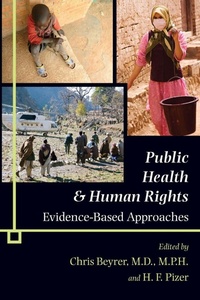
Public Health and Human Rights
Evidence-Based Approaches
Published on 23. November 2007
Book
Paperback/Softback
512 pages
978-0-8018-8647-8 (ISBN)
Description
Human rights violations are underlying causes of adverse health outcomes for vulnerable people and populations around the world. Public Health and Human Rights provides critical, evidence-based assessments and tools with which to investigate the role of rights abrogation in the health of populations-from repressive laws to social discord, gender-based violence, human trafficking, and violations in conflict. Divided into three sections, this provocative work investigates how the complex interactions between rights and health can best be studied, analyzed, and remedied; how the efforts of human rights advocates affect health outcomes; and how modern public health procedures can assist in documenting, understanding, and preventing human rights violations. Part I illuminates the powerful relationship between rights work and public health practice in Thailand, Russia, Burma, and China and in U.S. prisons. Part II explores new methodologies and new uses of previous practices for rights-based public health research.
Part III confronts current policy approaches-such as Brazil's integration of rights, HIV/AIDS programming, and the contradictory and confounding global policies on illicit drugs-and offers recommendations for future programs and strategies.
Part III confronts current policy approaches-such as Brazil's integration of rights, HIV/AIDS programming, and the contradictory and confounding global policies on illicit drugs-and offers recommendations for future programs and strategies.
Reviews / Votes
Many of the case studies are powerful and hopeful... Recommended. Choice 2008 The strength of the book is the authors' and editors' insistence on 'evidence-based approaches' to abuse and harm. They explain why acquiring reliable evidence about the effects on health of abuses of human rights requires changing principles and methods that researchers in industrial countries take for granted. -- Daniel M. Fox, PhD JAMA 2008 The message of this book is clear... A rights-based analysis of our public health policies is a requirement of the times in which we live. -- William M. Valenti AIDS Reader 2008 The book is well constructed and provides insights into how to approach public health programs in unique situations where human rights violations constrain public health workers' ability to assist populations at risk... The examples in this book provide a set of tools to consider when we find ourselves in unique situations. -- Maryn Elizabeth Torner Doody's Review Service 2008 A good resource for students. It is a quick and interesting read. -- Catherine G. Chalin Canadian Journal of Public Health 2008 This engaging and important book is likely to interest a broad range of readers. -- Steven S. Coughlin European Journal of Public Health 2008 Valuable and enlightening... Mental health specialists will find here much to reflect about. Journal of Nervous and Mental Disease 2008 A good addition to the burgeoning literature on global health, and I would recommend it strongly to practitioners. -- Nana K. Poku Development in Practice 2008 The individual case studies are fascinating, and provide insight into the challenges of working in oppressive and dangerous environments. -- Kate van Dooren Critical Public Health 2008 Well researched and timely, and cites well-documented evidence. Journal of Health Care for the Poor and Underserved 2010More details
Language
English
Place of publication
Baltimore, MD
United States
Target group
College/higher education
Product notice
Paperback (trade)
Illustrations
31 s/w Abbildungen
31 Illustrations, black and white
Dimensions
Height: 229 mm
Width: 152 mm
Thickness: 30 mm
Weight
826 gr
ISBN-13
978-0-8018-8647-8 (9780801886478)
DOI
10.56021/9780801886461
Copyright in bibliographic data and cover images is held by Nielsen Book Services Limited or by the publishers or by their respective licensors: all rights reserved.
Schweitzer Classification
Other editions
Additional editions
Book
11/2007
Johns Hopkins University Press
€72.00
Article not available for order
Persons
Chris Beyrer, M.D., M.P.H., is a professor of epidemiology and international health, director of the Center for Public Health and Human Rights, and associate director of the Center for Global Health at the Johns Hopkins Bloomberg School of Public Health. H. F. Pizer is the cofounder and principal of Health Care Strategies, Inc., and author, coauthor, or editor of thirteen medical books.
Content
Foreword, by Leonard S. Rubenstein
Preface
Contributors
List of Acronyms
Introduction: Human Rights and the Health of Populations
Part I: Cases and Contexts
1. Health and Human Rights in the Midst of a Drug War: The Thai Drug Uses' Network
2. The Impact of Human Rights Violations on Health among Internally Displaced Persons in Conflict Zones: Burma
3. Consequances of a Stalled Response: Iatrogenic Epidemic among Blood Donors in Central China
4. Women's Health and Women's Rights: Selling Sex in Moscow
5. Reducing Harm in Prisons: Lessons from the United States and Worldwide
Part II: Methods
6. using Molecular Tools to Track Epidemics and Investigate Human Rights and Disease Interactions
7. Documenting the Effects of Trafficking in Women
8. Documenting Sexual Violence among Internally Displaced Women: Sierra Leone
9. The Crime of Genocide: Darfur
10. Public Health Research in a Human Rights Crisis: The Effects of the Thai "War on Drugs"
11. Maps in the Sand: Investigating Health and Human Rights in Afghanistan and Darfur
12. Civil Conflict and Health Infromation: The Democratis Republic of Congo
Part III: Policy
13. From Human Rights Principles to Public Health Practice: HIV/AIDS Policy in Brazil
14. Seeing Double: Mapping Contradictions in HIV Prevention and Illicit Drug Policy Worldwide
15. Human Rights and Public Health Ethics: Responding to the Global HIV/AIDS pandemic
16. Gender and Sexual Health Rights: Burma
17. Advocacy Strategies for Affording the Right to Health
Index
Preface
Contributors
List of Acronyms
Introduction: Human Rights and the Health of Populations
Part I: Cases and Contexts
1. Health and Human Rights in the Midst of a Drug War: The Thai Drug Uses' Network
2. The Impact of Human Rights Violations on Health among Internally Displaced Persons in Conflict Zones: Burma
3. Consequances of a Stalled Response: Iatrogenic Epidemic among Blood Donors in Central China
4. Women's Health and Women's Rights: Selling Sex in Moscow
5. Reducing Harm in Prisons: Lessons from the United States and Worldwide
Part II: Methods
6. using Molecular Tools to Track Epidemics and Investigate Human Rights and Disease Interactions
7. Documenting the Effects of Trafficking in Women
8. Documenting Sexual Violence among Internally Displaced Women: Sierra Leone
9. The Crime of Genocide: Darfur
10. Public Health Research in a Human Rights Crisis: The Effects of the Thai "War on Drugs"
11. Maps in the Sand: Investigating Health and Human Rights in Afghanistan and Darfur
12. Civil Conflict and Health Infromation: The Democratis Republic of Congo
Part III: Policy
13. From Human Rights Principles to Public Health Practice: HIV/AIDS Policy in Brazil
14. Seeing Double: Mapping Contradictions in HIV Prevention and Illicit Drug Policy Worldwide
15. Human Rights and Public Health Ethics: Responding to the Global HIV/AIDS pandemic
16. Gender and Sexual Health Rights: Burma
17. Advocacy Strategies for Affording the Right to Health
Index