

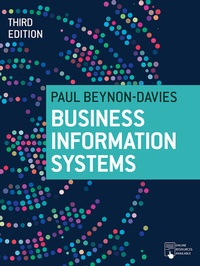
Business Information Systems
3rd Edition
Published on 11. November 2019
Book
Paperback/Softback
XXXV, 475 pages
978-1-352-00738-1 (ISBN)
Description
Focused on the needs of the Business and Management students, this text is comprehensive and builds up understanding in an integrated coherent way. Assuming no prior knowledge, and with a strong theoretical underpinning, coupled with practical application and case studies, it makes high level material accessible to newcomers to the discipline.
Reviews / Votes
The author offers a clearly-organized and case study supported approach for real-world information system topics. The textbook bridges theory and practice in an intuitive und understandable manner. It is a must-read for every student in the field. * Dirk Drechsler, Offenburg University, Germany * Beynon-Davies's updated classic provides a timely perspective on all elements of the modern ICT backbone that students and practitioners will find refreshing and useful in understanding the strategic role of IT in a data-driven decision making environment. * Nikolaos Korfiatis, University of East Anglia, UK * Business Information Systems provides an up-to-date and concise overview of a wide range of aspects related to the role of information in modern organisations, the increasing importance of electronic commerce and social media marketing as well as how to exploit digital opportunities for innovation. Relevant illustrations help to make it easier for students to understand the complexities of digital business. Exercises and Review Tests bring the subject matter to life even further. A balanced and usable book. * Markus Haag, University of Bedfordshire, UK * This third edition of Business Information Systems builds on previous editions by incorporating such key contemporary topics as big data; the internet of things; blockchain; social media; design thinking and cyber security. Importantly, considerations of sustainability and ethics also feature, as do reflections on contemporary technological trends and their impacts on business, organisations and society. This is essential reading, not just for those studying business information systems per se but for aspiring managers of all descriptions given the criticality and pervasiveness of digital technology both now and in the future. * Robert Galliers, Bentley University, USA * A very practical and up-to-date approach to business information systems. Grounded in principles of good teaching practice, this text is an excellent and accessible resource for both students and instructors. Terminology is contextually and gently introduced. The often-troublesome gap between theory and practice is effectively bridged through the extensive use of examples, stories and case studies, all highly relevant to the pervading digital environment. * Geraldine Torrisi-Steele, Griffith University, Australia * In a digital society it can be difficult to find a textbook that covers computer science and business in one place. However, Business Information Systems by Paul Beynon-Davies does just that and is a great book that simplifies the complicated and makes learning easy. I highly recommend this book. * Wayne Palmer, Buckinghamshire New University, UK * I have admired the work of Paul Beynon-Davies for years. His writing is of the highest standard and is truly engaging. That's why I welcome the third edition of his textbook on Business Information Systems. It offers a comprehensive, up-to-date and rich learning experience for students of information systems. * Markus Lahtinen, Lund University, Sweden * Paul Beynon-Davies provides an engaging and comprehensive explanation of information systems and why they are important to business. It is grounded in a clear understanding of how technology is continuing to evolve and of the impact of this on how we live and work. It is illustrated by a range of excellent thought-provoking case studies. * Martin Rich, City University, London, UK * Business Information Systems is a comprehensive teaching aid for both undergraduate and postgraduate university courses which covers both the fundamentals and also some more cutting edge aspects of information systems. The text is engaging and encourages students to learn and reflect. * Philip Garnett, University of York, UK *More details
Edition
3rd ed. 2020
Language
English
Place of publication
London
United Kingdom
Publishing group
Bloomsbury Publishing PLC
Target group
College/higher education
Professional and scholarly
Illustrations
223 farbige Tabellen
4 bw illus
Dimensions
Height: 210 mm
Width: 279 mm
Thickness: 21 mm
Weight
1294 gr
ISBN-13
978-1-352-00738-1 (9781352007381)
DOI
10.26777/978-1-352-00739-8
Schweitzer Classification
Other editions
Additional editions
Paul Beynon-Davies
Business Information Systems
E-Book
11/2019
3rd Edition
Bloomsbury Academic
€140.99
Available for download
Paul Beynon-Davies
Business Information Systems
E-Book
11/2019
3rd Edition
Bloomsbury Academic
€77.99
Available for download
Previous edition
Paul Beynon-Davies
Business Information Systems
Book
08/2013
2nd Edition
Red Globe Press
€72.75
Article exhausted; check for reprint
Person
Paul Beynon-Davies is Emeritus Professor of Organisational Informatics at Cardiff Business School, Cardiff University, UK. Prior to academia, he worked in the UK Informatics industry for a number of years, and has since published widely in the fields of Business Information Systems, Electronic Business and Business Analysis, including a number of other textbooks with us such as eBusiness, and he is currently writing a new text on Business Analysis. He is highly regarded among lecturers in the field, especially in the UK and Europe.
Content
1. Introduction: The domain of business information systems.- 2. Systems of organisation.- 3. Data and information.- 4. The infrastructure of organisation.- 5. ICT infrastructure.- 6. The digital environment.- 7. Digital business.- 8. Electronic marketing, procurement and government.- 9. Mobile commerce and social media.- 10. Designing digital organisation.- 11. Digital strategy and digital innovation.- 12. Managing and operating digital infrastructure.- 13. The changing nature of digital infrastructure.