

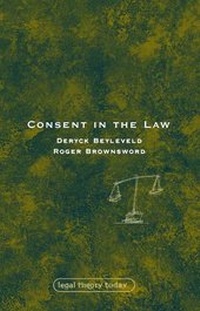
Consent in the Law
Published on 26. January 2007
Book
Hardback
406 pages
978-1-84113-679-0 (ISBN)
Description
In a community that takes rights seriously, consent features pervasively in both moral and legal discourse as a justifying reason: stated simply, where there is consent, there can be no complaint. However, without a clear appreciation of the nature of a consent-based justification, its integrity, both in principle and in practice, is liable to be compromised. This book examines the role of consent as a procedural justification, discussing the prerequisites for an adequate consent -- in particular, that an agent with the relevant capacity has made an unforced and informed choice, that the consent has been clearly signalled, and that the scope of the authorisation covers the act in question. It goes on to highlight both the Fallacy of Necessity (where there is no consent, there must be a wrong) and the Fallacy of Sufficiency (where there is consent, there cannot be a wrong). Finally, the extent to which the authority of law itself rests on consent is considered.
If the familiarity of consent-based justification engenders confusion and contempt, the analysis in this book acts as a corrective, identifying a range of abusive or misguided practices that variously under-value or over-value consent, that fictionalise it or that are fixated by it, and that treat it too casually or too cautiously. In short, the analysis in Consent in the Law points the way towards recognising an important procedural justification for precisely what it is as well as giving it a more coherent application.
If the familiarity of consent-based justification engenders confusion and contempt, the analysis in this book acts as a corrective, identifying a range of abusive or misguided practices that variously under-value or over-value consent, that fictionalise it or that are fixated by it, and that treat it too casually or too cautiously. In short, the analysis in Consent in the Law points the way towards recognising an important procedural justification for precisely what it is as well as giving it a more coherent application.
Reviews / Votes
...Beyleveld and Brownsword are to be congratulated on clarifying and sharpening a range of tools to assist when consent is at issue...Theirs is a dense and detailed look at consent from the ground up. Its argumentation is clear; preceded by introduction, capped with conclusion and sewn together meticulously. Matthew Dyson Cambridge Law Journal Vol 67, March 2008 ...provides much food for thought. I think that its greatest strength is its detailed and careful consideration of the various limits to consent as a justification for action. Beyleveld and Brownsword's book can be warmly commended to anyone interested in this extremely important topic in political and legal theory. Peter Cane Law and Politics Book Review Vol. 17 No.7 (July 2007) A major step forward, and a valuable addition to academic literature. Dr Benjamin Capps Legal Studies Vol 28, No 1 Deryck Beyleveld and Roger Brownsword's new book provides an ambitious and thorough account of the role of consent in the law and, also, as a possible basis for law's authority...Each part is almost unfailingly interesting, informative and rich in insight...one of the book's many virtues is that it raises...many...broad-ranging and interesting issues. It cannot therefore be judged anything other than a success. William Lucy International Journal of Law in Context Volume 4/4, 2009More details
Series
Language
English
Place of publication
Oxford
United Kingdom
Publishing group
Bloomsbury Publishing PLC
Target group
Professional and scholarly
Dimensions
Height: 234 mm
Width: 156 mm
Thickness: 32 mm
Weight
0 gr
ISBN-13
978-1-84113-679-0 (9781841136790)
Copyright in bibliographic data and cover images is held by Nielsen Book Services Limited or by the publishers or by their respective licensors: all rights reserved.
Schweitzer Classification
Other editions
Additional editions
Deryck Beyleveld | Roger Brownsword
Consent in the Law
E-Book
01/2007
1st Edition
Hart Publishing
€111.99
Available for download
Persons
Deryck Beyleveld is Professor of Law and Bioethics at the University of Durham Roger Brownsword is Professor of Law at King's College, London
Content
1 Consent in the Law: A Preliminary Examination
PART ONE: A GEWIRTHIAN APPROACH TO CONSENT IN THE LAW
2 The Principle of Generic Consistency: Its Justification and Application
3 The Functions of Consent in the Law
PART TWO: CONSENT IN THE LAW I: QUESTIONS OF ADEQUACY
4 Subjects of Consent: Questions of Capacity and Competence
5 The Conditions of (Valid) Consent I: Unforced and Informed Choice
6 The Conditions of Consent II: Duress, Undue Influence, and Disclosure
7 Questions of Signalling and Scope, Withdrawal, and Refusal
PART THREE: CONSENT IN THE LAW II: QUESTIONS OF NECESSITY AND SUFFICIENCY
8 The Necessity, Sufficiency, and Relevance of Consent I: Private Wrong and Private Empowerment
9 The Necessity, Sufficiency, and Relevance of Consent II: Public Wrong
PART FOUR: CONSENT AS THE BASIS OF LEGAL (POLITICAL) AUTHORITY AND OBLIGATION
10 Consent and the Stability and Authority of Law
11 Consent as Procedural Justification: Concluding Remark
PART ONE: A GEWIRTHIAN APPROACH TO CONSENT IN THE LAW
2 The Principle of Generic Consistency: Its Justification and Application
3 The Functions of Consent in the Law
PART TWO: CONSENT IN THE LAW I: QUESTIONS OF ADEQUACY
4 Subjects of Consent: Questions of Capacity and Competence
5 The Conditions of (Valid) Consent I: Unforced and Informed Choice
6 The Conditions of Consent II: Duress, Undue Influence, and Disclosure
7 Questions of Signalling and Scope, Withdrawal, and Refusal
PART THREE: CONSENT IN THE LAW II: QUESTIONS OF NECESSITY AND SUFFICIENCY
8 The Necessity, Sufficiency, and Relevance of Consent I: Private Wrong and Private Empowerment
9 The Necessity, Sufficiency, and Relevance of Consent II: Public Wrong
PART FOUR: CONSENT AS THE BASIS OF LEGAL (POLITICAL) AUTHORITY AND OBLIGATION
10 Consent and the Stability and Authority of Law
11 Consent as Procedural Justification: Concluding Remark