

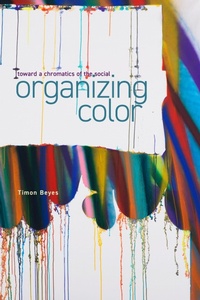
Organizing Color
Toward a Chromatics of the Social
Published on 12. March 2024
Book
Hardback
292 pages
978-1-5036-3830-3 (ISBN)
Description
We live in a world that is saturated with color, but how should we make sense of color's force and capacities? This book develops a theory of color as fundamental medium of the social.
Constructed as a montage of scenes from the past two hundred years, Organizing Color demonstrates how the interests of capital, management, governance, science, and the arts have wrestled with color's allure and flux. Beyes takes readers from Goethe's chocolate experiments in search of chromatic transformation to nineteenth-century Scottish cotton mills designed to modulate workers' moods and productivity, from the colonial production of indigo in India to globalized categories of skin colorism and their disavowal. Tracing the consumption, control and excess of industrial and digital color, other chapters stage encounters with the literary chromatics of Pynchon's Gravity's Rainbow processing the machinery of the chemical industries, the red of political revolt in Godard's films, and the blur of education and critique in Steyerl's Adorno's Grey.
Contributing to a more general reconsideration of aesthetic capitalism and the role of sensory media, this book seeks to pioneer a theory of social organization-a "chromatics of organizing"-that is attuned to the protean and world-making capacity of color.
Constructed as a montage of scenes from the past two hundred years, Organizing Color demonstrates how the interests of capital, management, governance, science, and the arts have wrestled with color's allure and flux. Beyes takes readers from Goethe's chocolate experiments in search of chromatic transformation to nineteenth-century Scottish cotton mills designed to modulate workers' moods and productivity, from the colonial production of indigo in India to globalized categories of skin colorism and their disavowal. Tracing the consumption, control and excess of industrial and digital color, other chapters stage encounters with the literary chromatics of Pynchon's Gravity's Rainbow processing the machinery of the chemical industries, the red of political revolt in Godard's films, and the blur of education and critique in Steyerl's Adorno's Grey.
Contributing to a more general reconsideration of aesthetic capitalism and the role of sensory media, this book seeks to pioneer a theory of social organization-a "chromatics of organizing"-that is attuned to the protean and world-making capacity of color.
Reviews / Votes
"The immanent critique and 'tender empiricism' of this book, its eloquence and capacity to move from detailed grounding to exciting passages of speculative thought, ensures that Organizing Color escapes 'the archaic stillness of the book.' Impressively researched and written."-Sean Cubitt, University of Melbourne "Inventive, brilliantly written, and very readable, Organizing Color recovers and explicates the relevance of color to social form-be that chromatic or racialized color."
-Esther Leslie, Birkbeck, University of London "Organizing is often imagined as a functional concept that belongs in business schools. In this beautifully written and illustrated book, Timon Beyes sprinkles aesthetics and politics over this black and white picture. The result is a breathtaking work that will change the way we understand how to 'see' organization."
-Martin Parker, University of Bristol "[Organizing Color] delves into fascinating questions about our color experiences.... Highly recommended."-L. L. Kriner, CHOICE "The book contributes to organizational scholarship by attenuating the 'colorblind constitution of socio-organizational thought', highlighting some of the intricate and interconnected ways in which the 'primary organizational force' of color manifests. Most notably, it provides a phenomenological template for the analysis of color in the field of organizational aesthetics. It also reinforces the recent tendency to conceptualize cultural products as configurations of particular elements, examining their social construction and relational nature in historical perspective."-Stoyan V. Sgourev, Administrative Science Quarterly
More details
Series
Edition
New edition
Language
English
Place of publication
Palo Alto
United States
Target group
Professional and scholarly
Edition type
New edition
Product notice
Cloth
Illustrations
18 halftones
Dimensions
Height: 229 mm
Width: 152 mm
Thickness: 23 mm
Weight
553 gr
ISBN-13
978-1-5036-3830-3 (9781503638303)
Copyright in bibliographic data and cover images is held by Nielsen Book Services Limited or by the publishers or by their respective licensors: all rights reserved.
Schweitzer Classification
Other editions
Additional editions
E-Book
03/2024
Stanford University Press
from
€57.99
Available for download
Person
Timon Beyes is Professor of Sociology of Organisation and Culture at Leuphana University Lueneburg.
Content
1. Something Winged: Color as Organizational Force
2. Weimar, ca. 1800: Cooking Chocolate
3. New Lanark, 1816: Working the Silent Monitor
4. Lower Bengal, 1859: The Coke of Empire
5. Berlin, 1924: Consuming the Color Chart
6. The Zone, 1945: Unleashing the Synthetic Rainbow
7. Paris, 1967: The Revolution Will Be Colorized
8. Houston, 1971: Two Kinds of Colorism
9. Cologne, 2007: The Distribution of the Insensible
10. Broken Tones: Toward a Chromatics of the Social
2. Weimar, ca. 1800: Cooking Chocolate
3. New Lanark, 1816: Working the Silent Monitor
4. Lower Bengal, 1859: The Coke of Empire
5. Berlin, 1924: Consuming the Color Chart
6. The Zone, 1945: Unleashing the Synthetic Rainbow
7. Paris, 1967: The Revolution Will Be Colorized
8. Houston, 1971: Two Kinds of Colorism
9. Cologne, 2007: The Distribution of the Insensible
10. Broken Tones: Toward a Chromatics of the Social