

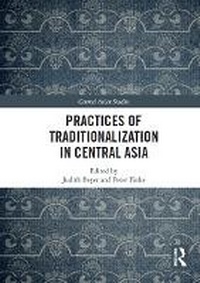
Practices of Traditionalization in Central Asia
1st Edition
Published on 24. June 2024
Book
Paperback/Softback
136 pages
978-1-032-83914-1 (ISBN)
Description
Practices of Traditionalization in Central Asia focuses on how tradition is 'everyday-ified' in contemporary Central Asia, including Tatarstan and Tibet, and what people seek to achieve in its name. The case studies range from political demonstrations and industrial workers' gatherings to institutions of religious education, minority communities, weddings, and the Internet.
In this volume we regard tradition as a practice that needs to be explored in its institutional and interactional context at a particular time, rather than as a reliable guide to the past: tradition can only be judged from the present; it is an interpretative concept, not a descriptive one. While the scholarly debate has so far centered on what tradition entails and what it does not, including the question of invention and ownership, less attention has been devoted to investigating how tradition is enacted, enforced, or motivated - in short, how it 'gets done.' In Central Asia, practices of traditionalization are closely related to the transformation of the socialist order and the emergence of highly stratified societies. This volume asks: When does tradition emerge as a line of argumentation, who are the actors invoking it and how is it being (materially) manifested?
Practices of Traditionalization in Central Asia will be of great interest to scholars of Central Asia, Anthropology, History, Political Science, and Sociology. The chapters were originally published as a special issue of Central Asian Survey.
In this volume we regard tradition as a practice that needs to be explored in its institutional and interactional context at a particular time, rather than as a reliable guide to the past: tradition can only be judged from the present; it is an interpretative concept, not a descriptive one. While the scholarly debate has so far centered on what tradition entails and what it does not, including the question of invention and ownership, less attention has been devoted to investigating how tradition is enacted, enforced, or motivated - in short, how it 'gets done.' In Central Asia, practices of traditionalization are closely related to the transformation of the socialist order and the emergence of highly stratified societies. This volume asks: When does tradition emerge as a line of argumentation, who are the actors invoking it and how is it being (materially) manifested?
Practices of Traditionalization in Central Asia will be of great interest to scholars of Central Asia, Anthropology, History, Political Science, and Sociology. The chapters were originally published as a special issue of Central Asian Survey.
More details
Series
Language
English
Place of publication
London
United Kingdom
Publishing group
Taylor & Francis Ltd
Target group
College/higher education
Postgraduate and Undergraduate
Dimensions
Height: 246 mm
Width: 174 mm
Weight
240 gr
ISBN-13
978-1-032-83914-1 (9781032839141)
Copyright in bibliographic data and cover images is held by Nielsen Book Services Limited or by the publishers or by their respective licensors: all rights reserved.
Schweitzer Classification
Other editions
Additional editions
Judith Beyer | Peter Finke
Practices of Traditionalization in Central Asia
E-Book
05/2020
1st Edition
Routledge
€59.49
Available for download
Judith Beyer | Peter Finke
Practices of Traditionalization in Central Asia
E-Book
05/2020
1st Edition
Routledge
€59.49
Available for download
Judith Beyer | Peter Finke
Practices of Traditionalization in Central Asia
Book
02/2020
1st Edition
Routledge
€179.51
Shipment within 15-20 days
Persons
Judith Beyer specializes in political and legal anthropology. She conducts long-term ethnographic fieldwork in Central Asia (Kyrgyzstan) and Southeast Asia (Myanmar) and increasingly in Europe. Her research focuses on the anthropology of law, the anthropology of the state, and theories of sociality and social order. Her current thematic interests are: the concept of community, common sense, statelessness, existential anthropology and ethnomethodology. She is the author of "The force of custom. Law and the ordering of everyday life in Kyrgyzstan" (2016) and co-editor of "Ethnographies of the state in Central Asia. Performing politics" (together with Madeleine Reeves and Johan Rasanayagam; 2014). Her second monograph problematizes the category of 'community,' drawing on case studies among Muslims and Hindus in urban Myanmar.
Peter Finke specializes in economic anthropology, political economy and post-socialist transformations. He has worked on pastoral nomadism, identity, cognitive anthropology, and norms and ideologies in Mongolia and Central Asia where he carried out extensive field research. He is the author of two books: "Variations on Uzbek Identity: Strategic Choices, Cognitive Schemas and Political Constraints in Identification Processes" (2014) and "Nomaden im Transformationsprozess. Kasachen in der post-sozialistischen Mongolei" (2004).
Peter Finke specializes in economic anthropology, political economy and post-socialist transformations. He has worked on pastoral nomadism, identity, cognitive anthropology, and norms and ideologies in Mongolia and Central Asia where he carried out extensive field research. He is the author of two books: "Variations on Uzbek Identity: Strategic Choices, Cognitive Schemas and Political Constraints in Identification Processes" (2014) and "Nomaden im Transformationsprozess. Kasachen in der post-sozialistischen Mongolei" (2004).
Content
Introduction: Practices of traditionalization in Central Asia Judith Beyer and Peter Finke 1. Women of protest, men of applause: political activism, gender and tradition in Kyrgyzstan Judith Beyer and Aijarkyn Kojobekova 2. Traditionalization, or the making of a reputation: women, weddings and expenditure in Tajikistan Juliette Cleuziou 3. The body global and the body traditional: a digital ethnography of Instagram and nationalism in Kazakhstan and Russia Diana T. Kudaibergenova 4. The veterans' gala: the use of tradition in an industrial labour conflict in contemporary Kazakhstan Tommaso Trevisani 5. Appropriating and contesting 'traditional Islam': Central Asian students at the Russian Islamic University in Tatarstan Dominik Mueller 6. Traditionalization as a response to state-induced development in rural Tibetan areas of Qinghai, PRC Jarmila Ptackova