

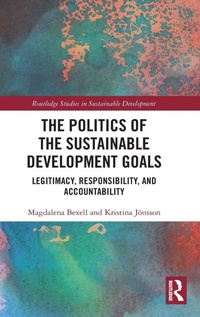
The Politics of the Sustainable Development Goals
Legitimacy, Responsibility, and Accountability
1st Edition
Published on 10. June 2021
Book
Hardback
174 pages
978-0-367-48948-9 (ISBN)
Description
This book draws attention to political aspects of sustainable development goal-setting, exploring the Sustainable Development Goals (SDGs) at the global-national nexus during their first five years.
After broad global deliberation and political negotiations, the 2030 Agenda and its SDGs were adopted in the United Nations (UN) General Assembly in 2015, and by now many countries have political structures in place for working towards their realisation. This book explores three concepts to call attention to the political qualities of processes related to the SDGs: legitimacy, responsibility, and accountability. Legitimacy is required to obtain broad political ownership for policy goals in order for them to become effective in addressing cross-border sustainability challenges. Responsibility needs to be clearly distributed among political institutions if a long-term set of broad goals such as the SDGs are to be realised. Accountability to the public is the retrospective mirror of political responsibility. The Politics of the Sustainable Development Goals contributes new knowledge on political processes at the nexus of global and national levels, focussing on three countries at different levels of socio-economic development and democratisation: namely Ghana, Tanzania, and Sweden. These countries illustrate a variety of challenges related to the realisation of the SDGs.
This book will be of great interest to students and scholars of sustainable development, international organisations, and global politics.
After broad global deliberation and political negotiations, the 2030 Agenda and its SDGs were adopted in the United Nations (UN) General Assembly in 2015, and by now many countries have political structures in place for working towards their realisation. This book explores three concepts to call attention to the political qualities of processes related to the SDGs: legitimacy, responsibility, and accountability. Legitimacy is required to obtain broad political ownership for policy goals in order for them to become effective in addressing cross-border sustainability challenges. Responsibility needs to be clearly distributed among political institutions if a long-term set of broad goals such as the SDGs are to be realised. Accountability to the public is the retrospective mirror of political responsibility. The Politics of the Sustainable Development Goals contributes new knowledge on political processes at the nexus of global and national levels, focussing on three countries at different levels of socio-economic development and democratisation: namely Ghana, Tanzania, and Sweden. These countries illustrate a variety of challenges related to the realisation of the SDGs.
This book will be of great interest to students and scholars of sustainable development, international organisations, and global politics.
More details
Series
Language
English
Place of publication
London
United Kingdom
Publishing group
Taylor & Francis Ltd
Target group
College/higher education
Illustrations
1 s/w Abbildung, 6 s/w Tabellen, 1 s/w Zeichnung
6 Tables, black and white; 1 Line drawings, black and white; 1 Illustrations, black and white
Dimensions
Height: 240 mm
Width: 161 mm
Thickness: 15 mm
Weight
449 gr
ISBN-13
978-0-367-48948-9 (9780367489489)
Copyright in bibliographic data and cover images is held by Nielsen Book Services Limited or by the publishers or by their respective licensors: all rights reserved.
Schweitzer Classification
Other editions
Additional editions
Magdalena Bexell | Kristina Joensson
The Politics of the Sustainable Development Goals
Legitimacy, Responsibility, and Accountability
Book
01/2023
1st Edition
Routledge
€62.60
Shipment within 10-20 days
Magdalena Bexell | Kristina Joensson
The Politics of the Sustainable Development Goals
Legitimacy, Responsibility, and Accountability
E-Book
06/2021
1st Edition
Routledge
€0.00
Available for download
Magdalena Bexell | Kristina Joensson
The Politics of the Sustainable Development Goals
Legitimacy, Responsibility, and Accountability
E-Book
06/2021
1st Edition
Routledge
€0.00
Available for download
Persons
Magdalena Bexell is Associate Professor at the Department of Political Science, Lund University. Her research revolves around international relations and development studies, with a focus on global governance, legitimacy, and responsibility. On-going research projects concern in particular the UN's 2030 Agenda and its SDGs. Her earlier studies explored notions of public and private in human rights protection and transnational public-private partnerships. Her works have appeared in journals such as Journal of International Relations and Development, Policy Studies, Development Policy Review, Journal of Human Development and Capabilities, Globalizations, International Feminist Journal of Politics, and Global Governance. She also edited the volume Global Governance, Legitimacy and Legitimation and co-edited Democracy and Public-Private Partnerships in Global Governance.
Kristina Joensson is Associate Professor at the Department of Political Science, Lund University. Her research concerns international relations, comparative politics, and development studies through an interest in global governance, policy processes, and global-local linkages. Current research deals with the UN's 2030 Agenda and its SDGs as well as global health governance. Her previous publications deal with politics and policy-making in South-East Asia with a special focus on health policy processes. Among her more recent publications are articles in Journal of International Relations and Development, Development Policy Review, Policy Studies, Journal of Human Development and Capabilities, Forum for Development Studies, Globalizations, and Third World Quarterly. She is co-author of Politics and development in a globalised world.
Kristina Joensson is Associate Professor at the Department of Political Science, Lund University. Her research concerns international relations, comparative politics, and development studies through an interest in global governance, policy processes, and global-local linkages. Current research deals with the UN's 2030 Agenda and its SDGs as well as global health governance. Her previous publications deal with politics and policy-making in South-East Asia with a special focus on health policy processes. Among her more recent publications are articles in Journal of International Relations and Development, Development Policy Review, Policy Studies, Journal of Human Development and Capabilities, Forum for Development Studies, Globalizations, and Third World Quarterly. She is co-author of Politics and development in a globalised world.
Content
Chapter 1 INTRODUCTION: The 2030 Agenda and the study of sustainable development politics Chapter 2 CONCEPTUAL FRAMEWORK: The politics of legitimacy, responsibility, and accountability at the global-national nexus Chapter 3 LEGITIMACY: A process perspective Chapter 4 RESPONSIBILITY: From promise to action Chapter 5 ACCOUNTABILITY: Vertical and horizontal relations Chapter 6 CONCLUSIONS: Interlinkages, continuity, and change in sustainable development politics