

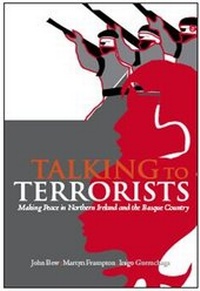
Talking to Terrorists
Making Peace in Northern Ireland and the Basque Country
Will be published approx. on 26. May 2009
Book
Paperback/Softback
978-1-85065-967-9 (ISBN)
Description
The peace agreement in Northern Ireland has been held up as a beacon for conflict resolution around the world. The lessons of Ulster have been applied by prime ministers, presidents, diplomats and intelligence agents to many areas of violent conflict, from Spain to Sri Lanka, from Afghanistan to Iraq and, frequently, the Israel-Palestine crisis. From Belfast to Basra, the notion that it is necessary to engage in dialogue with one's enemies has been fetishised across the political spectrum. Talking to terrorists is a necessary pre-requisite to peace, it is argued, and governments should avoid rigid pre-conditions in their attempt to bring in the extremes. But does this understanding really reflect what happened in Northern Ireland? Moreover, does it apply to other areas where democratic governments face threats from terrorist organisations, such as in the Basque region of northern Spain?
In challenging this notion, the authors offer an analytical history of the transition from war to peace in Northern Ireland, and compare the violent conflict in the Basque country over the same period, demonstrating how events there have developed very differently than the advocates of 'the Northern Ireland model' might presume. The authors recognise that governments have often talked to terrorists and will continue to do so in the future. But they argue that what really matters is not the act of talking to terrorists itself but a range of other variables including the role of state actors, intelligence agencies, hard power and the wider democratic process. Above all, there is a crucial difference between talking to terrorists who believe that their strategy is succeeding and those who have been made to realise that their aims are unattainable by violence.
In challenging this notion, the authors offer an analytical history of the transition from war to peace in Northern Ireland, and compare the violent conflict in the Basque country over the same period, demonstrating how events there have developed very differently than the advocates of 'the Northern Ireland model' might presume. The authors recognise that governments have often talked to terrorists and will continue to do so in the future. But they argue that what really matters is not the act of talking to terrorists itself but a range of other variables including the role of state actors, intelligence agencies, hard power and the wider democratic process. Above all, there is a crucial difference between talking to terrorists who believe that their strategy is succeeding and those who have been made to realise that their aims are unattainable by violence.
Reviews / Votes
'[Mark Perry's] writing conveys a strong impression that he has not spent his career merely watching the action from a safe seat in the bleachers - [His] tone calls to mind a Tom Clancy novel.' - New Yorker 'Why not distinguish between [terrorist] groups and engage in a little diplomacy with those extremists who can in their own way assist in our war on terror? Sounds crazy, perhaps, but Perry demonstrates in his book how a controversial approach to the war on terror may be a path to success in minimizing the terrorist threat.' - Washington Post.com 'Fascinating and original.' - The National (Abu Dhabi) 'This is clearly no dry academic exercise but an urgent mission - There is much to be learnt from Perry's discussions with leaders of groups like Hezbollah and Hamas - much that one can only hope Western leaders learn very soon - American statesmen and policymakers should read this book, urgently.' - Asia TimesMore details
Language
English
Place of publication
London
United Kingdom
Illustrations
Illustrations
Dimensions
Height: 225 mm
Width: 145 mm
ISBN-13
978-1-85065-967-9 (9781850659679)
Copyright in bibliographic data and cover images is held by Nielsen Book Services Limited or by the publishers or by their respective licensors: all rights reserved.
Schweitzer Classification
Persons
John Bew is Lecturer in Modern British History, Harris Fellow and Director of Studies at Peterhouse, Cambridge. Martyn Frampton is a Research Fellow, also at Peterhouse, Cambridge, and an expert on the Irish republican movement. Inigo Gurruchaga is the London correspondent for the Basque daily, El Correo.