

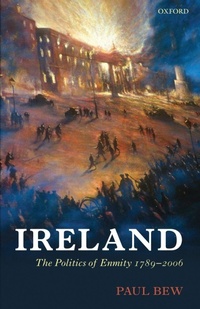
Ireland
The Politics of Enmity 1789-2006
Published on 12. February 2009
Book
Paperback/Softback
640 pages
978-0-19-956126-1 (ISBN)
Description
The French revolution had an electrifying impact on Irish society. The 1790s saw the birth of modern Irish republicanism and Orangeism, whose antagonism remains a defining feature of Irish political life. The 1790s also saw the birth of a new approach to Ireland within important elements of the British political elite, men like Pitt and Castlereagh. Strongly influenced by Edmund Burke, they argued that Britain's strategic interests were best served by a policy of catholic emancipation and political integration in Ireland. Britain's failure to achieve this objective, dramatised by the horrifying tragedy of the Irish famine of 1846-50, in which a million Irish died, set the context for the emergence of a popular mass nationalism, expressed in the Fenian, Parnell, and Sinn Fein movements, which eventually expelled Britain from the greater part of the island.
This book reassesses all the key leaders of Irish nationalism - Tone, O'Connell, Butt, Parnell, Collins, and de Valera - alongside key British political leaders such as Peel and Gladstone in the nineteenth century, or Winston Churchill and Tony Blair in the twentieth century. A study of the changing ideological passions of the modern Irish question, this analysis is, however, firmly placed in the context of changing social and economic realities.
Using a vast range of original sources, Paul Bew holds together the worlds of political class in London, Dublin, and Belfast in one coherent analysis which takes the reader all the way from the society of the United Irishman to the crisis of the Good Friday Agreement.
This book reassesses all the key leaders of Irish nationalism - Tone, O'Connell, Butt, Parnell, Collins, and de Valera - alongside key British political leaders such as Peel and Gladstone in the nineteenth century, or Winston Churchill and Tony Blair in the twentieth century. A study of the changing ideological passions of the modern Irish question, this analysis is, however, firmly placed in the context of changing social and economic realities.
Using a vast range of original sources, Paul Bew holds together the worlds of political class in London, Dublin, and Belfast in one coherent analysis which takes the reader all the way from the society of the United Irishman to the crisis of the Good Friday Agreement.
Reviews / Votes
Itour de force of historical interpretation that Bew has achieved in this work. The virtues of historical scholarship and stylish exposition, which have marked the best of Bew's work from the very outset, are here in abundance...He has written an absorbing, engaged, immensely learned and passionately argued interpretation of the last two centuries of political conflict in Ireland....an important book... * Gear?d Tuathaigh Galway Archaeological and Historical Society * Bew's impressive command of the subject, his eye for the telling detail and striking quotation make this a compelling and thought-provoking analysis of the conflicted history of modern Ireland. * Catriona Kennedy, European History Quarterly. *More details
Series
Language
English
Place of publication
Oxford
United Kingdom
Target group
Professional and scholarly
Dimensions
Height: 216 mm
Width: 140 mm
Thickness: 34 mm
Weight
778 gr
ISBN-13
978-0-19-956126-1 (9780199561261)
Copyright in bibliographic data and cover images is held by Nielsen Book Services Limited or by the publishers or by their respective licensors: all rights reserved.
Schweitzer Classification
Other editions
Additional editions
Book
08/2007
Oxford University Press
€136.40
Shipment within 15-20 days
Person
Content
Impact of the French Revolution: 'The Battle of Burke' - Tone or Castlereagh? ; The Union between Britain and Ireland: One People? ; Daniel O'Connell and the Road to Emancipation 1810-29 ; The Repealer Repulsed: O'Connell 1830-45 ; The Politics of Hunger 1845-50 ; The Fenian Impulse ; Parnellism: 'Fierce Ebullience linked to Constitutional Machinery' ; 'Squelching': By Way of a Hors D'euvres Conflict In Ireland 1891-1918 ; The Politics of the Gun or a 'Saving Formula 1919-1923 ; 'Melancholy Sanctitiy' in the South: 'Perfect Democracy in the North', Ireland 1923-66 ; 'Unbearably Oldfashioned and Pointless': The Era of the Troubles 1968-2005 ; Conclusion