

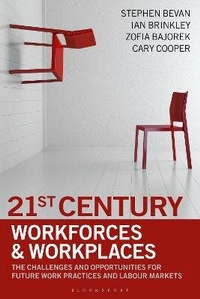
21st Century Workforces and Workplaces
The Challenges and Opportunities for Future Work Practices and Labour Markets
Published on 22. February 2018
Book
Hardback
400 pages
978-1-4729-0499-7 (ISBN)
Description
What does the future of work look like?
Every day, workplace decisions are made that directly impact and change the workforce of tomorrow. From the way we are managed to the rewards we receive, all aspects of our work life are determined by the changing dynamics of the workplace. Recent concerns about globalisation, productivity and the introduction of new technologies have raised questions about the future of the workforce and job security. But are these concerns really justified?
21st Century Workforces and Workplaces charts, explains and analyses the past five years, which has seen the rewriting of much of what we thought we knew about employment and how workplaces respond to pressure. The book also outlines what hasn't changed and, in doing so, distinguishes myth from reality.
Stephen Bevan, Ian Brinkley, Zofia Bajorek and Cary L. Cooper combine their considerable expertise to discuss the critical questions for any member of any workplace, including:
? Are permanent, long-term jobs a thing of the past?
? Does work have to be a 'place'?
? How will future managers be selected, educated and developed?
? What is the future for trade unions?
? Beyond pay, how will rewards evolve to incentivise workers alongside responsible capitalism?
? Are we seeing the end of retirement?
This book takes what we know and projects how the future labour market will develop. 21st Century Workforces and Workplaces asks what sort of work environments we want to see in 2025 and what we can do today to help bring about the necessary changes.
Every day, workplace decisions are made that directly impact and change the workforce of tomorrow. From the way we are managed to the rewards we receive, all aspects of our work life are determined by the changing dynamics of the workplace. Recent concerns about globalisation, productivity and the introduction of new technologies have raised questions about the future of the workforce and job security. But are these concerns really justified?
21st Century Workforces and Workplaces charts, explains and analyses the past five years, which has seen the rewriting of much of what we thought we knew about employment and how workplaces respond to pressure. The book also outlines what hasn't changed and, in doing so, distinguishes myth from reality.
Stephen Bevan, Ian Brinkley, Zofia Bajorek and Cary L. Cooper combine their considerable expertise to discuss the critical questions for any member of any workplace, including:
? Are permanent, long-term jobs a thing of the past?
? Does work have to be a 'place'?
? How will future managers be selected, educated and developed?
? What is the future for trade unions?
? Beyond pay, how will rewards evolve to incentivise workers alongside responsible capitalism?
? Are we seeing the end of retirement?
This book takes what we know and projects how the future labour market will develop. 21st Century Workforces and Workplaces asks what sort of work environments we want to see in 2025 and what we can do today to help bring about the necessary changes.
Reviews / Votes
The world of work is changing - and those organizations who change with it will win. This book offers powerful practical insights into how you can harness these changes to future-proof your workplace. -- Ann Francke * CEO, Chartered Management Institute * The authors examine and provide valuable insight into policy thinking around the big-picture challenges facing the workforce today - productivity, labour markets, globalisation, automation, wellbeing, ethics, rewards and demographics. The book paints a picture of the enormous challenges ahead. -- Paul Sparrow * Emeritus Professor of International HRM, Lancaster University Management School * Gazing into the fog of the future of work is always dangerous. This book offers clarity. It busts myths which need busting - current productivity measures, and that migrants and robots are taking our jobs. It also offers solutions to the real issues - the need for better wellbeing in work, better management of work and a recollectivisation of the rewards from work. The outcome would be 'good work' that contributes to both the economy and society. Read this book and smile. -- Professor Chris Warhurst * Director, Warwick Institute for Employment Research * This is a very reasoned and thought-provoking book, which is evidence-based and should be read by mangers, HR practitioners and academics. Current myths are debunked and a sensible insight into the future of work is presented. -- Robert Raeside * Director of the Employment Research Institute *More details
Language
English
Place of publication
London
United Kingdom
Publishing group
Bloomsbury Publishing PLC
Target group
Professional and scholarly
Dimensions
Height: 234 mm
Width: 156 mm
Weight
745 gr
ISBN-13
978-1-4729-0499-7 (9781472904997)
Copyright in bibliographic data and cover images is held by Nielsen Book Services Limited or by the publishers or by their respective licensors: all rights reserved.
Schweitzer Classification
Other editions
Additional editions
Stephen Bevan | Ian Brinkley | Cary Cooper
21st Century Workforces and Workplaces
The Challenges and Opportunities for Future Work Practices and Labour Markets
E-Book
02/2018
1st Edition
Bloomsbury Business
€27.49
Available for download
Stephen Bevan | Ian Brinkley | Cary Cooper
21st Century Workforces and Workplaces
The Challenges and Opportunities for Future Work Practices and Labour Markets
E-Book
02/2018
1st Edition
Bloomsbury Business
€27.49
Available for download
Persons
Stephen Bevan is Head of HR Research Development at the Institute for Employment Studies. He has previously been both Managing Director and Director of Research at The Work Foundation where he led a programme of applied research on workplace health, performance, reward, motivation and retention. He has conducted many UK and international research studies and advised employers and governments on both policy and practice. In 2016 he was designated the UK's 2nd 'Most Influential' HR thinker by HR magazine and he has been an Honorary Professor at Lancaster University Management School since 2010.
Ian Brinkley is currently an Associate of The Work Foundation and Fellow of the Institute for Employment Studies. He was Interim Chief Economist at the Chartered Institute for Personal Development (CIPD) between 2016 and 2017. Prior to that he served at The Work Foundation from 2006 onwards, including as Director from 2010 to 2013 and Chief Economist from 2013 to 2016. He served at the Trades Union Congress between 1980 and 2006, where he was Head of the Economic and Social Affairs Department (2004-2006) and its Chief Economist (1996-2006).
Dr Zofia Bajorek is the Lead Researcher of HR and Management at The Work Foundation, where she has worked for 4 years on a number of programmes including workplace health and wellbeing, employee engagement and the employment relationship. Prior to the, she was awarded a PhD in Management from KCL in 2013.
Sir Cary L. Cooper, CBE, is 50th Anniversary Professor of Organizational Psychology and Health at the ALLIANCE Manchester Business School, President of the British Academy of Management, President of the CIPD and was the Founding Chair of the Sunningdale Institute think tank in the National School of Government. He was the lead scientist on the Foresight project on Mental Capital and Wellbeing and has published over 125 books and many scholarly articles on organizational psychology and the workplace.
Ian Brinkley is currently an Associate of The Work Foundation and Fellow of the Institute for Employment Studies. He was Interim Chief Economist at the Chartered Institute for Personal Development (CIPD) between 2016 and 2017. Prior to that he served at The Work Foundation from 2006 onwards, including as Director from 2010 to 2013 and Chief Economist from 2013 to 2016. He served at the Trades Union Congress between 1980 and 2006, where he was Head of the Economic and Social Affairs Department (2004-2006) and its Chief Economist (1996-2006).
Dr Zofia Bajorek is the Lead Researcher of HR and Management at The Work Foundation, where she has worked for 4 years on a number of programmes including workplace health and wellbeing, employee engagement and the employment relationship. Prior to the, she was awarded a PhD in Management from KCL in 2013.
Sir Cary L. Cooper, CBE, is 50th Anniversary Professor of Organizational Psychology and Health at the ALLIANCE Manchester Business School, President of the British Academy of Management, President of the CIPD and was the Founding Chair of the Sunningdale Institute think tank in the National School of Government. He was the lead scientist on the Foresight project on Mental Capital and Wellbeing and has published over 125 books and many scholarly articles on organizational psychology and the workplace.
Content
CHAPTER 1: PRODUCTIVITY AND THE WORKPLACE
CHAPTER 2: THE CHANGING LABOUR MARKET - MYTHS AND REALITY
CHAPTER 3: THE GLOBAL WORKFORCE
CHAPTER 4: THE FUTURE WORKPLACE
CHAPTER 5: BETTER MANAGERS IN THE FUTURE WORKPLACE
CHAPTER 6: THE FUTURE HEALTH OF THE WORKFORCE
CHAPTER 7: THE FUTURE OF PAY & REWARD - THE TRIUMPH OF FAITH OVER EVIDENCE?
CHAPTER 8: THE FUTURE OF THE AGEING WORKFORCE
CHAPTER 9: WORKING FUTURES
CHAPTER 2: THE CHANGING LABOUR MARKET - MYTHS AND REALITY
CHAPTER 3: THE GLOBAL WORKFORCE
CHAPTER 4: THE FUTURE WORKPLACE
CHAPTER 5: BETTER MANAGERS IN THE FUTURE WORKPLACE
CHAPTER 6: THE FUTURE HEALTH OF THE WORKFORCE
CHAPTER 7: THE FUTURE OF PAY & REWARD - THE TRIUMPH OF FAITH OVER EVIDENCE?
CHAPTER 8: THE FUTURE OF THE AGEING WORKFORCE
CHAPTER 9: WORKING FUTURES