

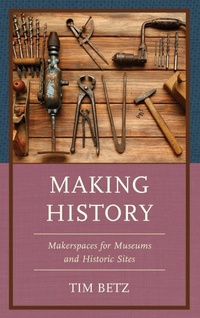
Making History
Makerspaces for Museums and Historic Sites
Published on 25. May 2023
Book
Hardback
134 pages
978-1-5381-6901-8 (ISBN)
Description
While first person interpretation and historic crafts have long been part of the museum world, current movements in the maker movement in libraries and schools have occurred mostly outside of the museum world. Instead, Makerspace in Museums: Hands-On History in Museums and Historic Sites shows the importance of the Maker Movement for museums and historic sites, and presents a roadmap to building, planning, researching, and using a makerspace alongside more traditional museum programming. It calls for a revitalization of living history, which can be done through makerspaces and the maker movement.
Highlights include:
Why museums and makerspaces are a natural fit togetherWays to organize and create a makerspace in a museum of any budgetCreating a makerspace and culture of making that is inclusive and for the entirety of the communityStrategies for researching historic making techniques and adapting them to the modern worldCreating meaningful makerspace-centered programming The processes and methods explored in this book will help produce a sustainable makerspace that will help the museum or historic site that adopts it reach new audiences, creating growth and new museums stakeholders. Likewise, through calling for a recalibration of living history through the language of the makerspace, this project calls for new approaches to living history. Thus, it is a call for a disruption to the status quo and a push towards sustainable and meaningful living history.
Highlights include:
Why museums and makerspaces are a natural fit togetherWays to organize and create a makerspace in a museum of any budgetCreating a makerspace and culture of making that is inclusive and for the entirety of the communityStrategies for researching historic making techniques and adapting them to the modern worldCreating meaningful makerspace-centered programming The processes and methods explored in this book will help produce a sustainable makerspace that will help the museum or historic site that adopts it reach new audiences, creating growth and new museums stakeholders. Likewise, through calling for a recalibration of living history through the language of the makerspace, this project calls for new approaches to living history. Thus, it is a call for a disruption to the status quo and a push towards sustainable and meaningful living history.
Reviews / Votes
Though makerspaces are frequently associated with STEM programs in the current landscape, museum professional Tim Betz argues that artists and historians have equal claims on makerspace facilities and services. To contextualize his argument, Betz begins with a brief history of making, highlighting its roots in the Arts and Crafts movement of the 19th century. He then looks at how resilient early-20th-century societies, with their emphasis on self-reliance and a do-it-yourself mentality, shaped the current maker models. Betz goes on to introduce his "Historic Making Manifesto" as a call and challenge to museum professionals to transform visitor experiences from passive observation to active engagement through tactile learning opportunities. Betz concludes with a pedagogical framework, including notes about space planning and budgetary concerns, for historians and museum leaders to use. Sample worksheets, program documentation, recipes, and project ideas are included as appendixes to facilitate discussions among practitioners. This book will be particularly valuable for museum professionals looking to integrate making experiences into their operations, but it is accessible and will be useful for a broad audience. Recommended. All readers. * Choice Reviews * Betz makes a compelling case for using makerspaces-usually connected with science museums and STEM education-to make historic sites more dynamic and engaging. Moving beyond historic sites' usual focus on demonstrations and finished pieces, Betz argues that makerspaces enhance empathy, connect past with present, and uncover untold stories. -- Donna R. Braden, senior curator and curator of public life, The Henry Ford, Dearborn, MI By rooting living history museums, historic sites, and history organizations within maker culture and examining how makerspaces can (and should!) be a natural fit within the museum ecosystem, Betz demonstrates how the act of 'making' can serve as a gateway for learning as well as a form of research. After sharing an overview of the history and pedagogy of the maker movement and museum education and interpretation, Betz provides a roadmap for building a makerspace, from the ground up, which is supplemented by programming strategies to borrow or build upon and appendices with supplemental materials. He offers a playbook for museum leadership, staff, and emerging professionals seeking to build and sustain 'historic makerspaces.' This book is more than a brief history, critique, and guide - it is a manifesto that embraces 'historic making' as a form of research and practice yielding accessible, experiential lifelong learning and engagement at history museums and organizations. -- Juilee Decker, Ph.D., professor of history and director of the museum studies program at Rochester Institute of Technology, Rochester, New YorkMore details
Series
Language
English
Place of publication
United States
Publishing group
Bloomsbury Publishing Plc
Target group
Professional and scholarly
Illustrations
2 tables
Dimensions
Height: 235 mm
Width: 157 mm
Thickness: 12 mm
Weight
356 gr
ISBN-13
978-1-5381-6901-8 (9781538169018)
Copyright in bibliographic data and cover images is held by Nielsen Book Services Limited or by the publishers or by their respective licensors: all rights reserved.
Schweitzer Classification
Other editions
Additional editions
E-Book
04/2023
1st Edition
Rowman & Littlefield Publishers
€30.49
Available for download
E-Book
04/2023
1st Edition
Bloomsbury eBooks US
€30.49
Available for download
Person
Tim Betz is a museum professional, historian, and artist. He is executive director of the Morgan Log House, a historical society in Lansdale, PA. He is an instructor of art history at Kutztown University of Pennsylvania and is completing his PhD in history at Lehigh University, in Bethlehem PA.
He is particularly interested in historic processes and historic craft, which he uses as a tool for understanding the past.
He is particularly interested in historic processes and historic craft, which he uses as a tool for understanding the past.
Content
Acknowledgements
Introduction
Chapter 1: Makerspaces and the Maker Movement
The Maker MovementA Genealogy of the Maker MovementA Place for Making: Makerspaces and HackerspacesCritiques of the Maker MovementThe Maker Movement and History MuseumsChapter 2: History and the Maker Movement
The Maker Movement at Historic SitesHistoric Making ManifestoThe Maker Movement and Living HistoryIf You Love It, Let it Go: Museums, Power, and MakingChapter 3: A Pedagogy of Museum Making
Just what is Pedagogy Anyway?Museum Education and Constructivist ThinkingMaking to Learn: the Makerspace and Museum EducationMeasuring Success in the Historic MakerspaceChapter 4: Making a Makerspace in Four (Somewhat Easy) Steps
AskingFundingLocatingMaintainingChapter 5: Putting the Makerspace to Work: Programming
Programming Your Historic MakerspaceProgramming Curiosity at Your MakerspaceThe Historical Makerspace and Regular ProgrammingWorkshopsMaker Programming Out of the MakerspaceThe Virtual Makerspace and Make From HomeChapter 6: Recreating the Past
Recreating the Past: a MethodologyA Hairy ExampleFriends in Historic PlacesChapter 7: Making as History
Experimental Archaeology and the Museum MakerspaceWhat Making Can Show UsProcess as Artifact: Interrogating Intangible Cultural HeritageWhere else but the Museum? Who else but Museum Professionals?Do!Appendices
Appendix A: Making and Your Site: Assessment WorksheetAppendix B: Your Mission and Your MakerspaceAppendix C: Historic Makerspace Sample BudgetAppendix D: Makerspace User AgreementAppendix E: InventoryAppendix F: Recipes and ProjectsWalnut InkVictorian Mourning JewelryEgg Tempera PaintOil Paint Appendix G: ProgramsDrop In WorkshopHistory Happy Hour
Introduction
Chapter 1: Makerspaces and the Maker Movement
The Maker MovementA Genealogy of the Maker MovementA Place for Making: Makerspaces and HackerspacesCritiques of the Maker MovementThe Maker Movement and History MuseumsChapter 2: History and the Maker Movement
The Maker Movement at Historic SitesHistoric Making ManifestoThe Maker Movement and Living HistoryIf You Love It, Let it Go: Museums, Power, and MakingChapter 3: A Pedagogy of Museum Making
Just what is Pedagogy Anyway?Museum Education and Constructivist ThinkingMaking to Learn: the Makerspace and Museum EducationMeasuring Success in the Historic MakerspaceChapter 4: Making a Makerspace in Four (Somewhat Easy) Steps
AskingFundingLocatingMaintainingChapter 5: Putting the Makerspace to Work: Programming
Programming Your Historic MakerspaceProgramming Curiosity at Your MakerspaceThe Historical Makerspace and Regular ProgrammingWorkshopsMaker Programming Out of the MakerspaceThe Virtual Makerspace and Make From HomeChapter 6: Recreating the Past
Recreating the Past: a MethodologyA Hairy ExampleFriends in Historic PlacesChapter 7: Making as History
Experimental Archaeology and the Museum MakerspaceWhat Making Can Show UsProcess as Artifact: Interrogating Intangible Cultural HeritageWhere else but the Museum? Who else but Museum Professionals?Do!Appendices
Appendix A: Making and Your Site: Assessment WorksheetAppendix B: Your Mission and Your MakerspaceAppendix C: Historic Makerspace Sample BudgetAppendix D: Makerspace User AgreementAppendix E: InventoryAppendix F: Recipes and ProjectsWalnut InkVictorian Mourning JewelryEgg Tempera PaintOil Paint Appendix G: ProgramsDrop In WorkshopHistory Happy Hour