

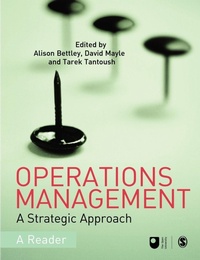
Operations Management
Description
How have consumer demands, environmental and ethical concerns, the advancement of technology and the globalization of business changed and redefined operations management?
This Reader explains new and emerging areas and re-evaluates some important mainstream issues. Leading specialists contribute their experiences and thoughts on four key areas. They are:
- Strategy - makes the case for regarding operations as a strategic asset in their own right
- Methodology - examines the myriad of approaches taken towards process improvement
- Technology - asks why problems associated with the implementation of technology continue to dog organisations
- Human Issues - repositions human input to the top of the operational agenda
More details
Other editions
Additional editions
Persons
David Mayle is an academic with the Open University Business School, where he currently chairs courses on Creative Management (B822 on the MBA) and on Managing Resources (B752 on the Professional Diploma). He is currently also chairing T836, Operations Management for the Faculty of Technology. After a period as head of the Business School′s Centre for Information and Innovation, he is now involved in the i10 project (a consortium of universities in the east of England). He is co-ordinating the design and production of a series of eLearning modules for use by business in the region. His other current research project concerns a study of value-based leadership for the 21st century. His most recent OU Reader was Managing innovation and change for the Creative Management course (Sage, 2002).
Tarek Tantoush is Staff tutor in technology at The Open University in the East Midlands for the Faculty, based in Nottingham. He is an academic programme co-ordinator for the postgraduate national office in Nottingham, managing a wide range of PG programmes in computing and technology. His particular interests include systems, manufacturing systems, operations management, organisational studies, and Islamic and Arabic studies. He has lectured and researched in most of these areas. He also managed research projects and has experience as a business technology advisor.
Content
THEME 1: OPERATIONS AS STRATEGY
Operations-Based Strategy - Robert Hayes and David Upton
Resource-based Competition and the New Operations Strategy - St[ac]ephane Gagnon
Stakeholder Capitalism and the Value Chain - Edward Freeman and Jeanne Liedtka
Managing the Transition from Products to Services - Rogelio Oliva and Robert Kallenburg
In Defense of Strategy as Design - Jeanne Liedtka
THEME 2: APPROACHES AND TECHNIQUES
Leveraging Management Improvement Techniques - Kenneth Euske and Steven Player
A Critical Examination of the Business Process Re-Engineering Phenomenon - Stefano Biazzo
Best Practice in Business Excellence - John Oakland, Steve Tanner and Ken Gadd
The Fallacy of Universal Best Practices - H J Harrington
THEME 3: THE ROLE OF TECHNOLOGY
Technology, the Technology Complex and the Paradox of Technology Determinism - James Fleck and John Howells
IT-Enabled Business Transformation - N Venkatraman
From Automation to Business Scope Redefinition
Executive Forum - Robert M Price
Technology and Strategic Advantage
Technology Infusion in Service Encounters - Mary Jo Bitner, Stephen Brown and Matthew Meuter
Integrating Environmental Issues into the Mainstream - Linda Angell and Robert Klassen
An Agenda for Research in Operations Management
THEME 4: HUMAN ISSUES
Seven Practices of Successful Organizations - Jeffrey Pfeffer
A Framework for Linking Culture and Improvement Initiatives in Organizations - James Detert, Roger Schroeder and John Mauriel
Empowering Service Employees - David Bowen and E Lawler
Client Co-Production in Knowledge-Intensive Business Services - Lance Bettencourt et al