

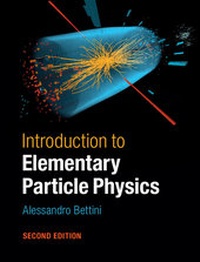
Introduction to Elementary Particle Physics
2nd Edition
Published on 13. February 2014
Book
Hardback
492 pages
978-1-107-05040-2 (ISBN)
Description
The second edition of this successful textbook is fully updated to include the discovery of the Higgs boson and other recent developments, providing undergraduate students with complete coverage of the basic elements of the standard model of particle physics for the first time. Physics is emphasised over mathematical rigour, making the material accessible to students with no previous knowledge of elementary particles. Important experiments and the theory linked to them are highlighted, helping students appreciate how key ideas were developed. The chapter on neutrino physics has been completely revised, and the final chapter summarises the limits of the standard model and introduces students to what lies beyond. Over 250 problems, including sixty that are new to this edition, encourage students to apply the theory themselves. Partial solutions to selected problems appear in the book, with full solutions and slides of all figures available at www.cambridge.org/9781107050402.
Reviews / Votes
'I liked the first edition very much, and used it for my classes. I like the second edition even better ... Best of all, for the current version, there are some timely additions, most notably the discovery of the Higgs boson and an expanded chapter on neutrino oscillations ... Let us hope that Run 2 at the LHC will necessitate the writing of a third edition of this wonderful book.' James W. Rohlf, CERN Courier '... [this] volume is complemented by ... exhaustive online material on the Cambridge University Press website, addressed and reserved to physics teachers: solutions of all the problems and exercises appearing throughout the volume ... and a series of colourful PowerPoint slides for each chapter, containing key figures and basic plots. This novel feature of the second edition makes [the book] even more attractive ... [it] deserves [to be] more and more widely adopted in all our universities.' L. Cifarelli, Il Nuovo Saggiatore 'What is special about this book is that it requires very little effort for the [reader] to like it. It is very well presented and ... goes out of its way - or rather the author goes out of his - to be friendly and (relatively) easy, bearing in mind that elementary particle physics is, by a long shot, not. ... this book can readily be used by true beginners lacking or without prior background in the subject.' B. Ishak, Contemporary Physics Review of the first edition: 'Bettini's expertise shines brightly throughout the text ... The choice of topics and the level of detail are excellent ... The book is extremely well-written, topically informative and easy to read - but best of all it is full of physics ... I enjoyed Bettini's book three times - not unlike a fine wine: the first time when admiring its contents; the second when reading it; and a third time when teaching from it. Bravo Sandro!' James W. Rohlf, CERN Courier Review of the first edition: 'There are many gems within these pages ... The author has managed to bring out the importance of experiment in the field, and to explain both the reasoning and the difficulties behind these experiments, but does not get bogged down in minutiae. We are left with an excellent introduction to the thinking behind modern quantum field theory.' Todd Huffman, University of Oxford Review of the first edition: 'Bettini has a talent to render complicated things as simple and clear as possible ... [He] provides the reader with a deep insight of the main steps which have brought to the present formulation of the Standard Model, with its essential ingredients, its limits and open questions.' Il Nuovo Saggiatore Review of the first edition: '... provides (postgraduate and advanced undergraduate) students with an admirably clear account of the Standard Model ... The prose is consistently fluent and interesting, the author's knowledge up to date and detailed and the explanations admirably lucid.' Lewis Ryder, Contemporary Physics 'This impressive collection resembles the genre with which it is concerned in so far as it pulls in several directions at once. ... like autobiography, the book is suggestive, variegated, provocative.' Trev Broughton, Life WritingMore details
Edition
2nd Revised edition
Language
English
Place of publication
Cambridge
United Kingdom
Target group
College/higher education
Professional and scholarly
Edition type
Revised edition
Illustrations
Worked examples or Exercises; 28 Halftones, unspecified; 237 Line drawings, unspecified
Dimensions
Height: 252 mm
Width: 192 mm
Thickness: 23 mm
Weight
1200 gr
ISBN-13
978-1-107-05040-2 (9781107050402)
Copyright in bibliographic data and cover images is held by Nielsen Book Services Limited or by the publishers or by their respective licensors: all rights reserved.
Schweitzer Classification
Other editions
New editions
Alessandro Bettini
Introduction to Elementary Particle Physics
Book
06/2024
3rd Edition
Cambridge University Press
€63.60
Shipment within 15-20 days
Additional editions
Alessandro Bettini
Introduction to Elementary Particle Physics
E-Book
02/2014
2nd Edition
Cambridge University Press
€58.99
Available for download
Alessandro Bettini
Introduction to Elementary Particle Physics
E-Book
02/2014
Cambridge University Press
€50.49
Available for download
Previous edition
Alessandro Bettini
Introduction to Elementary Particle Physics
Book
07/2012
Cambridge University Press
€45.79
Article exhausted; check for reprint
Person
Alessandro Bettini is Emeritus Professor of Physics at the University of Padua, Italy, where he has been teaching experimental, general and particle physics for forty years. An experimentalist in subnuclear physics for the Italian National Institute for Nuclear Physics (INFN), he is presently the Director of the Canfranc Underground Laboratory in Spain.
Content
Preface to the first edition; Preface to the second edition; 1. Preliminary notions; 2. Nucleons, leptons and mesons; 3. Symmetries; 4. Hadrons; 5. Quantum electrodynamics; 6. Chromodynamics; 7. Weak interactions; 8. The neutral mesons oscillations and CP violation; 9. The standard model; 10. Neutrinos; 11. Epilogue; Appendixes; References; Index.