

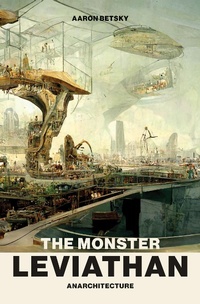
The Monster Leviathan
Anarchitecture
Will be published approx. on 9. January 2024
Book
Paperback/Softback
464 pages
978-0-262-54633-1 (ISBN)
Description
Visionary proposals for a mythic and strange architecture-or anarchitecture-through which we can imagine other and better worlds.
Lurking under the surface of our modern world lies an unseen architecture-or anarchitecture. It is a possible architecture, an analogous architecture, an architecture of anarchy, which haunts in the form of monsters that are humans and machines and cities all at once; or takes the form of explosions, veils, queer, playful spaces, or visions from artwork and video games. In The Monster Leviathan, Aaron Betsky traces anarchitecture through texts, design, and art of the twentieth and early twenty-first century, and suggests that these ephemeral evocations are concrete proposals in and of themselves. Neither working models nor suggestions for new forms, they are scenes just believable enough to convince us they exist, or just fantastical enough to open our eyes.
The Monster Leviathan gives students and lovers of architecture, as well as those hoping to construct a better, more sustainable, and socially just future, a set of tools through which they can imagine that such other worlds are possible. As Betsky eloquently articulates, anarchitecture already exists and does not exist at all. It is the myth of building, and all we have to do is find it.
Lurking under the surface of our modern world lies an unseen architecture-or anarchitecture. It is a possible architecture, an analogous architecture, an architecture of anarchy, which haunts in the form of monsters that are humans and machines and cities all at once; or takes the form of explosions, veils, queer, playful spaces, or visions from artwork and video games. In The Monster Leviathan, Aaron Betsky traces anarchitecture through texts, design, and art of the twentieth and early twenty-first century, and suggests that these ephemeral evocations are concrete proposals in and of themselves. Neither working models nor suggestions for new forms, they are scenes just believable enough to convince us they exist, or just fantastical enough to open our eyes.
The Monster Leviathan gives students and lovers of architecture, as well as those hoping to construct a better, more sustainable, and socially just future, a set of tools through which they can imagine that such other worlds are possible. As Betsky eloquently articulates, anarchitecture already exists and does not exist at all. It is the myth of building, and all we have to do is find it.
Reviews / Votes
"[A] substantial instalment . . . hugely ambitious . . . this will be one of those books that follows the reader around."-Apollo
More details
Language
English
Place of publication
Cambridge (Massachusetts)
United States
Publishing group
MIT Press Ltd
Product notice
Paperback (trade)
Illustrations
140 COLOR PHOTOS
Dimensions
Height: 241 mm
Width: 158 mm
Thickness: 36 mm
Weight
968 gr
ISBN-13
978-0-262-54633-1 (9780262546331)
Copyright in bibliographic data and cover images is held by Nielsen Book Services Limited or by the publishers or by their respective licensors: all rights reserved.
Schweitzer Classification
Person
Aaron Betsky is Professor in the School of Architecture and Design at Virginia Tech. He has served as Dean and President of the School of Architecture at Taliesin (2015-2020), Director of the Cincinnati Art Museum (2006-2014) and the Netherlands Architecture Institute (2001-2006), as well as Curator of Architecture and Design at the San Francisco Museum of Modern Art (1995-2001). In 2008, he also directed the 11th Venice International Biennale of Architecture.
Content
Introduction 7
1 The Monster Leviathan 13
2 The Explosion of the Tenth of a Second 51
3 The Veil 93
4 Empty Signs 137
5 Representational Space 189
6 Implosion 223
7 Myths and Datascapes 261
8 Smooth and Striated 303
9 Crossroads 341
10 Ghost 379
Acknowledgments 419
Notes 421
Index 449
1 The Monster Leviathan 13
2 The Explosion of the Tenth of a Second 51
3 The Veil 93
4 Empty Signs 137
5 Representational Space 189
6 Implosion 223
7 Myths and Datascapes 261
8 Smooth and Striated 303
9 Crossroads 341
10 Ghost 379
Acknowledgments 419
Notes 421
Index 449