

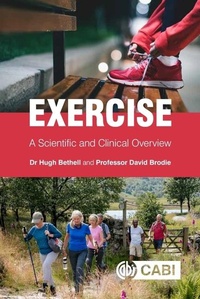
Exercise
A Scientific and Clinical Overview
Published on 18. May 2023
Book
Paperback/Softback
200 pages
978-1-80062-183-1 (ISBN)
Description
This book is about exercise - what it is, how it affects the individual, how it is measured and most of all what benefits it brings. Beginning with an introduction to the history and biology of exercise, the authors review the interactions between exercise and specific diseases, such as diabetes, coronary heart disease, cancer and many more, before considering exercise in a wider health context. The book covers: - Current societal norms, as well as the social and economic costs of inactivity. - Exercise for life - from starting young, to pregnancy, longevity and frailty. - Complications of exercise. - The intersections of behavioural psychology and exercise, such as encouragement and excuse making. With comprehensive and clear explanations based on sound science, yet written in an approachable and accessible style, this book is a valuable resource for students of medicine, public health, physiotherapy, sports science, coaching and training.
More details
Language
English
Place of publication
Wallingford
United Kingdom
Target group
College/higher education
Professional and scholarly
Product notice
Paperback (trade)
Unsewn / adhesive bound
Dimensions
Height: 246 mm
Width: 189 mm
Thickness: 10 mm
Weight
544 gr
ISBN-13
978-1-80062-183-1 (9781800621831)
Copyright in bibliographic data and cover images is held by Nielsen Book Services Limited or by the publishers or by their respective licensors: all rights reserved.
Schweitzer Classification
Persons
Hugh Bethel (Author)
Dr Hugh Bethell was a GP in Alton for over 40 years, with a specialism in cardiac rehabilitation. During this time, he established the highly successful Alton Cardiac Rehabilitation Programme. He has been involved with research in this field for over 40 years and has written extensively on the subject - two books, 9 book chapters, 65 original scientific papers and 76 review articles. In the early 90s he was the driver in setting up the British Association for Cardiac Rehabilitation (now the British Association for Cardiac Prevention and Rehabilitation) and became its first President. In 1995 he was awarded an MBE for his work in this field. He has been a great advocate of the benefits of exercise and has lectured and taught on the subject extensively.
David Brodie (Author)
Emeritus Professor David Brodie was head of the Department of Physical Education and Movement Science at the University of Liverpool for 20 years. He then moved to Buckinghamshire to join Prof Sir Magdi Yacoub's group at Harefield Hospital, where he worked on new methods of assessing patients waiting for heart transplantation. He has written 250 publications, including writing or co-writing six academic texts. He was awarded his DSc in 2010.
Dr Hugh Bethell was a GP in Alton for over 40 years, with a specialism in cardiac rehabilitation. During this time, he established the highly successful Alton Cardiac Rehabilitation Programme. He has been involved with research in this field for over 40 years and has written extensively on the subject - two books, 9 book chapters, 65 original scientific papers and 76 review articles. In the early 90s he was the driver in setting up the British Association for Cardiac Rehabilitation (now the British Association for Cardiac Prevention and Rehabilitation) and became its first President. In 1995 he was awarded an MBE for his work in this field. He has been a great advocate of the benefits of exercise and has lectured and taught on the subject extensively.
David Brodie (Author)
Emeritus Professor David Brodie was head of the Department of Physical Education and Movement Science at the University of Liverpool for 20 years. He then moved to Buckinghamshire to join Prof Sir Magdi Yacoub's group at Harefield Hospital, where he worked on new methods of assessing patients waiting for heart transplantation. He has written 250 publications, including writing or co-writing six academic texts. He was awarded his DSc in 2010.
Content
SECTION ONE: THE BACKGROUND TO EXERCISE Chapter 1: A Brief Historical Context for Exercise Chapter 2: The Muscles and Types of Exercise Chapter 3: Oxygen as the Fuel of Aerobic Exercise SECTION TWO: QUANTIFYING EXERCISE Chapter 4: Exercise Dose Chapter 5: Physical Fitness: the Best Measure of Exercise Capacity Chapter 6: The Components of Overall Exercise Volume Chapter 7: Population Activity Levels. Chapter 8: How Fit is the General Population? Chapter 9: Evidence: Interpreting the Science SECTION THREE: EXERCISE, FITNESS AND DISEASE Chapter 10: Obesity Chapter 11: High Blood Pressure (BP) Chapter 12: Dyslipidaemia Chapter 13: Diabetes Chapter 14: The Metabolic Syndrome Chapter 15: Coronary Heart Disease (CHD) Chapter 16: Peripheral Vascular Disease (PVD) Chapter 17: Stroke Chapter 18: Parkinson's Disease (PD) Chapter 19: Psychological Ill Health Chapter 20: Dementia and Cognition Chapter 21: Lung Disease Chapter 22: Cancer Chapter 23: Osteoporosis Chapter 24: Other Conditions SECTION FOUR: OTHER ISSUES WITH EXERCISE Chapter 25: Frailty Chapter 26: Longevity Chapter 27: Social and Economic Cost of Inactivity Chapter 28: Encouraging Exercise Chapter 29: Sedentary Behaviour Chapter 30: Complications of Exercise Chapter 31: Excuses to Avoid Exercise Chapter 32: Conclusions