

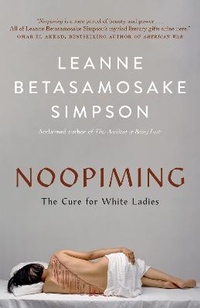
Noopiming
The Cure for White Ladies
Published on 15. October 2020
Book
Paperback/Softback
368 pages
978-1-4870-0764-5 (ISBN)
Description
Award-winning Nishnaabeg storyteller and writer Leanne Betasamosake Simpson returns with a bold reimagination of the novel, one that combines narrative and poetic fragments through a careful and fierce reclamation of Anishinaabe aesthetics.
Mashkawaji (they/them) lies frozen in the ice, remembering a long-ago time of hopeless connection and now finding freedom and solace in isolated suspension. They introduce us to the seven main characters: Akiwenzii, the old man who represents the narrator's will; Ninaatig, the maple tree who represents their lungs; Mindimooyenh, the old woman who represents their conscience; Sabe, the giant who represents their marrow; Adik, the caribou who represents their nervous system; Asin, the human who represents their eyes and ears; and Lucy, the human who represents their brain. Each attempts to commune with the unnatural urban-settler world, a world of SpongeBob Band-Aids, Ziploc baggies, Fjaellraeven Kanken backpacks, and coffee mugs emblazoned with institutional logos. And each searches out the natural world, only to discover those pockets that still exist are owned, contained, counted, and consumed. Cut off from nature, the characters are cut off from their natural selves.
Noopiming is Anishinaabemowin for "in the bush," and the title is a response to English Canadian settler and author Susanna Moodie's 1852 memoir Roughing It in the Bush. To read Simpson's work is an act of decolonization, degentrification, and willful resistance to the perpetuation and dissemination of centuries-old colonial myth-making. It is a lived experience. It is a breaking open of the self to a world alive with people, animals, ancestors, and spirits, who are all busy with the daily labours of healing - healing not only themselves, but their individual pieces of the network, of the web that connects them all together. Enter and be changed.
Mashkawaji (they/them) lies frozen in the ice, remembering a long-ago time of hopeless connection and now finding freedom and solace in isolated suspension. They introduce us to the seven main characters: Akiwenzii, the old man who represents the narrator's will; Ninaatig, the maple tree who represents their lungs; Mindimooyenh, the old woman who represents their conscience; Sabe, the giant who represents their marrow; Adik, the caribou who represents their nervous system; Asin, the human who represents their eyes and ears; and Lucy, the human who represents their brain. Each attempts to commune with the unnatural urban-settler world, a world of SpongeBob Band-Aids, Ziploc baggies, Fjaellraeven Kanken backpacks, and coffee mugs emblazoned with institutional logos. And each searches out the natural world, only to discover those pockets that still exist are owned, contained, counted, and consumed. Cut off from nature, the characters are cut off from their natural selves.
Noopiming is Anishinaabemowin for "in the bush," and the title is a response to English Canadian settler and author Susanna Moodie's 1852 memoir Roughing It in the Bush. To read Simpson's work is an act of decolonization, degentrification, and willful resistance to the perpetuation and dissemination of centuries-old colonial myth-making. It is a lived experience. It is a breaking open of the self to a world alive with people, animals, ancestors, and spirits, who are all busy with the daily labours of healing - healing not only themselves, but their individual pieces of the network, of the web that connects them all together. Enter and be changed.
Reviews / Votes
This brilliant novel is a carefully curated mix of prose and poetry, though the narrative and poetic form never leaves either; at all times, there is a deliberate attention to rhythm, movement, and sound. The layered storytelling is rich with wry and undeniable humour and introduces readers to an incredible cast of characters, giving us the perspective of Elders, Indigenous youth, raccoons, geese, and trees, braiding together past, present, and future and intentionally centring Nishnaabe life and practices ... This is the beauty and masterful work of this novel: it holds something for every Indigenous person. It's a gift that feels specifically for us. * Globe and Mail * [Noopiming] presses readers - Indigenous and settler alike - to consider the novel form as a wider venue for storytelling than it is traditionally conceived ... Language is thrilling in all of Simpson's work, and nowhere more so than in this newest offering ... Simpson's writing is at once political and loud, honest and whisper-quiet ... This novel will be reread for its many truths and teachings and for its undeniable power. The complicated questions Noopiming poses are worth revisiting, and the novel's wisdom will continue to grow as the reader does. * Quill & Quire, STARRED REVIEW * Taking traditional Anishinaabe teachings and weaving them through contemporary forms of understanding, Simpson brings the reader into not a new world, but a world already existing, one that breaks through the colonial bars that try to cage it. * Rabble.ca * In Noopiming, nothing is ever simply a metaphor. Everything is so wrought of love and care, spell and calling. * GenControlZ *More details
Language
English
Place of publication
Concord
Canada
Product notice
Paperback (trade)
Illustrations
Illustrations
Dimensions
Height: 215 mm
Width: 139 mm
Thickness: 22 mm
Weight
421 gr
ISBN-13
978-1-4870-0764-5 (9781487007645)
Copyright in bibliographic data and cover images is held by Nielsen Book Services Limited or by the publishers or by their respective licensors: all rights reserved.
Schweitzer Classification
Person
LEANNE BETASAMOSAKE SIMPSON is a Michi Saagiig Nishnaabeg writer, scholar, and musician, and a member of Alderville First Nation. She is the author of five previous books, including This Accident of Being Lost, which won the MacEwan Book of the Year and the Peterborough Arts Award for Outstanding Achievement by an Indigenous Author; was a finalist for the Rogers Writers' Trust Fiction Prize and the Trillium Book Award; was longlisted for CBC Canada Reads; and was named a best book of the year by the Globe and Mail, National Post, and Quill & Quire. She has released two albums, including f(l)ight, which is a companion piece to This Accident of Being Lost.