

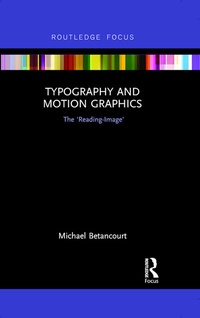
Typography and Motion Graphics: The 'Reading-Image'
The 'Reading-Image'
1st Edition
Published on 29. November 2018
Book
Hardback
148 pages
978-0-367-02928-9 (ISBN)
Description
In his latest book, Michael Betancourt explores the nature and role of typography in motion graphics as a way to consider its distinction from static design using the concept of the 'reading-image' to model the ways that motion typography dramatizes the process of reading and audience recognition of language on-screen. Using both classic and contemporary title sequences-including The Man With the Golden Arm (1955), Alien (1979), Flubber (1998), Six Feet Under (2001), The Number 23 (2007) and Scott Pilgrim vs. The World (2010)-Betancourt develops an argument about what distinguishes motion graphics from graphic design. Moving beyond title sequences, Betancourt also analyzes moving or kinetic typography in logo designs, commercials, film trailers, and information graphics, offering a striking theoretical model for understanding typography in media.
More details
Series
Language
English
Place of publication
London
United Kingdom
Publishing group
Taylor & Francis Ltd
Target group
College/higher education
Professional and scholarly
Illustrations
47 s/w Abbildungen, 1 s/w Tabelle
1 Tables, black and white; 47 Illustrations, black and white
Dimensions
Height: 216 mm
Width: 138 mm
Weight
340 gr
ISBN-13
978-0-367-02928-9 (9780367029289)
Copyright in bibliographic data and cover images is held by Nielsen Book Services Limited or by the publishers or by their respective licensors: all rights reserved.
Schweitzer Classification
Other editions
Additional editions
Michael Betancourt
Typography and Motion Graphics: The 'Reading-Image'
E-Book
11/2018
Routledge
€31.49
Available for download
Michael Betancourt
Typography and Motion Graphics: The 'Reading-Image'
E-Book
11/2018
1st Edition
Routledge
€31.49
Available for download
Person
Michael Betancourt is a research artist/theorist concerned with digital technology and capitalist ideology. His writing has been translated into Chinese, French, German, Greek, Italian, Persian, Portuguese, and Spanish, and published in journals such as The Atlantic, Make Magazine, CTheory, and Leonardo. He is the author of The ____________ Manifesto, and books such as The History of Motion Graphics, and The Critique of Digital Capitalism, as well as three books on the semiotics of motion graphics: Semiotics and Title Sequences, Synchronization and Title Sequences, and Title Sequences as Paratexts. These publications complement his movies, which have screened internationally at the Black Maria Film Festival, Art Basel Miami Beach, Contemporary Art Ruhr, Athens Video Art Festival, Festival des Cinemas Differents de Paris, Anthology Film Archives, Millennium Film Workshop, the San Francisco Cinematheque's Crossroads, and Experiments in Cinema, among many others.
Content
List of Figures
Acknowledgments
Motion Typography
A History of Formalist Approaches
Legibility
The Technical Lineage
Typography and Titling
The 'Reading-Image'
Kinetic Action
Graphic Expression
Chronic Progression
Conclusions
Motion versus Static Design
Reading / Discourse
The Role of Kinesis
Constraints on Semiosis
Index
Acknowledgments
Motion Typography
A History of Formalist Approaches
Legibility
The Technical Lineage
Typography and Titling
The 'Reading-Image'
Kinetic Action
Graphic Expression
Chronic Progression
Conclusions
Motion versus Static Design
Reading / Discourse
The Role of Kinesis
Constraints on Semiosis
Index