


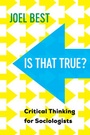
Is That True?
Critical Thinking for Sociologists
1st Edition
Published on 16. February 2021
Book
Hardback
184 pages
978-0-520-38139-1 (ISBN)
Description
Across disciplines, critical thinking is praised, taught, and put into practice. But what does it actually mean to think critically? In this brief volume, sociologist Joel Best examines how to evaluate arguments and the evidence used to support them as he hones in on how to think in the field of sociology and beyond.
With inimitable style that melds ethnographic verve with dry humor, Best examines the ways in which sociologists engage in fuzzy thinking through bias, faddish cultural waves, spurious reasoning, and implicit bias. The short chapters cover:
A general introduction to critical thinking and logic in the social sciences
Sociology as an enterprise
Key issues in thinking critically about sociological research
Challenging questions that confront sociologists and a call for the discipline to meet those challenges.
Students across disciplines will learn the building blocks of critical thinking in a sociological context and come away with key concepts to put into practice.
With inimitable style that melds ethnographic verve with dry humor, Best examines the ways in which sociologists engage in fuzzy thinking through bias, faddish cultural waves, spurious reasoning, and implicit bias. The short chapters cover:
A general introduction to critical thinking and logic in the social sciences
Sociology as an enterprise
Key issues in thinking critically about sociological research
Challenging questions that confront sociologists and a call for the discipline to meet those challenges.
Students across disciplines will learn the building blocks of critical thinking in a sociological context and come away with key concepts to put into practice.
More details
Edition
First Edition
Language
English
Place of publication
Berkerley
United States
Target group
Professional and scholarly
Product notice
Cloth over boards
Illustrations
3 tables
Dimensions
Height: 210 mm
Width: 140 mm
Thickness: 18 mm
Weight
318 gr
ISBN-13
978-0-520-38139-1 (9780520381391)
Copyright in bibliographic data and cover images is held by Nielsen Book Services Limited or by the publishers or by their respective licensors: all rights reserved.
Schweitzer Classification
Other editions
Additional editions
Book
02/2021
1st Edition
University of California Press
€26.00
Shipment within 10-20 days
E-Book
02/2021
1st Edition
Naval Institute Press
€24.49
Available for download
Person
Joel Best is Professor of Sociology and Criminal Justice at the University of Delaware. He is the author of the best-selling Damned Lies and Statistics, Stat-Spotting, and American Nightmares.
Content
Acknowledgments
1. What Is Critical Thinking?
2. The Basics: Arguments and Assumptions
3. Everyday Arguments
Anecdotes * Ad Hominem Arguments * Myths * Folk Wisdom and Metaphors * Facts * Everyday Reasoning
4. The Logic of Social Science
Patterns * Causality * Judging Social Scientific Claims * The Importance of Evidence
5. Authority and Social Science Arguments
Challenges for Social Science * The Case of Sociology * Thinking about Sociology and Critical Thinking
6. Sociology as a Social World
Camps * Envy * Sociology's Subdivisions
7. Orientations
Optimism and Pessimism * Team Culture and Team Structure * Insiders and Outsiders * Tragedy and Comedy * The Importance of Orientations Contents
8. Words
Jargon * Word Fads * Definitions * Concept Creep
9. Questions and Measurements
Sociological Questions * Empirical Questions * Measurement * What Is Being Measured? * Questioning Measurements
10. Variables and Comparison
Variables * Issues with Comparison * Varieties of Comparative Findings * Replication * Comparison in Qualitative Research * Questioning Comparisons
11. Tendencies
Patterned Tendencies * The Ecological Fallacy * The Modesty of Sociological Explanations * Thinking about Tendencies
12. Evidence
Effective Evidence * Not-So-Effective Evidence * Questioning Evidence Choices * Questions about Research
13. Echo Chambers
Recognizing and Addressing One's Own Biases * Expectations and Sociologists * The Complications of Ideological Homogeneity * The Importance of Self-Criticism
14. Tough Topics
Cultural Waves * Good Guys and Bad Guys * Taboos * Thinking about What's Difficult
Afterword: Why Critical Thinking Is Important
Notes
References
Index
1. What Is Critical Thinking?
2. The Basics: Arguments and Assumptions
3. Everyday Arguments
Anecdotes * Ad Hominem Arguments * Myths * Folk Wisdom and Metaphors * Facts * Everyday Reasoning
4. The Logic of Social Science
Patterns * Causality * Judging Social Scientific Claims * The Importance of Evidence
5. Authority and Social Science Arguments
Challenges for Social Science * The Case of Sociology * Thinking about Sociology and Critical Thinking
6. Sociology as a Social World
Camps * Envy * Sociology's Subdivisions
7. Orientations
Optimism and Pessimism * Team Culture and Team Structure * Insiders and Outsiders * Tragedy and Comedy * The Importance of Orientations Contents
8. Words
Jargon * Word Fads * Definitions * Concept Creep
9. Questions and Measurements
Sociological Questions * Empirical Questions * Measurement * What Is Being Measured? * Questioning Measurements
10. Variables and Comparison
Variables * Issues with Comparison * Varieties of Comparative Findings * Replication * Comparison in Qualitative Research * Questioning Comparisons
11. Tendencies
Patterned Tendencies * The Ecological Fallacy * The Modesty of Sociological Explanations * Thinking about Tendencies
12. Evidence
Effective Evidence * Not-So-Effective Evidence * Questioning Evidence Choices * Questions about Research
13. Echo Chambers
Recognizing and Addressing One's Own Biases * Expectations and Sociologists * The Complications of Ideological Homogeneity * The Importance of Self-Criticism
14. Tough Topics
Cultural Waves * Good Guys and Bad Guys * Taboos * Thinking about What's Difficult
Afterword: Why Critical Thinking Is Important
Notes
References
Index