

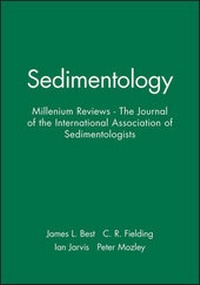
Sedimentology
Millenium Reviews - The Journal of the International Association of Sedimentologists
Published on 9. September 2000
Book
Hardback
400 pages
978-0-632-05794-8 (ISBN)
Description
Sedimentology has seen many significant advances and changes over the past 40 years, ranging from facies modelling to sequence stratigraphy; chemostratigraphy to basin analysis; and the integration of studies of physical, chemical and, increasingly, biological processes in the interpretation and prediction of sedimentary environments and products. The subject is becoming ever more interdisciplinary and applied, and now has far more links to other physical sciences. Research and debate are continuing afresh as we move into this new interdisciplinary phase and promise many developments and increased uses of our subject. Now seemed a good time to publish a series of review papers concerning some key current areas of research. We hope that these papers will provide comprehensive starting points for those wishing to become acquainted with an area, act as stimuli for debate, and provide awareness and ideas for future research avenues. No issue of this sort can, of course, ever be truly comprehensive in its coverage: these reviews concern only selected snippets from the wide scope of sedimentology and each has, of necessity, been selective in its own area.
More details
Language
English
Place of publication
Hoboken
United Kingdom
Publishing group
John Wiley and Sons Ltd
Target group
College/higher education
Professional and scholarly
Dimensions
Height: 276 mm
Width: 211 mm
Thickness: 12 mm
Weight
816 gr
ISBN-13
978-0-632-05794-8 (9780632057948)
Copyright in bibliographic data and cover images is held by Nielsen Book Services Limited or by the publishers or by their respective licensors: all rights reserved.
Schweitzer Classification
Other editions
Additional editions
James L. Best | C. R. Fielding | Ian Jarvis
Sedimentology
Millenium Reviews - The Journal of the International Association of Sedimentologists
E-Book
05/2009
Wiley-Blackwell
€59.99
Available for download
Persons
James L. Best is a Professor of Geography and Geographic Information Science at the University of Illinois. He was previously on the Earth Sciences faculty at the University of Leeds. His research is focused on the mechanics of sediment transport, the investigation of modern sedimentary environments, and the interpretation of ancient alluvium.
Content
Fluvial responses to climate and sea-level change: a review and look forward (M Blum & T Tornqvist). Dolomite formation and biogeochemical cycles in the Phanerozoic (S J Burns, J A McKenzie & C Vasconcelos).
The structure and fluid mechanics of turbidity currents: a review of some recent studies and their geological implications (B Kneller & C Buckee).
Spatial and temporal distribution of diagenetic alterations in siliciclastic rocks: implications for mass transfer in sedimentary basins (S Morad, J M Ketzer & L F de Ros).
Quantitative models of sedimentary basin filling (C Paola).
Microbial carbonates: the geological record of calcified bacteria algal mats and biofilms (R Riding).
Deposition and early alteration of evaporites (B C Schreiber & M El Tabakh).
Contental margin sedimentation, with special reference to the north-east Atlantic margin (P P E Weaver, R B Wynn & N H Kenyon).
The structure and fluid mechanics of turbidity currents: a review of some recent studies and their geological implications (B Kneller & C Buckee).
Spatial and temporal distribution of diagenetic alterations in siliciclastic rocks: implications for mass transfer in sedimentary basins (S Morad, J M Ketzer & L F de Ros).
Quantitative models of sedimentary basin filling (C Paola).
Microbial carbonates: the geological record of calcified bacteria algal mats and biofilms (R Riding).
Deposition and early alteration of evaporites (B C Schreiber & M El Tabakh).
Contental margin sedimentation, with special reference to the north-east Atlantic margin (P P E Weaver, R B Wynn & N H Kenyon).