

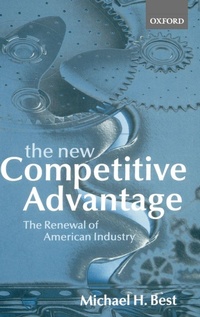
The New Competitive Advantage
The Renewal of American Industry
Published on 12. July 2001
Book
Hardback
304 pages
978-0-19-829744-4 (ISBN)
Description
This book addresses the sustained resurgence of American economy, and the firms, regions, and technologies that are driving this growth. Michael Best develops a new model of technology management and regional innovation based on the principle of systems integration. The principle of systems integration is manifest in the organizational capability of firms, individually and networked, to foster rapid technological change.
Application of the principle of sysyems integration to business organization means integrating an ongoing technology management capability into a production system. The effect is a network or clusterof entrepreneurial firms in which design is decentralized within the enterprise and diffused anongst networked enterprises.It is a business model ideally suited to product-led strategies and technological innovation. The combination of entreprenurial firms and inter-firm networks is shown to foster a range of dynamic cluster processes which, in turn, underlie the growth of Silicon Valley and the unexpected resurgence of Boston's Route 128.
The general character of the capabilities and innovation perspective is illustrated with applications to regions at different levels of industrial development. The implications for policy making are profound: technology management is a powerful lever for both fostering growth and shaping competitive advantage. Moreover, it offers a framework for addressing the challenge of ecologically sustainable growth. Complex product systems, such as energy, transportation, and health, are a consequence of past and present technology R&D choices and corresponding investements in technical education. Thus capability and skill development policies shape what is on offer in the marketplace.
Application of the principle of sysyems integration to business organization means integrating an ongoing technology management capability into a production system. The effect is a network or clusterof entrepreneurial firms in which design is decentralized within the enterprise and diffused anongst networked enterprises.It is a business model ideally suited to product-led strategies and technological innovation. The combination of entreprenurial firms and inter-firm networks is shown to foster a range of dynamic cluster processes which, in turn, underlie the growth of Silicon Valley and the unexpected resurgence of Boston's Route 128.
The general character of the capabilities and innovation perspective is illustrated with applications to regions at different levels of industrial development. The implications for policy making are profound: technology management is a powerful lever for both fostering growth and shaping competitive advantage. Moreover, it offers a framework for addressing the challenge of ecologically sustainable growth. Complex product systems, such as energy, transportation, and health, are a consequence of past and present technology R&D choices and corresponding investements in technical education. Thus capability and skill development policies shape what is on offer in the marketplace.
Reviews / Votes
Valuable insights ... an important contribution to our understanding of regional innovation systems ... well researched and well-written with some powerful ideas ... provides an important set of challenges for 21st century innovation research and practice. * Technovation * Best's analysis is insightful, contemporary, and rightfully stresses that technology, institutions, and geography all matter in interrelated ways for innovation and the creation of competitive advantage ... The case-study comparisons are interesting and effective, closely related to the conceptual discussion. * Environment and Planning *More details
Language
English
Place of publication
Oxford
United Kingdom
Target group
Professional and scholarly
Illustrations
16 figures; 3 boxes; 3 tables
Dimensions
Height: 240 mm
Width: 161 mm
Thickness: 21 mm
Weight
628 gr
ISBN-13
978-0-19-829744-4 (9780198297444)
Copyright in bibliographic data and cover images is held by Nielsen Book Services Limited or by the publishers or by their respective licensors: all rights reserved.
Schweitzer Classification
Other editions
Additional editions
E-Book
07/2001
1st Edition
Oxford University Press
€254.10
Available for download
Book
07/2001
Oxford University Press
€79.50
Shipment within 15-20 days
Person
Michael Best is University Professor and Co-Director of the Center for Industrial Competitiveness at the University of Massachusetts Lowell. He was Arthur Andersen Visiting Distinguished Professor at the Judge Institute of Management Studies, Cambridge in 1999. Professor Best has also taught at the University of Massachusetts, Amherst; Sussex University; and Queen Mary College, London University. He is the author of The New Competition: Institutions of Industrial Restructuring (Polity Press and Harvard University Press, 1991) which has sold over 10,000 copies.
Content
1. Introduction ; 2. Production Systems ; 3. Cluster Dynamics ; 4. Innovation Capabilities and Skill Formation ; 5. The Resurgence of Route 128: The Triumph of Open Systems ; 6. Cluster Dynamics in Malaysian Electronics ; 7. The Case of Northern Ireland ; 8. Policy Implications