

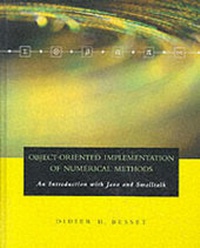
Object-Oriented Implementation of Numerical Methods
An Introduction with Java & Smalltalk
Published on 6. November 2000
Book
Hardback
766 pages
978-1-55860-679-1 (ISBN)
Description
Numerical methods naturally lend themselves to an object-oriented approach. Mathematics builds high- level ideas on top of previously described, simpler ones. Once a property is demonstrated for a given concept, it can be applied to any new concept sharing the same premise as the original one, similar to the ideas of reuse and inheritance in object-oriented (OO) methodology.
Few books on numerical methods teach developers much about designing and building good code. Good computing routines are problem-specific. Insight and understanding are what is needed, rather than just recipes and black box routines. Developers need the ability to construct new programs for different applications.
Object-Oriented Implementation of Numerical Methods reveals a complete OO design methodology in a clear and systematic way. Each method is presented in a consistent format, beginning with a short explanation and following with a description of the general OO architecture for the algorithm. Next, the code implementations are discussed and presented along with real-world examples that the author, an experienced software engineer, has used in a variety of commercial applications.
Few books on numerical methods teach developers much about designing and building good code. Good computing routines are problem-specific. Insight and understanding are what is needed, rather than just recipes and black box routines. Developers need the ability to construct new programs for different applications.
Object-Oriented Implementation of Numerical Methods reveals a complete OO design methodology in a clear and systematic way. Each method is presented in a consistent format, beginning with a short explanation and following with a description of the general OO architecture for the algorithm. Next, the code implementations are discussed and presented along with real-world examples that the author, an experienced software engineer, has used in a variety of commercial applications.
Reviews / Votes
"There are few books that show how to build programs of any kind. One common theme is compiler building, and there are shelves full of them. There are few others. It's an area, or a void, that needs filling. this book does a great job of showing how to build numerical analysis programs."-David N. Smith, IBM T J Watson Research CenterMore details
Series
Language
English
Place of publication
San Francisco
United States
Publishing group
Elsevier Science & Technology
Target group
Professional and scholarly
Programmers, developers, engineers, scientists and computer scientists who create or maintain industrial or scientific software applications.
Weight
1590 gr
ISBN-13
978-1-55860-679-1 (9781558606791)
Copyright in bibliographic data and cover images is held by Nielsen Book Services Limited or by the publishers or by their respective licensors: all rights reserved.
Schweitzer Classification
Person
Didier Besset obtained a degree in physics at the Swiss Federal Institute of Technology Zurich (ETH Zurich) and a Ph.D. in high-energy physics at the University of Geneva. He did postgraduate research at the Stanford Linear Accelerator Center and was Adjunct Professor at Princeton University where he taught physics. Since 1990 he has worked as an independent consultant on decision-support systems based on medical or technical data, all written using object-oriented technology. He has been programming in Smalltalk since 1987 and in Java since 1997.
Content
Code Listings
Preface
1 Introduction
2 Function Evaluation
3 Interpolation
4 Iterative Algorithms
5 Finding the Zero of a Function
6 Integration of Functions
7 Series
8 Linear Algebra
9 Elements of Statistics
10 Statistical Analysis
11 Optimization
12 Data Mining
App. A Decimal Floating-Point Simulation
App. B Smalltalk Primer for Java Programmers
App. C Java Primer for Smalltalk Programmers
App. D Additional Probability Distributions
App. E Accurate Accumulation of Expectation Values
App. F Accompanying CD-ROM
References
Index
Preface
1 Introduction
2 Function Evaluation
3 Interpolation
4 Iterative Algorithms
5 Finding the Zero of a Function
6 Integration of Functions
7 Series
8 Linear Algebra
9 Elements of Statistics
10 Statistical Analysis
11 Optimization
12 Data Mining
App. A Decimal Floating-Point Simulation
App. B Smalltalk Primer for Java Programmers
App. C Java Primer for Smalltalk Programmers
App. D Additional Probability Distributions
App. E Accurate Accumulation of Expectation Values
App. F Accompanying CD-ROM
References
Index