

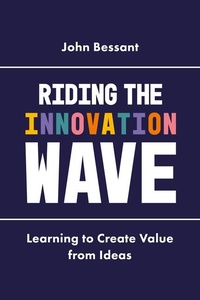
Riding the Innovation Wave
Learning to Create Value from Ideas
Published on 17. November 2017
Book
Hardback
296 pages
978-1-78714-570-2 (ISBN)
Description
Innovation matters - being able to create value from ideas is crucial to survival and growth. But while any organization might get lucky once being able to repeat the trick requires learning and developing particular ways of working which enable the process. Over a hundred years of research and practical experience now provides a knowledge base from which we can draw to help develop such approaches.
But how do we move from prescription to implementation? And how does the innovation challenge play out over the lifetime of an organization? How does it renew its capability to innovate and do so against a background of dramatically changing markets, technologies and social trends?
This book draws on a detailed history of a large German company (HELLA ), now active in over 35 countries, employing 34,000 people. It didn't start out that way, it began as an entrepreneurial start-up in the late 19th century in the (then) uncertain early days of the car industry. It moved from selling whips and other buggy accessories for horse-drawn carriages to horns and lamps for the new-fangled motor cars beginning to appear on the roads of north-western Germany. The journey since then has been one of innovation - in products and processes, in entering new markets, in adding services to its products, and in changing its underlying business models. Survival for over a hundred years is not an accident - it has been built on learning how to innovate and on constantly challenging and updating those models.
But how do we move from prescription to implementation? And how does the innovation challenge play out over the lifetime of an organization? How does it renew its capability to innovate and do so against a background of dramatically changing markets, technologies and social trends?
This book draws on a detailed history of a large German company (HELLA ), now active in over 35 countries, employing 34,000 people. It didn't start out that way, it began as an entrepreneurial start-up in the late 19th century in the (then) uncertain early days of the car industry. It moved from selling whips and other buggy accessories for horse-drawn carriages to horns and lamps for the new-fangled motor cars beginning to appear on the roads of north-western Germany. The journey since then has been one of innovation - in products and processes, in entering new markets, in adding services to its products, and in changing its underlying business models. Survival for over a hundred years is not an accident - it has been built on learning how to innovate and on constantly challenging and updating those models.
Reviews / Votes
The author uses a case study of automotive, lighting, and electronics company Hella to outline a model of innovation that is focused on competence, capability, and continuity. He details Hella's innovation history, including specific innovation examples and milestones; how it maintains momentum in innovation and mobilizes entrepreneurial engagement; its continuous improvement efforts; its mindset of frugal innovation; and the elements of platform thinking, innovation networks, dealing with discontinuity, and agile innovation, with discussion of the concept in general, why it matters, why it matters to Hella, and what Hella is currently doing. -- Annotation (c)2017 * (protoview.com) *More details
Language
English
Place of publication
Bingley
United Kingdom
Target group
Professional and scholarly
Product notice
With printed dust jacket
Dimensions
Height: 235 mm
Width: 157 mm
Thickness: 21 mm
Weight
597 gr
ISBN-13
978-1-78714-570-2 (9781787145702)
Copyright in bibliographic data and cover images is held by Nielsen Book Services Limited or by the publishers or by their respective licensors: all rights reserved.
Schweitzer Classification
Other editions
Additional editions
E-Book
11/2017
1st Edition
Emerald Publishing Limited
€40.99
Available for download
Person
Originally a chemical engineer, John Bessant has been
active in the field of research and consultancy in technology and innovation
management for over 35 years. He currently
holds the Chair in Innovation and Entrepreneurship at the University of Exeter
and has visiting appointments at the universities of Erlangen-Nuremburg and
Queensland University of Technology. In
2003 he was elected a Fellow of the British Academy of Management and in 2016 a
Fellow of the International Society for Professional Innovation Management (ISPIM). He has
acted as advisor to various national governments, international bodies
(including the United Nations,World Bank and OECD) and to many public and
private sector organizations. He is the
author of 30 books and many articles on the topic and has lectured and
consulted widely around the world.
active in the field of research and consultancy in technology and innovation
management for over 35 years. He currently
holds the Chair in Innovation and Entrepreneurship at the University of Exeter
and has visiting appointments at the universities of Erlangen-Nuremburg and
Queensland University of Technology. In
2003 he was elected a Fellow of the British Academy of Management and in 2016 a
Fellow of the International Society for Professional Innovation Management (ISPIM). He has
acted as advisor to various national governments, international bodies
(including the United Nations,World Bank and OECD) and to many public and
private sector organizations. He is the
author of 30 books and many articles on the topic and has lectured and
consulted widely around the world.
Content
Chapter 1. Introductions Chapter 2. Hella's innovation history
Chapter 3. Patterns of innovation
Chapter 4. We are the champions
Chapter 5. Maintaining innovation momentum
Chapter 6. Mobilising entrepreneurial engagement
Chapter 7. Continuous improvement
Chapter 8. Frugal innovation
Chapter 9. Platform innovation
Chapter 10. Creating new networks
Chapter 11. Dealing with discontinuity
Chapter 12. Agile innovation
Chapter 13. Looking to the future
Notes, resources and reflection questions
Chapter 3. Patterns of innovation
Chapter 4. We are the champions
Chapter 5. Maintaining innovation momentum
Chapter 6. Mobilising entrepreneurial engagement
Chapter 7. Continuous improvement
Chapter 8. Frugal innovation
Chapter 9. Platform innovation
Chapter 10. Creating new networks
Chapter 11. Dealing with discontinuity
Chapter 12. Agile innovation
Chapter 13. Looking to the future
Notes, resources and reflection questions