

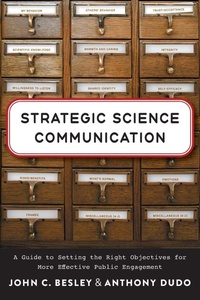
Strategic Science Communication
A Guide to Setting the Right Objectives for More Effective Public Engagement
Published on 22. November 2022
Book
Paperback/Softback
336 pages
978-1-4214-4420-8 (ISBN)
Description
What tactics can effective science communicators use to reach a wide audience and achieve their goals?
Effective science communication-the type that can drive behavior change while boosting the likelihood that people will turn to science when faced with challenges-is not simply a matter of utilizing social media or employing innovative tactics like nudges. Even more important for success is building long-term strategic paths to achieve well-articulated goals. Smart science communicators also want to create communication opportunities to improve their own thinking and behavior.
In this guidebook, John C. Besley and Anthony Dudo encapsulate their practical expertise in 11 evidence-based principles of strategic science communication. Among other things, science communicators, they argue, should strive to seem competent, warm, honest, and willing to listen. Their work should also convey a desire to make the world a better place. Highlighting time-tested methods for building rapport with an audience through several modes of communication, Besley and Dudo explain how to achieve each strategic objective. All scientific communication is goal-oriented, and Besley and Dudo discuss the importance of recognizing the right goals, then employing strategic and tactical communication in order to achieve them. Finally, they offer specific suggestions for how practitioners can evaluate the effectiveness of their communications (and in fact, build evaluation into their plans from the beginning).
Strategic Science Communication is the first book to use social science to help scientists and professional science communicators become more evidence-based. Besley and Dudo draw on insightful research into the science of science communication to provide readers with an opportunity to think more deeply about how to make communication choices. This guidebook is essential reading for all professionals in the field.
Effective science communication-the type that can drive behavior change while boosting the likelihood that people will turn to science when faced with challenges-is not simply a matter of utilizing social media or employing innovative tactics like nudges. Even more important for success is building long-term strategic paths to achieve well-articulated goals. Smart science communicators also want to create communication opportunities to improve their own thinking and behavior.
In this guidebook, John C. Besley and Anthony Dudo encapsulate their practical expertise in 11 evidence-based principles of strategic science communication. Among other things, science communicators, they argue, should strive to seem competent, warm, honest, and willing to listen. Their work should also convey a desire to make the world a better place. Highlighting time-tested methods for building rapport with an audience through several modes of communication, Besley and Dudo explain how to achieve each strategic objective. All scientific communication is goal-oriented, and Besley and Dudo discuss the importance of recognizing the right goals, then employing strategic and tactical communication in order to achieve them. Finally, they offer specific suggestions for how practitioners can evaluate the effectiveness of their communications (and in fact, build evaluation into their plans from the beginning).
Strategic Science Communication is the first book to use social science to help scientists and professional science communicators become more evidence-based. Besley and Dudo draw on insightful research into the science of science communication to provide readers with an opportunity to think more deeply about how to make communication choices. This guidebook is essential reading for all professionals in the field.
Reviews / Votes
In Strategic Science Communication: A Guide to Setting the Right Objectives for More Effective Public Engagement, authors John Besley and Anthony Dudomake a much-needed link between the practice of and training in science communication, and the research that impacts those activities. Throughout the book, the authors balance actionable information for practitioners and the theoretical literatures underpinning them-and they do so admirably. Both of the book's intended audiences, practitioners and researchers, can glean informative insight from its pages.-Journal of Science Communication
More details
Language
English
Place of publication
Baltimore, MD
United States
Target group
Professional and scholarly
Product notice
Paperback (trade)
Illustrations
4 s/w Zeichnungen, 4 s/w Photographien bzw. Rasterbilder
4 Halftones, black and white; 4 Line drawings, black and white
Dimensions
Height: 229 mm
Width: 152 mm
Thickness: 21 mm
Weight
550 gr
ISBN-13
978-1-4214-4420-8 (9781421444208)
DOI
10.56021/9781421444215
Copyright in bibliographic data and cover images is held by Nielsen Book Services Limited or by the publishers or by their respective licensors: all rights reserved.
Schweitzer Classification
Other editions
Additional editions
John C. Besley | Anthony Dudo
Strategic Science Communication
A Guide to Setting the Right Objectives for More Effective Public Engagement
E-Book
11/2022
Johns Hopkins University Press
€38.99
Available for download
Persons
John C. Besley (EAST LANSING, MI) is the Ellis N. Brandt Professor of Public Relations at Michigan State University. He has authored more than a hundred articles, chapters, and reports on public opinion about science and scientists' views about communication. Anthony Dudo (AUSTIN, TX) is an associate professor in the School of Public Relations & Advertising at the University of Texas, Austin, where he is the program director of science communication at the Center for Media Engagement.
Content
Acknowledgments
Introduction
Chapter 1.What It Means to Be a Strategic Science Communicator
Chapter 2. Science Knowledge as a Communication Objective
Chapter 3. Show Warmth
Chapter 4. Show Integrity
Chapter 5. Be Willing to Listen
Chapter 6. Show You Are Not That Different (and Respect Others' Differences)
Chapter 7. Show Competence
Chapter 8. Share Risks and Benefits
Chapter 9. Share What Other People Think Is Normal
Chapter 10. Foster Self-Efficacy
Chapter 11. Share Emotions and Frames, Carefully
Chapter 12. The Need to Take Communication More Seriously
Appendixes
A. Survey Methods
B. Supplementary Tables
C. Examining Goals and Objectives Worksheets
Index
Introduction
Chapter 1.What It Means to Be a Strategic Science Communicator
Chapter 2. Science Knowledge as a Communication Objective
Chapter 3. Show Warmth
Chapter 4. Show Integrity
Chapter 5. Be Willing to Listen
Chapter 6. Show You Are Not That Different (and Respect Others' Differences)
Chapter 7. Show Competence
Chapter 8. Share Risks and Benefits
Chapter 9. Share What Other People Think Is Normal
Chapter 10. Foster Self-Efficacy
Chapter 11. Share Emotions and Frames, Carefully
Chapter 12. The Need to Take Communication More Seriously
Appendixes
A. Survey Methods
B. Supplementary Tables
C. Examining Goals and Objectives Worksheets
Index