

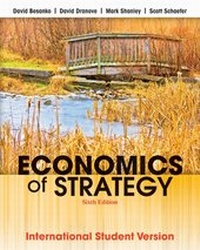
Economics of Strategy International Student Version
6th Edition
Published on 11. January 2013
Book
Paperback/Softback
560 pages
978-1-118-31918-5 (ISBN)
Description
In today's global recession, strong management of firmsand organizations are of the utmost importance. Economics ofStrategy focuses on the key economic concepts students mustmaster in order to develop a sound business strategy. The text alsobrings economic theory and strategic analysis to life in anengaging and uniquely modern way. Besanko, Dranove, Shanley, andSchaefer have collaborated for over 15 years to build anintroductory business course that combines basic concepts fromeconomic theory of the firm and industrial organization with ideasfrom modern strategy literature.
Ideal for undergraduate managerial economics and business strategycourses, Economics of Strategy offers real-worldapplications to make these courses more relevant. Armed withgeneral principles, today's students--tomorrow'sfuture managers--will be prepared to adjust their firms'business strategies to the demands of the ever-changingenvironment
Ideal for undergraduate managerial economics and business strategycourses, Economics of Strategy offers real-worldapplications to make these courses more relevant. Armed withgeneral principles, today's students--tomorrow'sfuture managers--will be prepared to adjust their firms'business strategies to the demands of the ever-changingenvironment
More details
Other editions
Previous edition
Book
11/2009
5th Edition
Wiley
€61.90
Article exhausted; check for reprint
Persons
Professor David Besanko is the Alvin J. Huss Distinguished Professor of Management and Strategy at the Kellogg School of Management at Northwestern University. Besanko is a Kellogg graduate, having received his PhD in Managerial Economics and Decision Sciences in 1982. He received his AB in Political Science from Ohio University in 1977. Before joining the Kellogg faculty in 1991, Professor Besanko was a member of the faculty of the School of Business at Indiana University from 1982 to 1991. In addition, in 1985, he held a post-doctorate position on the Economics Staff at Bell Communications Research. Professor Besanko's research covers topics relating to industry dynamics, competitive strategy, industrial organization, the theory of the firm, and economics of regulation. He has received grants from the National Science Foundation and from the Citicorp Behavioral Science Research Council to support this research.
Content
INTRODUCTION: STRATEGY AND ECONOMICS 1
ECONOMICS PRIMER BASIC PRINCIPLES 9
PART ONE: FIRM BOUNDARIES
1 The Power of Principles: An Historical Perspective 41
2 The Horizontal Boundaries of the Firm 61
3 The Vertical Boundaries of the Firm 98
4 Integration and Its Alternatives 132
PART TWO: MARKET AND COMPETITIVE ANALYSIS
5 Competitors and Competition 165
6 Entry and Exit 196
7 Dynamics: Competing Across Time 226
8 Industry Analysis 258
PART THREE: STRATEGIC POSITION AND DYNAMICS
9 Strategic Positioning for Competitive Advantage 293
10 Information and Value Creation 333
11 Sustaining Competitive Advantage 363
PART FOUR: STRATEGIC POSITION AND DYNAMICS
12 Performance Measurement and Incentives 401
13 Strategy and Structure 437
14 Environment, Power, and Culture 470
ECONOMICS PRIMER BASIC PRINCIPLES 9
PART ONE: FIRM BOUNDARIES
1 The Power of Principles: An Historical Perspective 41
2 The Horizontal Boundaries of the Firm 61
3 The Vertical Boundaries of the Firm 98
4 Integration and Its Alternatives 132
PART TWO: MARKET AND COMPETITIVE ANALYSIS
5 Competitors and Competition 165
6 Entry and Exit 196
7 Dynamics: Competing Across Time 226
8 Industry Analysis 258
PART THREE: STRATEGIC POSITION AND DYNAMICS
9 Strategic Positioning for Competitive Advantage 293
10 Information and Value Creation 333
11 Sustaining Competitive Advantage 363
PART FOUR: STRATEGIC POSITION AND DYNAMICS
12 Performance Measurement and Incentives 401
13 Strategy and Structure 437
14 Environment, Power, and Culture 470